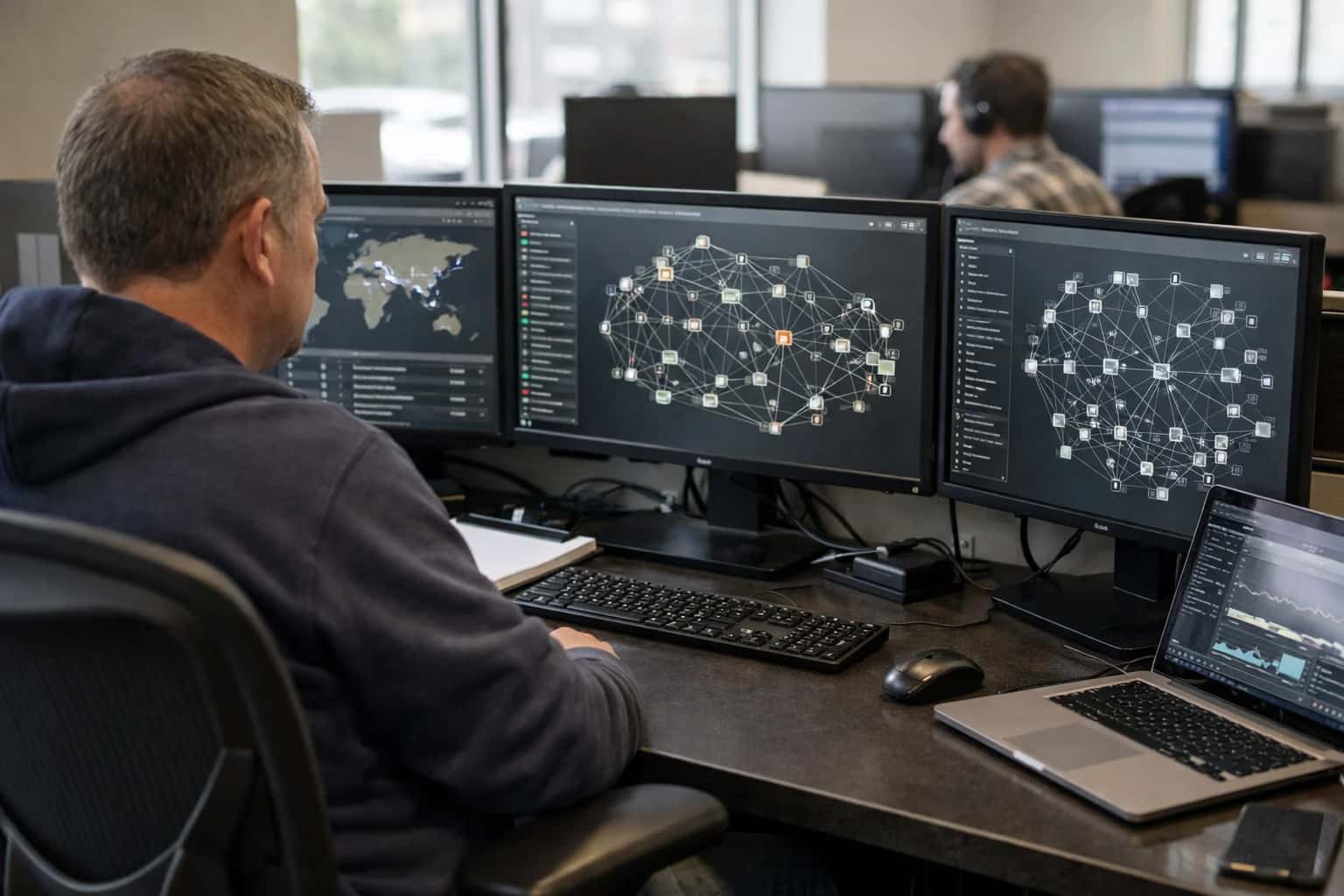
A Graph Neural Network Variant Caller represents the alignment of sequencing reads to a reference genome as a computational graph. In this architecture, individual reads and candidate variant alleles are encoded as nodes, while edges define relationships such as read-to-read overlap or read-to-allele support. The model then applies message-passing operations—iteratively aggregating and transforming information from neighboring nodes—to refine each node's representation, allowing the network to consider the full local alignment context rather than treating each read independently.

Glossary
Graph Neural Network Variant Caller
A variant detection model that represents the alignment of reads to a reference as a graph, using message-passing operations to propagate information between connected reads and candidate alleles for improved accuracy.
DEFINITION
What is a Graph Neural Network Variant Caller?
A graph neural network variant caller is a deep learning model that identifies genetic variants by representing aligned sequencing reads and candidate alleles as nodes in a graph, using message-passing operations to propagate information between connected elements for improved accuracy.
This graph-based approach excels at resolving complex genomic regions where traditional pileup-based callers struggle, such as areas with structural variants, repetitive sequences, or ambiguous mapping. By explicitly modeling the relationships between reads and candidate haplotypes, the network can propagate evidence across the graph to disambiguate true variants from sequencing artifacts. The final readout layer classifies each candidate allele as present or absent, producing genotype likelihoods that account for the collective evidence from the entire connected read neighborhood.
Graph Neural Network Variant Caller
Key Architectural Features
The core components that distinguish a graph-based variant caller from traditional pileup-based or alignment-based methods, enabling superior accuracy in complex genomic regions.
01
Read-Reference Alignment Graph
The foundational data structure where nodes represent individual sequencing reads and the reference genome, while edges encode alignment overlaps and candidate allele relationships. Unlike a rigid pileup, this graph captures the full topology of read connectivity, preserving information about paired-end insert sizes and split-read mappings that are critical for resolving structural variants and indels. The graph is constructed by chaining alignments, creating a rich relational structure that explicitly models the evidence for each allele.
02
Message-Passing Neural Network
The core learning mechanism where nodes iteratively exchange and aggregate feature vectors with their neighbors. Each message function computes information to send along edges, while an update function (typically a small neural network) integrates received messages to refine each node's hidden state. After multiple rounds of propagation, the read nodes contain contextualized embeddings that reflect not just their own sequence but the consensus of all overlapping reads, enabling the model to distinguish true variants from sequencing errors.
03
Candidate Allele Proposal Module
A preprocessing stage that scans the alignment graph to identify positions with evidence for variation. This module generates a set of candidate alleles—including SNPs, insertions, deletions, and complex substitutions—by analyzing read pileups, soft-clipped bases, and discordant read pairs. By proposing candidates before the neural network runs, the system avoids the computational cost of evaluating every possible genotype at every position, focusing the message-passing computation only on plausible variant sites.
04
Genotype Likelihood Decoder
The final layer that transforms the refined node embeddings into calibrated genotype probabilities. For each candidate variant, the decoder aggregates the hidden states of all reads and reference nodes in the local subgraph and outputs a diploid genotype likelihood across all possible allele combinations (homozygous reference, heterozygous, homozygous alternate). The decoder is trained to produce well-calibrated probabilities, enabling direct integration with downstream Variant Quality Score Recalibration pipelines.
05
Edge Feature Encoding
A critical design choice where the properties of each alignment are encoded as edge features in the graph. These features include mapping quality, base quality scores, CIGAR string operations, strand orientation, and edit distance. By providing the neural network with rich information about the quality and nature of each read-reference relationship, the model can learn to downweight unreliable alignments and upweight high-confidence evidence during message passing.
06
Multi-Scale Graph Pooling
A hierarchical aggregation strategy that operates at multiple resolutions within the graph. Local pooling aggregates information within a single candidate variant's neighborhood, while global pooling captures broader genomic context such as coverage depth trends and regional mappability. This multi-scale approach allows the model to condition its variant calls on both local read evidence and regional characteristics, reducing false positives in low-complexity or repetitive regions.
GRAPH NEURAL NETWORK VARIANT CALLER
Frequently Asked Questions
Explore the core concepts behind graph-based variant calling, from message-passing mechanics to real-world clinical deployment.
A Graph Neural Network (GNN) Variant Caller is a deep learning model that represents aligned sequencing reads and candidate alleles as a computational graph to identify genetic variants. Unlike traditional pileup-based methods that treat reads as independent observations, a GNN variant caller constructs a graph where nodes represent individual reads and candidate variant alleles, while edges represent overlapping alignments or shared sequence context. The model then performs message-passing operations, where each node aggregates information from its neighbors to refine its own representation. This allows the network to propagate evidence across connected reads, resolving ambiguities caused by mapping errors, repetitive regions, or complex haplotypes. The final node embeddings are passed through a classification layer to predict genotype likelihoods for each candidate variant. This architecture excels at disambiguating variants in low-complexity regions and detecting structural rearrangements by explicitly modeling the topology of read alignments rather than collapsing them into a fixed-dimensional pileup image.
Enabling Efficiency, Speed & Accuracy
Intelligent Analysis, Decision & Execution
We build AI systems for teams that need search across company data, workflow automation across tools, or AI features inside products and internal software.
Talk to Us
Search across company data
Give teams answers from docs, tickets, runbooks, and product data with sources and permissions.
Useful when people spend too long searching or get different answers from different systems.
Enterprise searchRAGPermissions
Read more
Automate internal workflows
Use AI to route work, draft outputs, trigger actions, and keep approvals and logs in place.
Useful when repetitive work moves across multiple tools and teams.
AI agentsWorkflow automationGovernance
Read more
Add AI to products and internal tools
Build assistants, guided actions, or decision support into the software your team or customers already use.
Useful when AI needs to be part of the product, not a separate tool.
AI integrationDecision supportModel routing
Read more
About the author
Prasad Kumkar
CEO & MD, Inference Systems
Prasad Kumkar is the CEO & MD of Inference Systems and writes about AI systems architecture, LLM infrastructure, model serving, evaluation, and production deployment. Over 5+ years, he has worked across computer vision models, L5 autonomous vehicle systems, and LLM research, with a focus on taking complex AI ideas into real-world engineering systems.
His work and writing cover AI systems, large language models, AI agents, multimodal systems, autonomous systems, inference optimization, RAG, evaluation, and production AI engineering.
LinkedIn
Limited slotsGet a Free AI Consultation
Partnered with leading AI, data, and software stack.





How We Work
Custom AI workflows for your Business
One-fit-all AI don't work for modern businesses. At Inferensys, we aim to understand your business & custom requirements; which we use to define most efficient agentic workflows, the data, and the tools for your business.
01
Review the use case
We understand the task, the users, and where AI can actually help.
Read more02
Pick the right approach
We define what needs search, automation, or product integration.
Read more03
Build the first useful version
We implement the part that proves the value first.
Read more04
Improve from there
We add the checks and visibility needed to keep it useful.
Read moreThe first call is a practical review of your use case and the right next step.
Talk to Us