Query routing functions as the intelligent traffic controller of a retrieval-augmented generation (RAG) system. Rather than sending every request to a single, monolithic vector database, a routing layer—often implemented via a lightweight classifier or a specialized language model—parses the user's intent. It then dispatches the query to the optimal downstream resource, such as a specific embedding space, a keyword-based sparse index, or a structured knowledge graph.

Glossary
Query Routing
An adaptive retrieval strategy that analyzes an incoming query to dynamically select the most appropriate index, embedding model, or retrieval pipeline for that specific request.
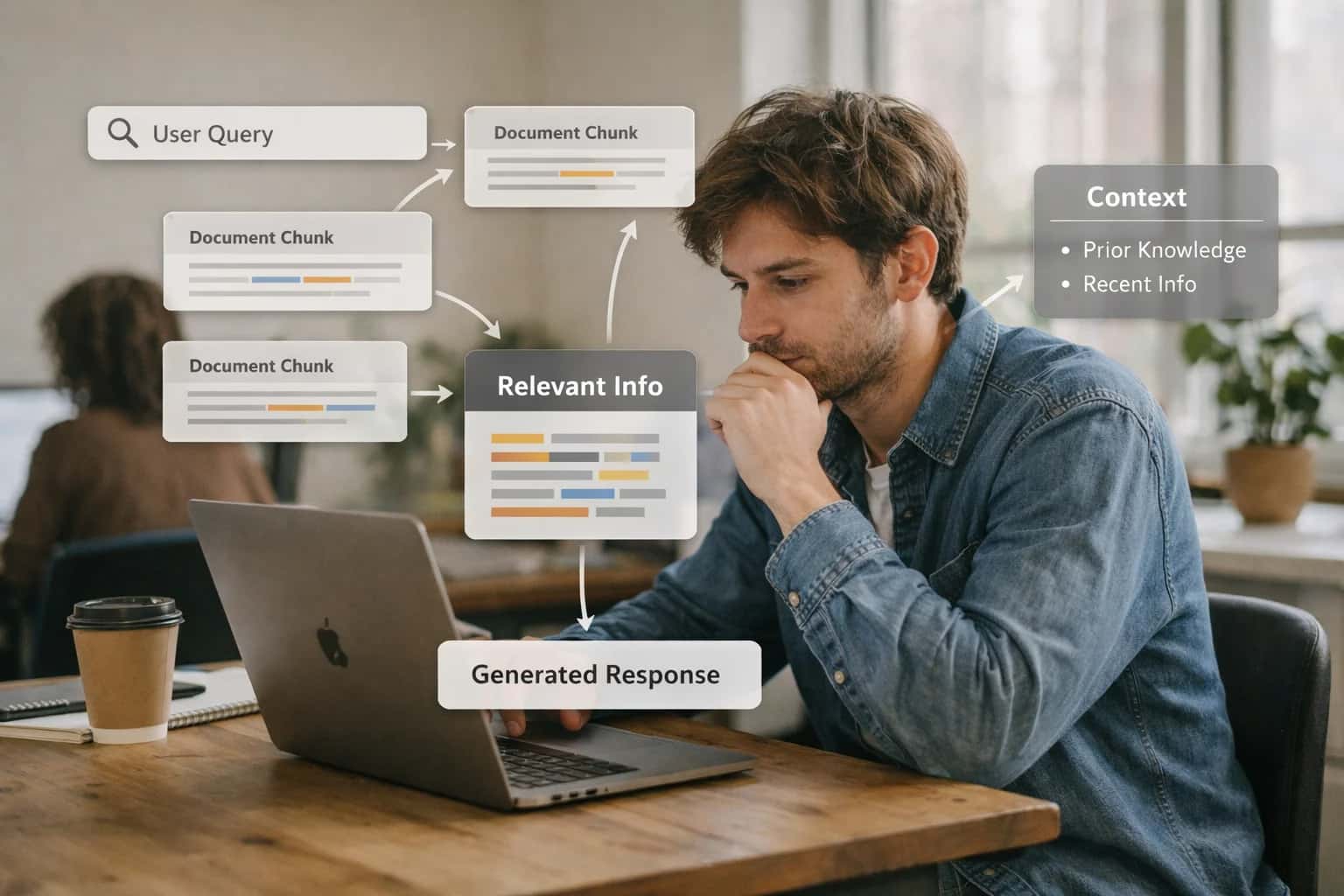
What is Query Routing?
Query routing is an adaptive retrieval strategy that analyzes an incoming query to dynamically select the most appropriate index, embedding model, or retrieval pipeline for that specific request, optimizing for relevance and latency.
This dynamic selection prevents the dilution of retrieval quality caused by searching irrelevant data silos. For instance, a technical support query might be routed to a product-specific dense embedding index, while a factual lookup is sent to a structured query engine. This architecture minimizes latency by avoiding exhaustive parallel searches and maximizes precision by ensuring the query is resolved against the most semantically aligned data source available.
ADAPTIVE RETRIEVAL ARCHITECTURE
Key Characteristics of Query Routing
Query routing is an intelligent triage layer that analyzes an incoming request to dynamically select the optimal retrieval pipeline, embedding model, or index partition. This prevents the one-size-fits-all degradation common in monolithic search systems.
01
Classifier-Based Routing
A lightweight classifier model is trained to categorize incoming queries into predefined buckets (e.g., factual, conversational, code-generation). Each bucket maps to a specific retrieval pipeline. This is the most common production pattern because it is deterministic and debuggable. The classifier can be as simple as a fine-tuned BERT model or a logistic regression on query embeddings. Key considerations include training data drift as user behavior evolves and the need for an 'unknown' fallback class that defaults to a general-purpose index.
02
Embedding-Weighted Selection
Rather than a hard classification, the system computes the centroid similarity between the query embedding and the centroid of each candidate index. The index with the highest cosine similarity is selected. This approach is fully unsupervised and adapts smoothly to semantic shifts without retraining a classifier. However, it assumes that the centroid of an index accurately represents its contents. Outlier documents can skew the centroid, and the computational cost of comparing against all centroids grows linearly with the number of indices.
03
Keyword-to-Index Mapping
A rules engine parses the query for explicit trigger tokens or regular expressions to route to specialized indices. For example, a query containing 'SEC filing' or a ticker symbol like '$AAPL' routes directly to a financial document index. This method offers zero latency overhead and is trivially explainable. The trade-off is maintenance: the keyword dictionary requires manual curation and cannot handle paraphrased queries that lack the exact trigger token. Often used as a fast-path optimization before falling back to a semantic router.
04
LLM-as-Router
A small, fast language model is prompted to output a structured routing decision based on the query. The prompt includes descriptions of available indices and their strengths. This enables nuanced, compositional routing—a query like 'summarize the legal risks in our Q3 financials' can be routed to both a legal index and a financial index for a hybrid retrieval. The primary cost is inference latency and token overhead. This pattern is gaining traction with the availability of low-latency inference APIs, but requires careful prompt engineering to prevent hallucinated routing targets.
05
Multi-Index Fan-Out
The query is broadcast to all candidate indices in parallel, and results are merged using a fusion algorithm like Reciprocal Rank Fusion (RRF). This avoids the single-point-of-failure risk of misrouting a query to the wrong index. The trade-off is increased computational cost and latency, as every index must be queried. This pattern is ideal when the cost of a missed result is extremely high, such as in medical literature search or legal discovery. Caching and index pruning can mitigate the overhead.
06
Query Decomposition Routing
Complex multi-hop queries are decomposed into sub-queries by a planner model. Each sub-query is independently routed to the most appropriate index. For example, 'What was the revenue impact of the competitor product launched after our patent expired?' decomposes into a patent index query, a competitor product index query, and a financial index query. The retrieved contexts are then synthesized. This is the most sophisticated routing pattern, foundational to agentic RAG systems, but introduces significant orchestration complexity and latency.
QUERY ROUTING CLARIFIED
Frequently Asked Questions
Query Routing is a critical architectural pattern in modern Retrieval-Augmented Generation (RAG) and agentic systems. It ensures that a user's natural language request is directed to the most appropriate data source, embedding model, or retrieval pipeline, rather than relying on a one-size-fits-all search index. The following answers address the most common technical questions about this adaptive retrieval strategy.
Query Routing is an adaptive retrieval strategy that analyzes an incoming query to dynamically select the most appropriate index, embedding model, or retrieval pipeline for that specific request. It functions as a classifier or logical switch placed before the retrieval step in a RAG pipeline. When a query arrives, the router evaluates its semantic intent, domain, or metadata—often using a lightweight language model or a text classifier—and then directs the query to the optimal downstream handler. For example, a medical chatbot might route questions about drug interactions to a pharmacological vector store, while directing questions about symptoms to a diagnostic knowledge graph. This prevents cross-domain contamination and significantly improves the precision of retrieved context by ensuring the query is matched against the most relevant data silo and embedding representation.
Enabling Efficiency, Speed & Accuracy
Intelligent Analysis, Decision & Execution
We build AI systems for teams that need search across company data, workflow automation across tools, or AI features inside products and internal software.
Talk to Us
Search across company data
Give teams answers from docs, tickets, runbooks, and product data with sources and permissions.
Useful when people spend too long searching or get different answers from different systems.
Enterprise searchRAGPermissions
Read more
Automate internal workflows
Use AI to route work, draft outputs, trigger actions, and keep approvals and logs in place.
Useful when repetitive work moves across multiple tools and teams.
AI agentsWorkflow automationGovernance
Read more
Add AI to products and internal tools
Build assistants, guided actions, or decision support into the software your team or customers already use.
Useful when AI needs to be part of the product, not a separate tool.
AI integrationDecision supportModel routing
Read moreRETRIEVAL ARCHITECTURE COMPARISON
Query Routing vs. Related Retrieval Strategies
A feature-level comparison of Query Routing against other adaptive and static retrieval paradigms in RAG pipelines.
| Feature | Query Routing | Hybrid Search | Cross-Encoder Reranking |
|---|---|---|---|
Primary Mechanism | Dynamic index/model selection based on query classification | Parallel sparse (BM25) and dense (vector) retrieval with score fusion | Two-stage cascade: fast bi-encoder retrieval followed by joint cross-encoder scoring |
Adaptive to Query Type | |||
Uses Multiple Indices | |||
Uses Multiple Embedding Models | |||
Fusion Algorithm | Reciprocal Rank Fusion (RRF) | Relevance scoring via cross-attention | |
Latency Profile | Low (single-pass after classification) | Medium (parallel retrieval + merge) | High (re-encoding all candidates) |
Primary Optimization Goal | Precision via domain-specific retrieval pipelines | Recall via combining lexical and semantic signals | Precision via fine-grained query-document interaction |

About the author
Prasad Kumkar
CEO & MD, Inference Systems
Prasad Kumkar is the CEO & MD of Inference Systems and writes about AI systems architecture, LLM infrastructure, model serving, evaluation, and production deployment. Over 5+ years, he has worked across computer vision models, L5 autonomous vehicle systems, and LLM research, with a focus on taking complex AI ideas into real-world engineering systems.
His work and writing cover AI systems, large language models, AI agents, multimodal systems, autonomous systems, inference optimization, RAG, evaluation, and production AI engineering.
LinkedIn
Limited slotsGet a Free AI Consultation
Partnered with leading AI, data, and software stack.





How We Work
Custom AI workflows for your Business
One-fit-all AI don't work for modern businesses. At Inferensys, we aim to understand your business & custom requirements; which we use to define most efficient agentic workflows, the data, and the tools for your business.
01
Review the use case
We understand the task, the users, and where AI can actually help.
Read more02
Pick the right approach
We define what needs search, automation, or product integration.
Read more03
Build the first useful version
We implement the part that proves the value first.
Read more04
Improve from there
We add the checks and visibility needed to keep it useful.
Read moreThe first call is a practical review of your use case and the right next step.
Talk to Us