Chunk linking is the process of establishing explicit directional or bidirectional references between related text chunks—such as sequential, hierarchical, or semantic connections—to preserve the structural integrity of a source document after segmentation. Unlike isolated chunk retrieval, which treats each segment as an independent unit, chunk linking encodes the relationships between chunks as metadata, enabling retrieval systems to navigate to adjacent context, parent sections, or related passages when a specific chunk is matched by a query.

Glossary
Chunk Linking
Chunk linking is the process of establishing explicit references between related text chunks to enable retrieval of adjacent context or navigation through a document's structure during AI generation.
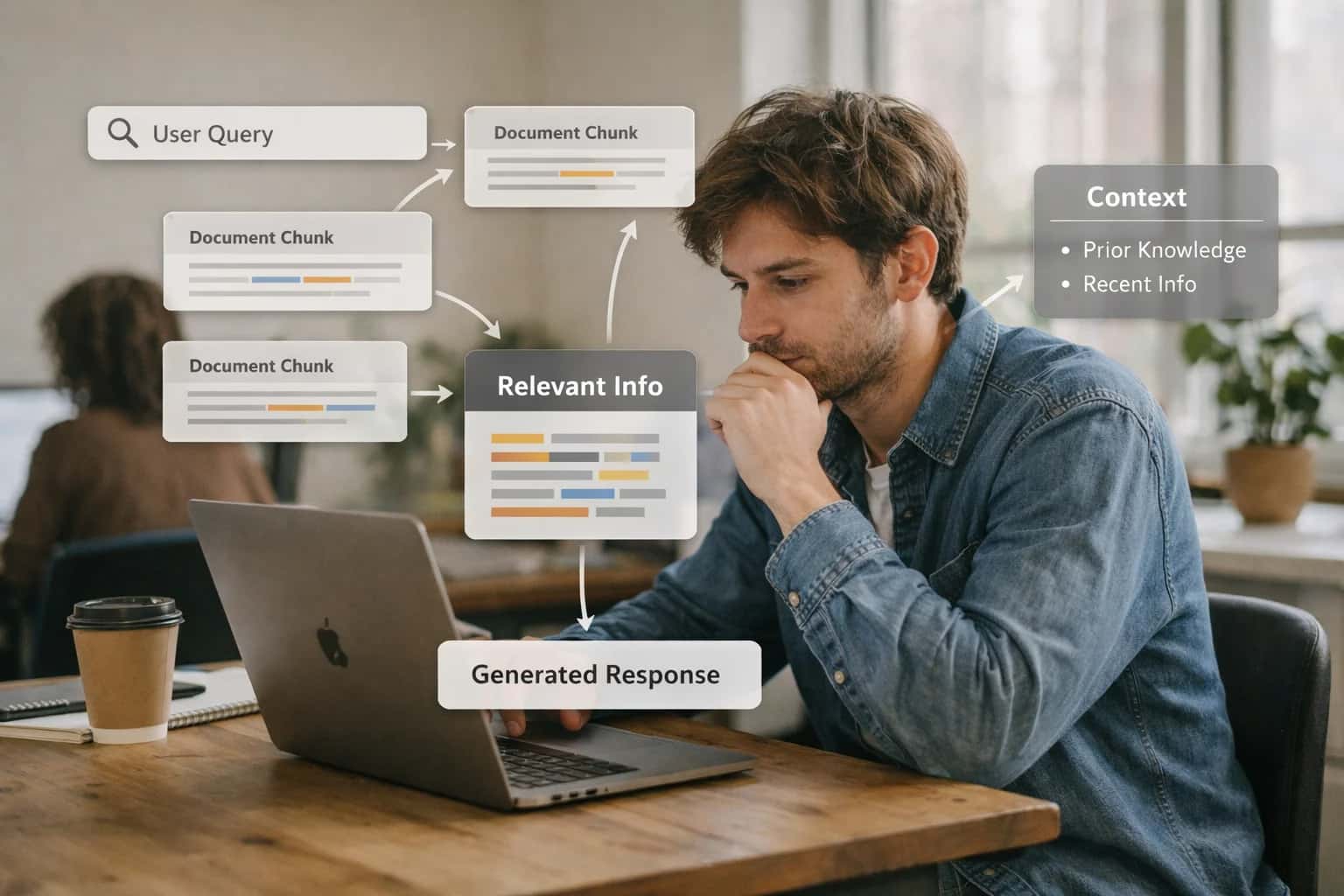
RETRIEVAL-AUGMENTED CONTENT DESIGN
What is Chunk Linking?
Chunk linking establishes explicit, navigable references between discrete text segments to preserve document structure and enable retrieval of adjacent context during AI generation.
This technique is critical for retrieval-augmented generation (RAG) pipelines where a matched chunk alone may lack sufficient context for accurate generation. By following links to preceding or following chunks, the retriever can reconstruct the surrounding narrative, while hierarchical links allow traversal from a specific paragraph to its containing section. Implementations typically store link references as metadata fields within vector database entries, enabling post-retrieval expansion that balances the precision of small-chunk search with the completeness of broader document context.
STRUCTURAL RETRIEVAL
Key Features of Chunk Linking
Chunk linking establishes explicit, navigable references between discrete text segments, enabling retrieval systems to reconstruct document structure and fetch adjacent context that would otherwise be lost during the chunking process.
01
Sequential Context Windows
Establishes prev and next pointers between consecutive chunks from the same source document. When a chunk is retrieved, the system can automatically expand the context window by fetching its immediate neighbors.
- Prevents information loss at chunk boundaries
- Reconstructs the original narrative flow during generation
- Critical for long-form documents where meaning spans multiple segments
- Often implemented as metadata fields in vector databases like Pinecone or Weaviate
02
Hierarchical Parent-Child Linking
Maps the structural relationship between a parent chunk (e.g., a full section) and its child chunks (subsections or atomic facts). This enables small-to-big retrieval, where a precise child match returns the broader parent context.
- Preserves document hierarchy: H1 → H2 → H3
- Enables LangChain's ParentDocumentRetriever pattern
- Reduces fragmentation while maintaining search precision
- Supports recursive expansion up to the full document level
03
Cross-Reference Anchors
Explicit links between semantically related chunks that are not sequentially adjacent — such as a definition in one section and its application in another. These anchors mirror internal hyperlinks in web content.
- Connects distributed concepts across a document
- Enables graph-based traversal beyond linear order
- Supports "see also" style retrieval patterns
- Can be generated automatically via cosine similarity thresholds between chunk embeddings
04
Metadata-Driven Linkage
Links are stored as structured metadata fields (e.g., chunk_id, parent_id, next_chunk_id, related_chunk_ids) within each vector database entry. This keeps the linking layer separate from the embedding itself.
- Enables metadata filtering during retrieval
- Allows links to be updated without re-embedding
- Supports complex queries: "fetch chunk X plus all linked neighbors"
- Compatible with self-querying retrieval where LLMs construct metadata-aware queries
05
Graph-Based Document Navigation
When chunk links are treated as edges in a knowledge graph, the retrieval system can traverse the document as a connected network rather than a flat list. This enables multi-hop retrieval across related sections.
- Supports breadth-first expansion from a matched chunk
- Enables path-finding between related concepts
- Integrates with graph databases like Neo4j for complex traversals
- Provides deterministic structure that complements semantic vector search
06
Provenance Chain Integrity
Each link preserves the source lineage of information, creating an unbroken chain from the generated output back through retrieved chunks to the original document. This is essential for citation accuracy and auditability.
- Enables full provenance tracking for every generated claim
- Supports attribution fidelity verification
- Creates tamper-evident retrieval paths
- Critical for regulated industries requiring auditable AI outputs
Enabling Efficiency, Speed & Accuracy
Intelligent Analysis, Decision & Execution
We build AI systems for teams that need search across company data, workflow automation across tools, or AI features inside products and internal software.
Talk to Us
Search across company data
Give teams answers from docs, tickets, runbooks, and product data with sources and permissions.
Useful when people spend too long searching or get different answers from different systems.
Enterprise searchRAGPermissions
Read more
Automate internal workflows
Use AI to route work, draft outputs, trigger actions, and keep approvals and logs in place.
Useful when repetitive work moves across multiple tools and teams.
AI agentsWorkflow automationGovernance
Read more
Add AI to products and internal tools
Build assistants, guided actions, or decision support into the software your team or customers already use.
Useful when AI needs to be part of the product, not a separate tool.
AI integrationDecision supportModel routing
Read moreCHUNK LINKING
Frequently Asked Questions
Clear, technical answers to the most common questions about establishing explicit references between content chunks for enhanced retrieval and generation.
Chunk linking is the process of establishing explicit, machine-readable references between discrete content chunks—such as sequential, hierarchical, or semantic connections—to enable retrieval systems to navigate document structure and pull adjacent context during generation. It works by embedding metadata pointers (e.g., parent_id, next_chunk_id, section_hierarchy) within each chunk's index entry. When a RAG system retrieves a chunk matching a query, the link graph allows it to also fetch the preceding paragraph, the parent section, or a related definition. This transforms a flat vector store into a navigable knowledge structure, preventing the fragmentation of long-form reasoning across isolated chunks. Common implementations include LangChain's ParentDocumentRetriever and custom graph-based indices built on Neo4j or LlamaIndex.

About the author
Prasad Kumkar
CEO & MD, Inference Systems
Prasad Kumkar is the CEO & MD of Inference Systems and writes about AI systems architecture, LLM infrastructure, model serving, evaluation, and production deployment. Over 5+ years, he has worked across computer vision models, L5 autonomous vehicle systems, and LLM research, with a focus on taking complex AI ideas into real-world engineering systems.
His work and writing cover AI systems, large language models, AI agents, multimodal systems, autonomous systems, inference optimization, RAG, evaluation, and production AI engineering.
LinkedIn
Limited slotsGet a Free AI Consultation
Partnered with leading AI, data, and software stack.





How We Work
Custom AI workflows for your Business
One-fit-all AI don't work for modern businesses. At Inferensys, we aim to understand your business & custom requirements; which we use to define most efficient agentic workflows, the data, and the tools for your business.
01
Review the use case
We understand the task, the users, and where AI can actually help.
Read more02
Pick the right approach
We define what needs search, automation, or product integration.
Read more03
Build the first useful version
We implement the part that proves the value first.
Read more04
Improve from there
We add the checks and visibility needed to keep it useful.
Read moreThe first call is a practical review of your use case and the right next step.
Talk to Us