Contextual Compression is a retrieval augmentation technique where a secondary, lightweight model compresses retrieved documents by extracting only the minimal information necessary to answer a user's query, discarding irrelevant text to maximize the utility of the limited context window. Unlike naive truncation, it performs query-conditioned filtering, preserving semantic relevance over raw token count.

Glossary
Contextual Compression
A retrieval augmentation technique where a secondary model compresses retrieved documents by extracting only the minimal information necessary to answer the user's query, maximizing the utility of the limited context window.
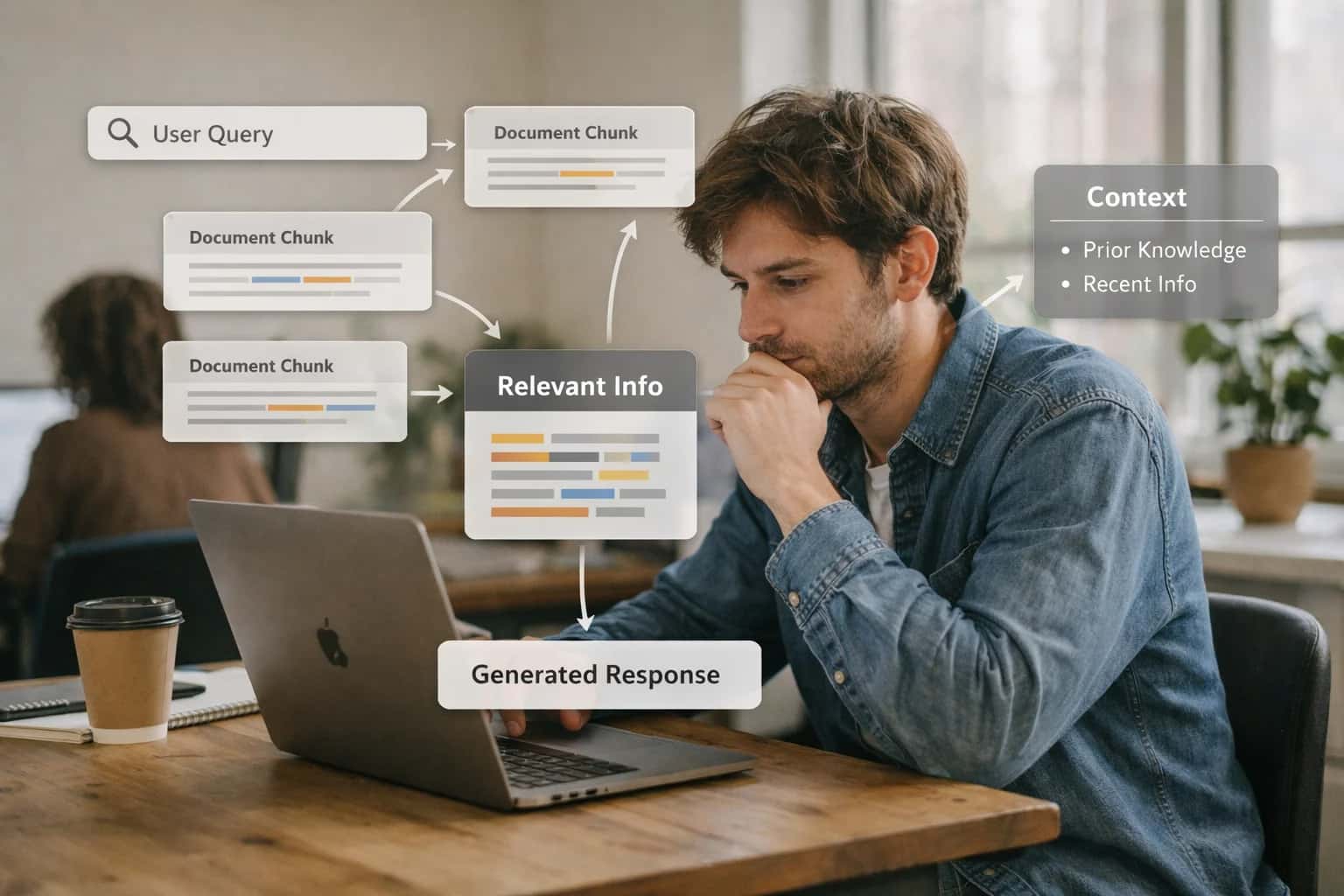
LLM CONTEXT WINDOW OPTIMIZATION
What is Contextual Compression?
A retrieval augmentation technique that maximizes the utility of a limited context window by extracting only the minimal, query-relevant information from retrieved documents.
This process typically employs a Filter-Then-Extract pipeline: a fast filter model first removes entirely irrelevant passages, then an extractive compressor selects the most salient sentences or phrases. This directly mitigates the Lost-in-the-Middle phenomenon by ensuring only high-signal, query-aligned tokens occupy the model's attention mechanism, improving factual grounding in Retrieval-Augmented Generation architectures.
MECHANISM
Key Characteristics of Contextual Compression
Contextual compression is a retrieval augmentation technique where a secondary model filters retrieved documents to extract only the minimal information necessary to answer a user's query, maximizing the utility of the limited context window.
01
Query-Conditioned Extraction
Unlike generic summarization, contextual compression is strictly query-dependent. A lightweight compressor model evaluates each retrieved document chunk against the user's specific question, extracting only the spans, sentences, or facts that are semantically relevant. This process discards the surrounding noise, ensuring that every token placed in the context window directly contributes to answering the query. The compressor acts as a filtering gate, mapping (query, document) -> compressed_document.
02
Maximizing Context Window Utility
The primary goal is to overcome the Lost-in-the-Middle problem and token limits. By compressing 10 retrieved documents into information-dense snippets, the system can effectively present the model with the key facts from a much larger corpus. This transforms the context window from a passive container into an active, high-signal workspace, allowing the LLM to reason over a broader set of sources without exceeding its architectural constraints.
03
Compressor Model Architectures
The compressor is typically a smaller, efficient model fine-tuned for extractive or abstractive compression:
- Extractive Compression: Selects and concatenates the most relevant sentences from the source document.
- Abstractive Compression: Generates a condensed summary in new, concise language.
- Encoder-Based: Models like BERT are often used for token-level relevance classification.
- Seq2Seq: Models like T5 can be trained to output a compressed string given the query and document as input.
04
Pipeline Integration with RAG
Contextual compression sits as a post-retrieval, pre-generation stage in a RAG pipeline. The standard flow is:
- Retrieval: Fetch top-k document chunks from a vector store.
- Compression: Pass each chunk through the compressor with the query.
- Assembly: Concatenate the compressed results into the final prompt. This ensures the LLM sees a high-density information payload rather than raw, noisy chunks.
05
Reducing Hallucination Risk
By stripping away irrelevant context, compression reduces the cognitive load on the LLM. The model is less likely to be distracted by tangential information or to conflate facts from different sources. The compressed content provides clean, atomic facts that are directly tied to the query, which improves factual grounding and lowers the probability of the model generating plausible-sounding but incorrect statements based on misinterpreting noisy context.
06
Latency and Cost Trade-offs
Introducing a compressor adds a computational step, increasing latency. However, this is often offset by the reduction in prompt tokens sent to the larger, more expensive LLM. The trade-off is a cost-performance optimization:
- Small Compressor: Fast, low-cost filtering.
- Large Generator: Receives fewer, higher-quality tokens. The net effect is often a reduction in total inference cost and time-to-first-token, especially when the initial retrieved documents are large.
CONTEXTUAL COMPRESSION
Frequently Asked Questions
Clear, technically precise answers to the most common questions about how contextual compression maximizes the utility of limited LLM context windows.
Contextual compression is a retrieval augmentation technique where a secondary, lightweight model filters and condenses retrieved documents by extracting only the minimal information necessary to answer a specific user query, discarding irrelevant filler. The process works by passing each retrieved document chunk alongside the user's query through a small compressor model—often a fine-tuned encoder or a distilled language model—that scores each sentence or token for its relevance to the query. Only the high-scoring segments are retained and assembled into the final prompt. This maximizes the utility of the context window by ensuring every token presented to the primary LLM carries high information density, directly combating the Lost-in-the-Middle phenomenon where irrelevant content dilutes the model's attention. Unlike simple truncation, contextual compression is query-aware, dynamically selecting different content from the same document depending on what the user is asking.
COMPARATIVE ANALYSIS
Contextual Compression vs. Related Techniques
A feature-level comparison of Contextual Compression against Prompt Compression and standard Retrieval-Augmented Generation (RAG) for optimizing LLM context window utility.
| Feature | Contextual Compression | Prompt Compression | Standard RAG |
|---|---|---|---|
Core Mechanism | Extracts query-relevant spans from retrieved docs using a secondary model | Condenses the entire prompt via summarization or token pruning | Prepends full retrieved document chunks to the prompt without modification |
Information Selectivity | Query-conditional; retains only minimal necessary context | Query-agnostic; applies uniform compression to all content | None; all retrieved content is passed through verbatim |
Token Reduction Efficacy | High; often reduces context by 60-80% | Moderate; typically reduces context by 30-50% | Low; no reduction, may waste tokens on irrelevant passages |
Preserves Factual Grounding | |||
Requires Secondary Model | |||
Inference Latency Overhead | Moderate; adds a compression pass before generation | Low; single-pass summarization or pruning | None; direct retrieval-to-prompt pipeline |
Risk of Information Loss | Low; compression is conditioned on the specific query | High; may discard critical details not salient to a generic summary | None; all information is preserved, including irrelevant noise |
Optimal Use Case | Long-document QA with precise, narrow queries | Reducing token costs for broad, open-ended tasks | Tasks requiring exhaustive context where token budget is not constrained |
Enabling Efficiency, Speed & Accuracy
Intelligent Analysis, Decision & Execution
We build AI systems for teams that need search across company data, workflow automation across tools, or AI features inside products and internal software.
Talk to Us
Search across company data
Give teams answers from docs, tickets, runbooks, and product data with sources and permissions.
Useful when people spend too long searching or get different answers from different systems.
Enterprise searchRAGPermissions
Read more
Automate internal workflows
Use AI to route work, draft outputs, trigger actions, and keep approvals and logs in place.
Useful when repetitive work moves across multiple tools and teams.
AI agentsWorkflow automationGovernance
Read more
Add AI to products and internal tools
Build assistants, guided actions, or decision support into the software your team or customers already use.
Useful when AI needs to be part of the product, not a separate tool.
AI integrationDecision supportModel routing
Read more
About the author
Prasad Kumkar
CEO & MD, Inference Systems
Prasad Kumkar is the CEO & MD of Inference Systems and writes about AI systems architecture, LLM infrastructure, model serving, evaluation, and production deployment. Over 5+ years, he has worked across computer vision models, L5 autonomous vehicle systems, and LLM research, with a focus on taking complex AI ideas into real-world engineering systems.
His work and writing cover AI systems, large language models, AI agents, multimodal systems, autonomous systems, inference optimization, RAG, evaluation, and production AI engineering.
LinkedIn
Limited slotsGet a Free AI Consultation
Partnered with leading AI, data, and software stack.





How We Work
Custom AI workflows for your Business
One-fit-all AI don't work for modern businesses. At Inferensys, we aim to understand your business & custom requirements; which we use to define most efficient agentic workflows, the data, and the tools for your business.
01
Review the use case
We understand the task, the users, and where AI can actually help.
Read more02
Pick the right approach
We define what needs search, automation, or product integration.
Read more03
Build the first useful version
We implement the part that proves the value first.
Read more04
Improve from there
We add the checks and visibility needed to keep it useful.
Read moreThe first call is a practical review of your use case and the right next step.
Talk to Us