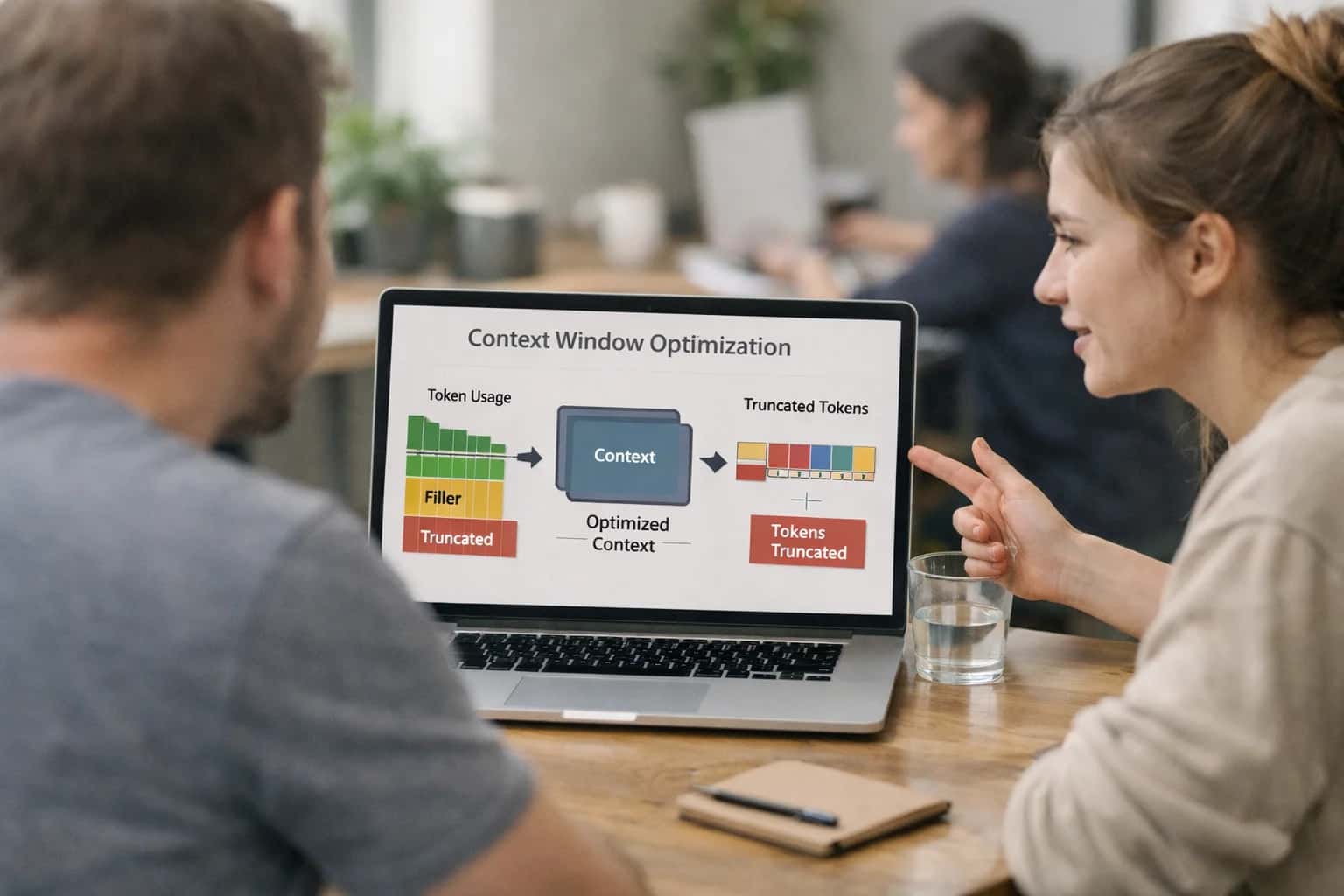
The context window is the total number of tokens—comprising both the input prompt and the model's generated output—that a Transformer-based LLM can attend to simultaneously. This finite capacity, governed by the model's architecture and KV-Cache memory allocation, represents the model's complete short-term memory for a given interaction. Any information exceeding this hard limit is truncated or lost, making the strategic placement of critical data within the window essential for reliable task execution.

Glossary
Context Window
The maximum span of text, measured in tokens, that a large language model can process in a single inference request, defining the upper limit of its immediate working memory.
FOUNDATIONAL LLM ARCHITECTURE
What is Context Window?
The context window defines the maximum span of text, measured in tokens, that a large language model can process in a single inference request, establishing the upper limit of its immediate working memory.
Maximizing the utility of this constrained space requires engineering techniques such as prompt compression, semantic chunking, and re-ranking to ensure only the most salient information occupies the window. A well-documented failure mode, Lost-in-the-Middle, reveals that content positioned centrally is often ignored, necessitating architectural strategies that prioritize key instructions and verifiable data at the beginning or end of the sequence to maintain output fidelity.
ARCHITECTURAL PROPERTIES
Key Characteristics of the Context Window
The context window is not a monolithic memory buffer but a complex architectural component with distinct performance characteristics. Understanding these properties is essential for engineering reliable LLM-powered systems.
01
Token-Based Capacity
The context window's capacity is measured in tokens, not words or characters. A token is an atomic unit from the model's vocabulary, typically representing ~0.75 words in English. The window size is a hard architectural limit set during pre-training and cannot be exceeded at inference time without specialized extrapolation techniques.
- GPT-4 Turbo: 128K tokens
- Claude 3 Opus: 200K tokens
- Gemini 1.5 Pro: Up to 1M tokens
Exceeding the limit triggers a context length exceeded error, requiring truncation or compression strategies.
128K–1M
Typical Token Range
02
Quadratic Attention Complexity
The standard self-attention mechanism scales with O(n²) computational complexity relative to sequence length n. Doubling the context window quadruples the attention computation and memory requirements.
This quadratic scaling is why long-context models require optimizations like:
- FlashAttention: Minimizes HBM reads/writes via tiling
- Ring Attention: Distributes computation across devices
- Sparse Attention: Limits attention to local or selected tokens
Without these, serving long-context models becomes prohibitively expensive in GPU memory and latency.
O(n²)
Attention Complexity
03
Positional Encoding Dependency
Transformers are permutation-invariant by design—they have no inherent sense of token order. The context window's ability to understand sequence depends entirely on positional encodings injected into token embeddings.
Key encoding methods:
- RoPE (Rotary Position Embedding): Encodes relative positions via rotation matrices, enabling superior length extrapolation
- ALiBi: Applies linear distance-based biases to attention scores, no learned embeddings required
- Learned Absolute: Fixed-size lookup table, cannot generalize beyond trained length
The choice of encoding directly determines whether a model can handle sequences longer than its training window.
04
The Lost-in-the-Middle Phenomenon
LLMs exhibit a well-documented U-shaped attention curve: information at the beginning (primacy bias) and end (recency bias) of the context window is retrieved with high accuracy, while content in the middle suffers significant degradation.
- Multi-document QA accuracy can drop by 20-30% for middle-positioned documents
- This effect intensifies as context length increases
- Mitigation strategies include re-ranking to place critical chunks at window boundaries and contextual compression to reduce filler content
The phenomenon is a fundamental limitation of current attention architectures, not a training artifact.
20–30%
Mid-Window Accuracy Drop
05
KV-Cache Memory Footprint
During autoregressive generation, the Key-Value (KV) Cache stores pre-computed attention tensors for all previous tokens to avoid recomputation. For long contexts, this cache dominates GPU memory consumption.
Memory formula for a single layer:
code2 × batch_size × num_heads × seq_length × head_dim × precision_bytes
Optimization techniques:
- Grouped-Query Attention (GQA): Shares KV heads across query heads, reducing cache size by 4-8×
- Multi-Query Attention (MQA): Single KV head for all queries, maximum compression
- Prefix Caching: Reuses KV-Cache for shared prompt prefixes across requests
Without these, a 128K context can consume tens of gigabytes of GPU memory for the cache alone.
4–8×
GQA Cache Reduction
06
Context as a Retrieval Target
In Retrieval-Augmented Generation (RAG) architectures, the context window serves as the fusion point where retrieved external knowledge meets the model's parametric knowledge. The window's finite capacity creates a zero-sum allocation problem: every retrieved chunk consumes tokens that could be used for instructions, conversation history, or generation output.
Strategic allocation patterns:
- Instruction Prefix: 5-15% of window for system prompts and task definitions
- Retrieved Context: 60-80% for grounding documents
- Conversation History: 10-20% for multi-turn coherence
- Output Buffer: Reserved tokens for generation
Effective RAG design requires re-ranking to prioritize high-value chunks and contextual compression to maximize information density per token.
TOKEN CAPACITY COMPARISON
Context Window Sizes Across Major LLM Providers
A comparison of maximum input context window sizes, effective utilization characteristics, and architectural approaches across leading foundation model providers as of early 2025.
| Feature | GPT-4o (OpenAI) | Claude 3.5 Sonnet (Anthropic) | Gemini 1.5 Pro (Google DeepMind) |
|---|---|---|---|
Maximum Context Window | 128,000 tokens | 200,000 tokens | 2,097,152 tokens (2M) |
Effective Retrieval Range | ~64,000 tokens | ~150,000 tokens | ~1,000,000 tokens |
Lost-in-the-Middle Severity | Moderate | Low-Moderate | Very Low |
Position Encoding Method | RoPE | RoPE with Adaptive Scaling | RoPE with NTK-Aware Scaling |
KV-Cache Optimization | Grouped-Query Attention | Grouped-Query Attention | Multi-Query Attention |
Native Long-Context Benchmark (>128K) | |||
Contextual Retrieval Accuracy at 90%+ Capacity | 62% | 78% | 91% |
Cost per 1M Input Tokens (Approx.) | $2.50 | $3.00 | $1.25 |
CONTEXT WINDOW FAQ
Frequently Asked Questions
Quick answers to the most common questions about LLM context windows, token limits, and how they impact retrieval-augmented generation and enterprise AI deployments.
A context window is the maximum span of text, measured in tokens, that a large language model can process in a single inference request. It functions as the model's immediate working memory. When you send a prompt, the entire input—including system instructions, conversation history, retrieved documents, and your query—must fit within this window. The model applies its attention mechanism across all tokens simultaneously, computing weighted relevance scores to determine which information is most salient for generating the next token. Anything exceeding the window is truncated or ignored entirely, making precise content chunking and retrieval strategies critical for enterprise RAG deployments.
Enabling Efficiency, Speed & Accuracy
Intelligent Analysis, Decision & Execution
We build AI systems for teams that need search across company data, workflow automation across tools, or AI features inside products and internal software.
Talk to Us
Search across company data
Give teams answers from docs, tickets, runbooks, and product data with sources and permissions.
Useful when people spend too long searching or get different answers from different systems.
Enterprise searchRAGPermissions
Read more
Automate internal workflows
Use AI to route work, draft outputs, trigger actions, and keep approvals and logs in place.
Useful when repetitive work moves across multiple tools and teams.
AI agentsWorkflow automationGovernance
Read more
Add AI to products and internal tools
Build assistants, guided actions, or decision support into the software your team or customers already use.
Useful when AI needs to be part of the product, not a separate tool.
AI integrationDecision supportModel routing
Read more
About the author
Prasad Kumkar
CEO & MD, Inference Systems
Prasad Kumkar is the CEO & MD of Inference Systems and writes about AI systems architecture, LLM infrastructure, model serving, evaluation, and production deployment. Over 5+ years, he has worked across computer vision models, L5 autonomous vehicle systems, and LLM research, with a focus on taking complex AI ideas into real-world engineering systems.
His work and writing cover AI systems, large language models, AI agents, multimodal systems, autonomous systems, inference optimization, RAG, evaluation, and production AI engineering.
LinkedIn
Limited slotsGet a Free AI Consultation
Partnered with leading AI, data, and software stack.





How We Work
Custom AI workflows for your Business
One-fit-all AI don't work for modern businesses. At Inferensys, we aim to understand your business & custom requirements; which we use to define most efficient agentic workflows, the data, and the tools for your business.
01
Review the use case
We understand the task, the users, and where AI can actually help.
Read more02
Pick the right approach
We define what needs search, automation, or product integration.
Read more03
Build the first useful version
We implement the part that proves the value first.
Read more04
Improve from there
We add the checks and visibility needed to keep it useful.
Read moreThe first call is a practical review of your use case and the right next step.
Talk to Us