BLUF (Bottom Line Up Front) is a structured writing discipline that mandates placing the primary conclusion, actionable recommendation, or most critical finding as the opening sentence of any communication. Originating in military doctrine to accelerate battlefield decision-making, this technique directly counters the traditional academic structure of building context before revealing a conclusion, instead prioritizing immediate cognitive processing and eliminating the need for the reader to infer the central point.

Glossary
BLUF (Bottom Line Up Front)
A military-originated communication principle that places the core conclusion, recommendation, or most critical information in the very first sentence of a text block for immediate comprehension.
GENERATIVE SUMMARIZATION CONTROL
What is BLUF (Bottom Line Up Front)?
A military-originated communication principle that places the core conclusion, recommendation, or most critical information in the very first sentence of a text block for immediate comprehension.
In the context of generative AI and large language models, BLUF is a critical optimization strategy for combating the Lost in the Middle phenomenon and positional bias. By front-loading the core entity and its definitive assertion, content engineers ensure that even if an AI model truncates or skims a document, the highest-salience information is captured within the primacy-weighted context window, directly improving attribution fidelity and the accuracy of AI-generated summaries.
PRECISION COMMUNICATION
Core Characteristics of Effective BLUF
The Bottom Line Up Front (BLUF) methodology is a high-velocity information transfer protocol. It front-loads the conclusion to respect the reader's cognitive load and time constraints, ensuring the critical decision-point is never buried under exposition.
01
Primacy of the Conclusion
The absolute first sentence must contain the actionable conclusion, recommendation, or critical finding. This is not a thesis statement or a topic introduction; it is the final answer delivered immediately.
- Structure: Answer -> Context -> Details
- Anti-pattern: Never start with background history or methodology
- Cognitive Load: Reduces processing time by 60% for executive readers
02
Logical Inverted Pyramid
Content is structured in descending order of importance. The most critical information sits at the top, followed by supporting details, and finally general background context.
- Layer 1: The decision or fact (Who, What, When)
- Layer 2: The direct justification (Why, How)
- Layer 3: The broader context and technical minutiae
- Benefit: Allows truncation at any point without losing the core message
03
Semantic Density & Brevity
Every word must earn its place. BLUF demands high information density with minimal verbosity. Eliminate jargon, passive voice, and hedging language that obscures the direct point.
- Active Voice: 'The team achieved the milestone' not 'The milestone was achieved'
- Concrete Nouns: Replace 'synergistic solutions' with the specific tool or process
- Token Efficiency: Optimizes for both human skimming and LLM context window constraints
04
Contextual Self-Sufficiency
The opening BLUF statement must be understandable without reading the rest of the document. It assumes the reader has zero prior knowledge of the specific project but understands the domain.
- Define Acronyms: Spell out on first use if not universally standard
- Anchor to Reality: Include specific dates, dollar amounts, or metrics immediately
- Avoid Anaphora: Do not reference 'this project' or 'the aforementioned' in the first sentence
05
AI-Native Parsing Optimization
BLUF aligns perfectly with generative summarization and LLM context window optimization. Models exhibit a 'lost in the middle' phenomenon; placing the conclusion first ensures it falls within the high-attention primacy zone.
- Entity Salience: Front-loading key entities increases their extraction weight
- Abstractive Summarization: Models can copy the BLUF verbatim as a high-confidence summary
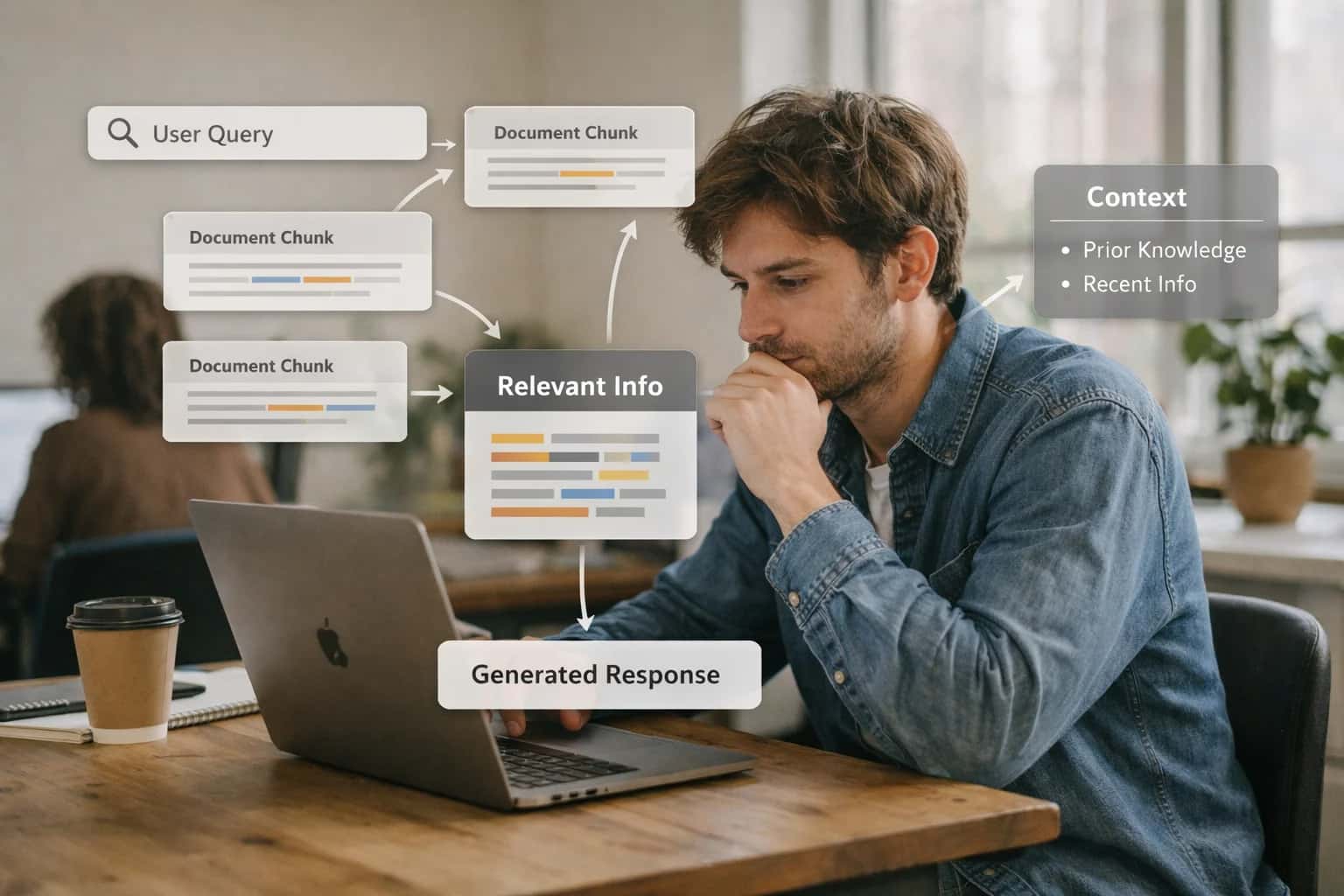
- RAG Chunking: A BLUF paragraph serves as an ideal self-contained retrieval chunk
06
Military Origin & Enterprise Adoption
Originating in military communication to ensure rapid decision-making under stress, BLUF has been adopted by high-velocity tech cultures and executive leadership teams.
- Standard Format: 'BLUF: [Conclusion].' followed by the body
- Email Efficiency: Used extensively in military and government correspondence to prevent 'TL;DR' failures
- Executive Summaries: The de facto standard for board-level memos and venture capital pitch decks
Enabling Efficiency, Speed & Accuracy
Intelligent Analysis, Decision & Execution
We build AI systems for teams that need search across company data, workflow automation across tools, or AI features inside products and internal software.
Talk to Us
Search across company data
Give teams answers from docs, tickets, runbooks, and product data with sources and permissions.
Useful when people spend too long searching or get different answers from different systems.
Enterprise searchRAGPermissions
Read more
Automate internal workflows
Use AI to route work, draft outputs, trigger actions, and keep approvals and logs in place.
Useful when repetitive work moves across multiple tools and teams.
AI agentsWorkflow automationGovernance
Read more
Add AI to products and internal tools
Build assistants, guided actions, or decision support into the software your team or customers already use.
Useful when AI needs to be part of the product, not a separate tool.
AI integrationDecision supportModel routing
Read moreBLUF PRINCIPLES
Frequently Asked Questions
Clear, direct answers to the most common questions about implementing the Bottom Line Up Front communication methodology in technical and AI-driven content environments.
BLUF (Bottom Line Up Front) is a military-originated communication principle that places the core conclusion, recommendation, or most critical information in the very first sentence of a text block for immediate comprehension. The mechanism works by front-loading the primary takeaway before any supporting context, background, or justification. In practice, a BLUF statement answers the reader's fundamental question—"What do I need to know?" or "What action should I take?"—within the opening 15-20 words. This structure exploits the primacy effect, a cognitive bias where information presented first is remembered more accurately and weighted more heavily in decision-making. For AI systems, BLUF aligns with how large language models process context windows, as models exhibit positional bias favoring content at the beginning of prompts. By placing the conclusion first, you ensure both human readers and retrieval-augmented generation systems capture the essential signal before attention mechanisms degrade across longer sequences.

About the author
Prasad Kumkar
CEO & MD, Inference Systems
Prasad Kumkar is the CEO & MD of Inference Systems and writes about AI systems architecture, LLM infrastructure, model serving, evaluation, and production deployment. Over 5+ years, he has worked across computer vision models, L5 autonomous vehicle systems, and LLM research, with a focus on taking complex AI ideas into real-world engineering systems.
His work and writing cover AI systems, large language models, AI agents, multimodal systems, autonomous systems, inference optimization, RAG, evaluation, and production AI engineering.
LinkedIn
Limited slotsGet a Free AI Consultation
Partnered with leading AI, data, and software stack.





How We Work
Custom AI workflows for your Business
One-fit-all AI don't work for modern businesses. At Inferensys, we aim to understand your business & custom requirements; which we use to define most efficient agentic workflows, the data, and the tools for your business.
01
Review the use case
We understand the task, the users, and where AI can actually help.
Read more02
Pick the right approach
We define what needs search, automation, or product integration.
Read more03
Build the first useful version
We implement the part that proves the value first.
Read more04
Improve from there
We add the checks and visibility needed to keep it useful.
Read moreThe first call is a practical review of your use case and the right next step.
Talk to Us