Retrieval-Augmented Generation (RAG) is an architectural framework that enhances a large language model's output by first executing a semantic search against an external, authoritative knowledge base, then injecting the retrieved documents directly into the model's context window to provide factual grounding before text generation begins.

Glossary
Retrieval-Augmented Generation (RAG)
A framework that grounds a large language model's responses by first retrieving relevant information from an external knowledge base, then augmenting the prompt with this context before generation.
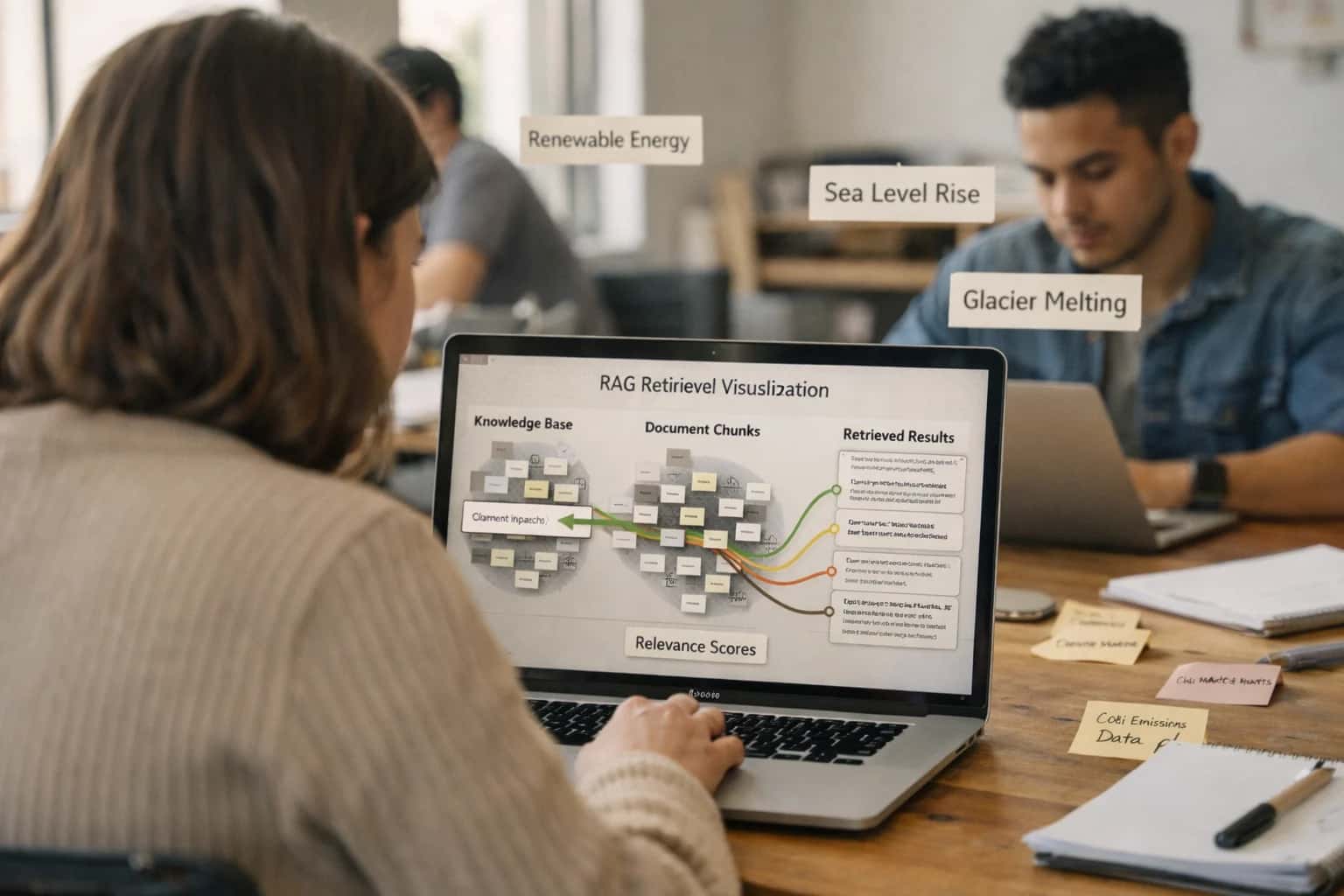
FACTUAL GROUNDING ARCHITECTURE
What is Retrieval-Augmented Generation (RAG)?
A framework that grounds a large language model's responses by first retrieving relevant information from an external knowledge base, then augmenting the prompt with this context before generation.
By bridging parametric memory with non-parametric, queryable data stores, RAG mitigates hallucination entropy and ensures attribution fidelity. The architecture typically employs a dual-encoder Dense Passage Retrieval (DPR) system to fetch relevant chunks from a vector database, which are then fused with the original prompt, allowing the model to synthesize answers anchored in verifiable source provenance rather than relying solely on its internal weights.
ARCHITECTURAL PRINCIPLES
Core Characteristics of RAG
Retrieval-Augmented Generation is not a single technique but a composite architecture defined by several interdependent characteristics that together ground language model outputs in verifiable external knowledge.
01
Retrieval-First Pipeline
The defining architectural constraint of RAG: retrieval always precedes generation. A query is encoded into a dense vector, an Approximate Nearest Neighbor (ANN) search fetches the top-k relevant document chunks from a vector database, and only then is the augmented prompt constructed. This strict ordering ensures the model conditions on retrieved evidence rather than relying solely on parametric memory, directly reducing hallucination entropy.
Top-k
Typical retrieval depth
< 100ms
Target retrieval latency
02
Dual-Encoder Architecture
Modern RAG systems employ a bi-encoder structure: one transformer encodes the query, another independently encodes all document passages. This separation allows documents to be pre-indexed offline into a vector store. At query time, only the query encoder runs, enabling sub-100ms retrieval. The alternative, a cross-encoder, processes query-document pairs jointly for superior accuracy but is computationally prohibitive for first-pass retrieval and is typically reserved for re-ranking.
2
Independent encoders
04
Context Window Augmentation
The 'Augmented' in RAG refers to the explicit injection of retrieved documents into the model's context window before generation. The prompt template typically follows a structured pattern: system instructions, retrieved context passages with source metadata, and the user query. This design leverages in-context learning—the model attends to the provided evidence during autoregressive generation. The constraint is the context window limit, making content chunking strategies critical for fitting relevant evidence without truncation.
128k+
Max context tokens (GPT-4 Turbo)
05
Attribution by Design
A well-architected RAG system embeds source provenance directly into the generation pipeline. Each retrieved chunk carries metadata—document ID, page number, URL, retrieval score—that is passed alongside the text into the prompt. The model is explicitly instructed to cite sources, enabling attribution fidelity measurement. This transforms the system from a black-box generator into an auditable engine where every claim can be traced back to a specific, verifiable passage.
06
Re-Ranking Cascade
Initial ANN retrieval prioritizes speed over precision, often returning noisy results. A re-ranking cascade applies progressively more expensive and accurate models to narrow the candidate set:
- Stage 1: Bi-encoder retrieves top-100 candidates
- Stage 2: Cross-encoder scores top-100, keeps top-10
- Stage 3 (optional): LLM-based relevance filtering This tiered approach balances the cost-accuracy tradeoff, ensuring only the most relevant passages enter the context window.
RETRIEVAL-AUGMENTED GENERATION
Frequently Asked Questions
Clear, technically precise answers to the most common questions about how RAG architectures ground large language models in external knowledge to eliminate hallucination and ensure factual accuracy.
Retrieval-Augmented Generation (RAG) is a hybrid AI framework that grounds a large language model's (LLM) responses by first retrieving relevant information from an external, authoritative knowledge base and then augmenting the model's prompt with this retrieved context before text generation. The architecture operates in two distinct phases: a retrieval phase, where a query is embedded into a dense vector using an encoder model and the most semantically similar documents are fetched from a vector database via Approximate Nearest Neighbor (ANN) search, and a generation phase, where the original query and the retrieved documents are concatenated into an augmented prompt and passed to the LLM. This design allows the model to access proprietary, up-to-date, or domain-specific information it was never trained on, directly addressing the hallucination problem by tethering outputs to verifiable source material. Advanced implementations often employ Reciprocal Rank Fusion (RRF) to combine results from sparse lexical retrieval (like BM25) and dense semantic retrieval (like Dense Passage Retrieval (DPR)) for improved recall, followed by a Cross-Encoder re-ranker to score the precise relevance of each query-document pair before the final generation step.
Enabling Efficiency, Speed & Accuracy
Intelligent Analysis, Decision & Execution
We build AI systems for teams that need search across company data, workflow automation across tools, or AI features inside products and internal software.
Talk to Us
Search across company data
Give teams answers from docs, tickets, runbooks, and product data with sources and permissions.
Useful when people spend too long searching or get different answers from different systems.
Enterprise searchRAGPermissions
Read more
Automate internal workflows
Use AI to route work, draft outputs, trigger actions, and keep approvals and logs in place.
Useful when repetitive work moves across multiple tools and teams.
AI agentsWorkflow automationGovernance
Read more
Add AI to products and internal tools
Build assistants, guided actions, or decision support into the software your team or customers already use.
Useful when AI needs to be part of the product, not a separate tool.
AI integrationDecision supportModel routing
Read moreGROUNDING TECHNIQUE COMPARISON
RAG vs. Fine-Tuning vs. Prompt Engineering
A technical comparison of three primary methods for steering large language model behavior and improving factual accuracy in enterprise deployments.
| Feature | Retrieval-Augmented Generation | Parameter-Efficient Fine-Tuning | Prompt Engineering |
|---|---|---|---|
Core Mechanism | Augments prompt with real-time retrieved context from external knowledge base before generation | Updates model weights on domain-specific data to permanently alter behavior | Crafts static instructions or few-shot examples in the input context window |
Knowledge Source | External vector databases, knowledge graphs, or document stores queried at inference | Internalized into model parameters during training | Encoded directly in the prompt text by the user |
Factual Freshness | Real-time; reflects latest data in connected sources | Stale; frozen at training cutoff date unless retrained | Stale; limited to model's pre-trained knowledge |
Hallucination Mitigation | Strong; grounds responses in retrieved passages with explicit provenance | Moderate; reduces domain errors but can still confabulate with high confidence | Weak; relies entirely on model's parametric memory |
Attribution Fidelity | High; can cite specific retrieved chunks or document IDs | Low; cannot trace output to specific training examples | None; no source provenance available |
Latency Overhead | 50-500ms additional retrieval latency per query | None at inference; overhead absorbed during training | None; only token processing time |
Infrastructure Complexity | Requires vector database, embedding pipeline, and retrieval orchestration | Requires curated training dataset and GPU compute for fine-tuning run | Minimal; no external infrastructure needed |
Cost Profile | Ongoing: embedding API calls, vector store hosting, retrieval compute | Upfront: one-time training cost; minimal inference overhead | Negligible: only standard inference cost |
PRACTICAL APPLICATIONS
Enterprise Use Cases for RAG
Retrieval-Augmented Generation moves from theoretical architecture to tangible business value when applied to specific enterprise workflows. These use cases demonstrate how grounding LLMs in proprietary data eliminates hallucinations and unlocks mission-critical automation.
01
Internal Knowledge Base Q&A
Transform static company wikis, Confluence pages, and SharePoint repositories into a conversational interface. RAG retrieves the most relevant policy documents, onboarding guides, or technical specifications in real-time, providing employees with precise, sourced answers instead of requiring manual search across fragmented systems.
- Source provenance ensures every answer cites the exact internal document and section
- Reduces IT support tickets by 40-60% in large organizations
- Maintains access control by respecting existing document permissions during retrieval
02
Customer Support Augmentation
Equip human agents with an AI co-pilot that retrieves relevant troubleshooting steps, product manuals, and historical ticket resolutions during live customer interactions. The RAG system ingests past support transcripts, technical documentation, and known bug databases to surface the exact information needed for the current issue.
- Cross-encoder re-ranking ensures the most contextually relevant article appears first
- Reduces average handle time by 35% while improving first-contact resolution rates
- Prevents hallucinated troubleshooting steps that could damage customer trust
03
Legal Document Review & Contract Analysis
Deploy RAG over massive corpora of case law, regulatory filings, and internal contracts to accelerate due diligence and legal research. Attorneys query the system in natural language and receive synthesized answers with attribution fidelity to specific clauses, precedents, and jurisdictions.
- Atomic fact decomposition enables fine-grained verification of every legal assertion
- Reduces contract review cycles from weeks to hours for M&A transactions
- Maintains strict chain of custody for evidentiary citations required in court filings
04
Clinical Decision Support
Ground diagnostic suggestions in the latest medical literature, clinical trial data, and institutional treatment protocols. A RAG system retrieves relevant studies from PubMed, internal EHR data, and drug interaction databases to provide physicians with evidence-based recommendations at the point of care.
- Temporal consistency checks ensure cited studies are current and not superseded
- Reduces adverse drug events by flagging contraindications from retrieved pharmacology data
- HIPAA-compliant deployment keeps patient data within the institution's secure vector store
05
Financial Research & Investment Analysis
Analysts query a RAG system over earnings call transcripts, SEC filings, market data, and proprietary research reports to generate investment theses with full citation trails. The system retrieves specific financial metrics, management commentary, and competitor comparisons to ground every analytical claim.
- Semantic triples extracted from filings enable structured comparison across companies
- Eliminates temporal hallucinations about quarterly performance or guidance figures
- Reduces research report generation time by 70% while improving factual accuracy scores
06
Manufacturing Troubleshooting & Maintenance
Provide field technicians with instant access to equipment manuals, historical maintenance logs, and known failure patterns through a RAG-powered interface. The system retrieves relevant schematics, torque specifications, and past repair notes based on the specific error code and machine model.
- Multi-modal grounding links textual procedures to retrieved equipment diagrams and photos
- Reduces mean time to repair by 50% in industrial settings
- Prevents costly errors by ensuring technicians follow the exact retrieved procedure for their equipment variant

About the author
Prasad Kumkar
CEO & MD, Inference Systems
Prasad Kumkar is the CEO & MD of Inference Systems and writes about AI systems architecture, LLM infrastructure, model serving, evaluation, and production deployment. Over 5+ years, he has worked across computer vision models, L5 autonomous vehicle systems, and LLM research, with a focus on taking complex AI ideas into real-world engineering systems.
His work and writing cover AI systems, large language models, AI agents, multimodal systems, autonomous systems, inference optimization, RAG, evaluation, and production AI engineering.
LinkedIn
Limited slotsGet a Free AI Consultation
Partnered with leading AI, data, and software stack.





How We Work
Custom AI workflows for your Business
One-fit-all AI don't work for modern businesses. At Inferensys, we aim to understand your business & custom requirements; which we use to define most efficient agentic workflows, the data, and the tools for your business.
01
Review the use case
We understand the task, the users, and where AI can actually help.
Read more02
Pick the right approach
We define what needs search, automation, or product integration.
Read more03
Build the first useful version
We implement the part that proves the value first.
Read more04
Improve from there
We add the checks and visibility needed to keep it useful.
Read moreThe first call is a practical review of your use case and the right next step.
Talk to Us