Metadata enrichment is the practice of augmenting raw text chunks with structured key-value pairs—such as source, date, author, section_title, or entity_type—before indexing them in a vector database. This transforms a purely semantic search into a hybrid, attribute-filtered operation, allowing retrieval systems to apply precise scoping constraints like "only search chunks from 2024" or "limit to financial reports" alongside vector similarity.

Glossary
Metadata Enrichment
The practice of appending structured attributes like source, date, author, and section title to chunk vectors to enable filtered and scoped retrieval queries.
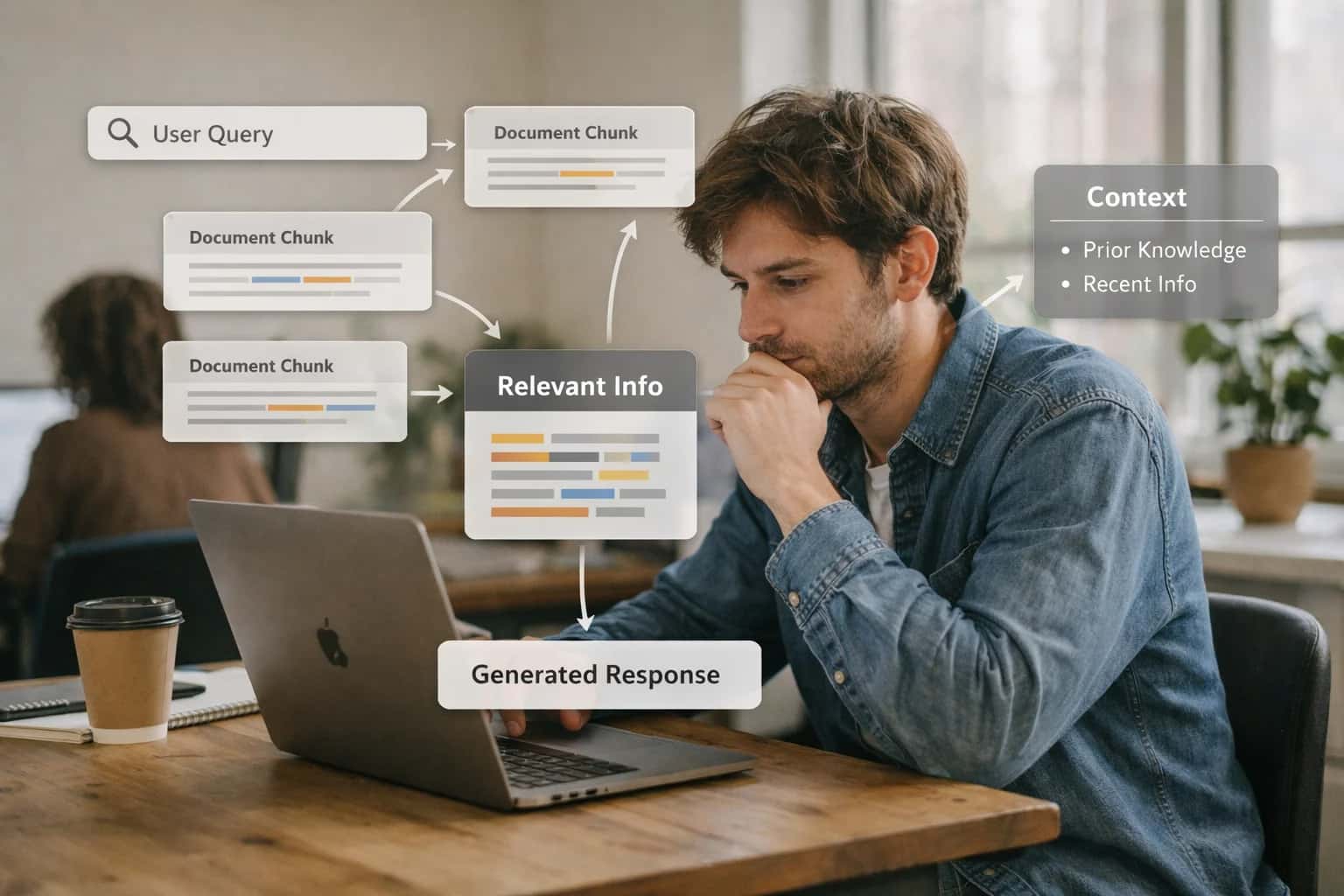
VECTOR DATABASE PRECISION
What is Metadata Enrichment?
Metadata enrichment is the process of appending structured, descriptive attributes to unstructured text chunks to enable filtered, scoped, and context-aware retrieval in vector database systems.
Effective enrichment bridges the gap between unstructured content and structured query logic. By attaching granular metadata at the chunk level rather than the document level, RAG architectures can execute pre-filtering and post-filtering strategies that dramatically reduce noise, improve chunk attribution accuracy, and prevent cross-contamination from irrelevant sections during LLM context window assembly.
STRUCTURED ATTRIBUTION
Core Characteristics of Metadata Enrichment
Metadata enrichment transforms raw text chunks into queryable, filterable data objects by appending structured attributes. This practice is essential for enabling scoped retrieval and provenance verification in RAG architectures.
01
Structured Attribute Injection
The process of appending key-value pairs to chunk vectors to enable filtered retrieval. Common attributes include source_document, publication_date, author, section_title, and chunk_index. This allows a retrieval system to scope a semantic search to a specific time range or document section before performing vector similarity, drastically reducing the search space and improving precision.
02
Provenance and Citation Grounding
Metadata is the backbone of chunk attribution. When an LLM generates a response, the system must trace the output back to the source chunk. Enriched metadata fields like document_id and chunk_hash provide the deterministic link required for:
- Verifiable citations in generated text
- Auditing retrieval pipelines
- Complying with data governance policies
03
Temporal and Version Control
Appending ingestion_timestamp and document_version to chunks enables time-scoped retrieval. This is critical for:
- Avoiding stale data in fast-moving knowledge bases
- Performing point-in-time audits of agent behavior
- Managing content updates without full re-indexing A query can be filtered to retrieve only chunks ingested after a specific ISO 8601 timestamp.
04
Access Control and Security Scoping
Metadata fields like security_clearance or user_group enable document-level access control within vector stores. Before returning chunks to the LLM, the retriever applies a metadata filter to exclude chunks the current user is not authorized to see. This prevents sensitive data leakage in multi-tenant RAG applications without requiring separate indexes per user role.
05
Automated Enrichment Pipelines
Manual tagging does not scale. Production systems use metadata enrichment pipelines that automatically:
- Extract entities via NER models
- Classify document types
- Generate summaries for chunk-level context
- Append source URLs and crawl dates These pipelines run as part of the ingestion workflow, ensuring every chunk is fully attributed before embedding.
06
Filtered Vector Search
The primary operational benefit of metadata enrichment is the ability to combine vector similarity with boolean filters. A query like "Find chunks semantically similar to 'revenue growth' where year=2024 AND department='sales'" requires metadata. This hybrid approach—pre-filtering before ANN search—ensures retrieval is both semantically relevant and contextually scoped, avoiding irrelevant but vector-similar results.
Enabling Efficiency, Speed & Accuracy
Intelligent Analysis, Decision & Execution
We build AI systems for teams that need search across company data, workflow automation across tools, or AI features inside products and internal software.
Talk to Us
Search across company data
Give teams answers from docs, tickets, runbooks, and product data with sources and permissions.
Useful when people spend too long searching or get different answers from different systems.
Enterprise searchRAGPermissions
Read more
Automate internal workflows
Use AI to route work, draft outputs, trigger actions, and keep approvals and logs in place.
Useful when repetitive work moves across multiple tools and teams.
AI agentsWorkflow automationGovernance
Read more
Add AI to products and internal tools
Build assistants, guided actions, or decision support into the software your team or customers already use.
Useful when AI needs to be part of the product, not a separate tool.
AI integrationDecision supportModel routing
Read moreMETADATA ENRICHMENT
Frequently Asked Questions
Clear, technical answers to the most common questions about appending structured context to text chunks for precise, filtered retrieval in RAG systems.
Metadata enrichment is the practice of programmatically appending structured, non-content attributes—such as source, date, author, section_title, or record_id—to the vector representation or payload of a text chunk before it is indexed in a vector database. This process transforms a raw, context-free text segment into a richly described data object. When a retrieval query is executed, the system can apply pre-filtering or scoped retrieval based on these metadata fields, ensuring that only chunks from a specific time period, document, or trusted source are considered for semantic search. This is critical for enterprise RAG architectures where factual grounding must be restricted to authoritative corpora, preventing the large language model from synthesizing answers from irrelevant or outdated documents. The metadata is typically stored alongside the chunk in a document store and can be used to construct complex boolean filters that run before or after the vector similarity search.

About the author
Prasad Kumkar
CEO & MD, Inference Systems
Prasad Kumkar is the CEO & MD of Inference Systems and writes about AI systems architecture, LLM infrastructure, model serving, evaluation, and production deployment. Over 5+ years, he has worked across computer vision models, L5 autonomous vehicle systems, and LLM research, with a focus on taking complex AI ideas into real-world engineering systems.
His work and writing cover AI systems, large language models, AI agents, multimodal systems, autonomous systems, inference optimization, RAG, evaluation, and production AI engineering.
LinkedIn
Limited slotsGet a Free AI Consultation
Partnered with leading AI, data, and software stack.





How We Work
Custom AI workflows for your Business
One-fit-all AI don't work for modern businesses. At Inferensys, we aim to understand your business & custom requirements; which we use to define most efficient agentic workflows, the data, and the tools for your business.
01
Review the use case
We understand the task, the users, and where AI can actually help.
Read more02
Pick the right approach
We define what needs search, automation, or product integration.
Read more03
Build the first useful version
We implement the part that proves the value first.
Read more04
Improve from there
We add the checks and visibility needed to keep it useful.
Read moreThe first call is a practical review of your use case and the right next step.
Talk to Us