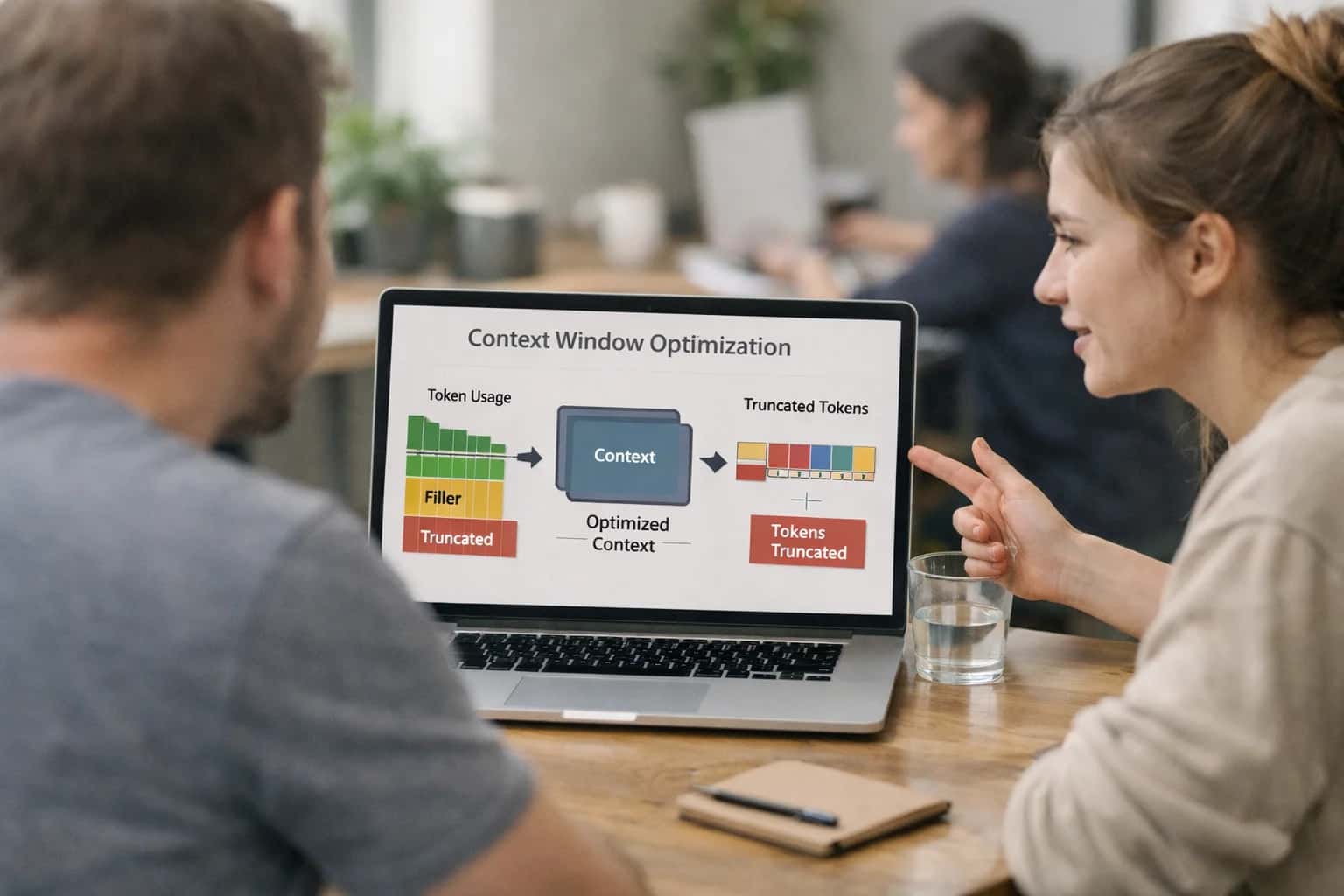
The context window is the finite span of tokens—encompassing both the input prompt and the model's generated output—that a large language model can attend to simultaneously. It represents the model's working memory for a single inference, directly constraining how much text, code, or data can be ingested for a specific task. Exceeding this limit triggers truncation, where the oldest tokens are discarded, causing catastrophic forgetting of earlier instructions or retrieved documents.

Glossary
Context Window
The maximum span of tokens a large language model can process in a single forward pass, defining the upper limit for chunk size and retrieval context.
FOUNDATIONAL ARCHITECTURE
What is Context Window?
The context window defines the maximum span of tokens a large language model can process in a single forward pass, establishing the hard upper limit for chunk size and the total information available for in-context retrieval.
Modern architectures have expanded context windows from 4K tokens to over 1M tokens through techniques like RoPE scaling and sparse attention mechanisms. However, the Lost in the Middle phenomenon demonstrates that model accuracy degrades for information placed in the center of long contexts. This directly impacts content chunking strategies, as chunks must be sized to fit within the window while reserving space for the system prompt, conversation history, and generated output.
ARCHITECTURAL CONSTRAINTS
Key Characteristics of Context Windows
The context window defines the maximum span of tokens a large language model can process in a single forward pass, establishing the upper limit for chunk size and retrieval context.
01
Token Capacity
The context window is measured in tokens, not words or characters. A token is roughly 0.75 words in English, meaning a 128k token window can hold approximately 96,000 words—equivalent to a 300-page novel. This capacity defines the absolute ceiling for how much retrieved context, conversation history, and instruction text can be passed to the model simultaneously. Exceeding this limit triggers truncation errors or requires chunking strategies.
128K+
Max Tokens (GPT-4 Turbo)
1M+
Max Tokens (Gemini 1.5 Pro)
02
Attention Mechanism Constraints
The self-attention mechanism scales quadratically with context length—doubling the window quadruples the compute cost. This creates a fundamental tension between context size and inference speed. Models use techniques like Grouped-Query Attention (GQA) and FlashAttention to mitigate this, but the Lost-in-the-Middle phenomenon persists: models attend most strongly to the beginning and end of the context window, often missing critical information placed in the middle.
O(n²)
Attention Complexity
03
Effective vs. Theoretical Window
The theoretical context window is the model's advertised maximum token limit. The effective context window is the span within which the model actually maintains high recall accuracy. Research shows that even in models with 128k token windows, retrieval accuracy degrades significantly beyond ~73k tokens for factual recall tasks. This gap drives architectural decisions around chunk sizing—chunks must be small enough to fit within the high-accuracy zone while carrying sufficient semantic context.
~73K
Effective Accuracy Threshold
04
Context Window vs. Training Cutoff
The context window is distinct from the model's training data cutoff. The window governs how much input the model can process at inference time, while the cutoff determines what knowledge was available during pre-training. A model with a 1M token window but a January 2024 cutoff can ingest a massive document but cannot know about events after that date unless provided via in-context learning within the window itself.
Inference
Window Governs
Pre-training
Cutoff Governs
05
Sliding Window Attention
Some architectures employ sliding window attention to extend effective context without quadratic cost. Instead of attending to all tokens, each token attends only to a fixed-size neighborhood (e.g., 4,096 tokens) plus a few global tokens. This creates a receptive field that grows linearly with layers, allowing models like Mistral to process long sequences efficiently. However, this trades off long-range dependency capture for computational tractability.
4,096
Typical Sliding Window Size
06
Context Window Inflation
Modern models achieve large context windows through position interpolation techniques like RoPE scaling. Rather than training from scratch on long sequences, models fine-tune with rescaled position encodings—compressing the original positional space into the extended range. Methods include NTK-aware scaling and YaRN, which adjust the rotary base frequency to preserve high-frequency information while extending low-frequency range. This enables 4x-8x window expansion with minimal fine-tuning.
4x-8x
Typical Expansion Ratio
TOKEN CAPACITY COMPARISON
Context Window Sizes Across Major LLMs
A comparison of maximum context window sizes, effective utilization ceilings, and architectural approaches across leading large language models as of mid-2025.
| Model | Max Context (Tokens) | Effective Ceiling | Attention Mechanism | Chunking Recommendation |
|---|---|---|---|---|
GPT-4o | 128,000 | ~96,000 | Sparse Flash Attention | 8,000–16,000 tokens |
Claude 3.5 Sonnet | 200,000 | ~150,000 | Sliding Window + Global | 12,000–24,000 tokens |
Gemini 1.5 Pro | 1,000,000 | ~500,000 | Ring Attention + MoE | 16,000–32,000 tokens |
Gemini 2.0 Flash | 1,000,000 | ~600,000 | Hybrid Sparse-Dense | 16,000–32,000 tokens |
Claude 3 Opus | 200,000 | ~140,000 | Sliding Window + Global | 12,000–24,000 tokens |
GPT-4 Turbo | 128,000 | ~80,000 | Sparse Flash Attention | 8,000–16,000 tokens |
Llama 3.1 405B | 128,000 | ~90,000 | Grouped Query Attention | 8,000–16,000 tokens |
Mistral Large 2 | 128,000 | ~100,000 | Sliding Window Attention | 8,000–16,000 tokens |
CONTEXT WINDOW FAQ
Frequently Asked Questions
Clear, technical answers to the most common questions about the context window—the fundamental constraint governing how much information a large language model can process in a single inference pass.
A context window is the maximum span of tokens—encompassing both the input prompt and the model's generated output—that a large language model can process in a single forward pass. It defines the hard upper limit on the amount of information the model can 'attend to' at once. The mechanism is rooted in the self-attention computation of the Transformer architecture, where the computational and memory complexity scales quadratically with sequence length. When the combined input and output tokens exceed this limit, the model loses access to the earliest tokens, a phenomenon known as context window exhaustion. Modern models like GPT-4 Turbo offer 128K-token windows, while Gemini 1.5 Pro pushes to 1M+ tokens, enabling the processing of entire codebases or novel-length documents in a single request.
Enabling Efficiency, Speed & Accuracy
Intelligent Analysis, Decision & Execution
We build AI systems for teams that need search across company data, workflow automation across tools, or AI features inside products and internal software.
Talk to Us
Search across company data
Give teams answers from docs, tickets, runbooks, and product data with sources and permissions.
Useful when people spend too long searching or get different answers from different systems.
Enterprise searchRAGPermissions
Read more
Automate internal workflows
Use AI to route work, draft outputs, trigger actions, and keep approvals and logs in place.
Useful when repetitive work moves across multiple tools and teams.
AI agentsWorkflow automationGovernance
Read more
Add AI to products and internal tools
Build assistants, guided actions, or decision support into the software your team or customers already use.
Useful when AI needs to be part of the product, not a separate tool.
AI integrationDecision supportModel routing
Read more
About the author
Prasad Kumkar
CEO & MD, Inference Systems
Prasad Kumkar is the CEO & MD of Inference Systems and writes about AI systems architecture, LLM infrastructure, model serving, evaluation, and production deployment. Over 5+ years, he has worked across computer vision models, L5 autonomous vehicle systems, and LLM research, with a focus on taking complex AI ideas into real-world engineering systems.
His work and writing cover AI systems, large language models, AI agents, multimodal systems, autonomous systems, inference optimization, RAG, evaluation, and production AI engineering.
LinkedIn
Limited slotsGet a Free AI Consultation
Partnered with leading AI, data, and software stack.





How We Work
Custom AI workflows for your Business
One-fit-all AI don't work for modern businesses. At Inferensys, we aim to understand your business & custom requirements; which we use to define most efficient agentic workflows, the data, and the tools for your business.
01
Review the use case
We understand the task, the users, and where AI can actually help.
Read more02
Pick the right approach
We define what needs search, automation, or product integration.
Read more03
Build the first useful version
We implement the part that proves the value first.
Read more04
Improve from there
We add the checks and visibility needed to keep it useful.
Read moreThe first call is a practical review of your use case and the right next step.
Talk to Us