A chunk graph is a relational data structure that connects discrete text segments through nodes (chunks) and edges (relationships). Unlike flat vector indices that treat chunks as isolated units, a chunk graph preserves the semantic and structural connections between segments—such as shared entities, hyperlinks, or sequential adjacency—allowing retrieval systems to traverse related information beyond a single chunk's boundary.

Glossary
Chunk Graph
A data structure that links text chunks based on shared entities, references, or sequential order to enable graph-based traversal and multi-hop retrieval.
GRAPH-BASED RETRIEVAL STRUCTURE
What is Chunk Graph?
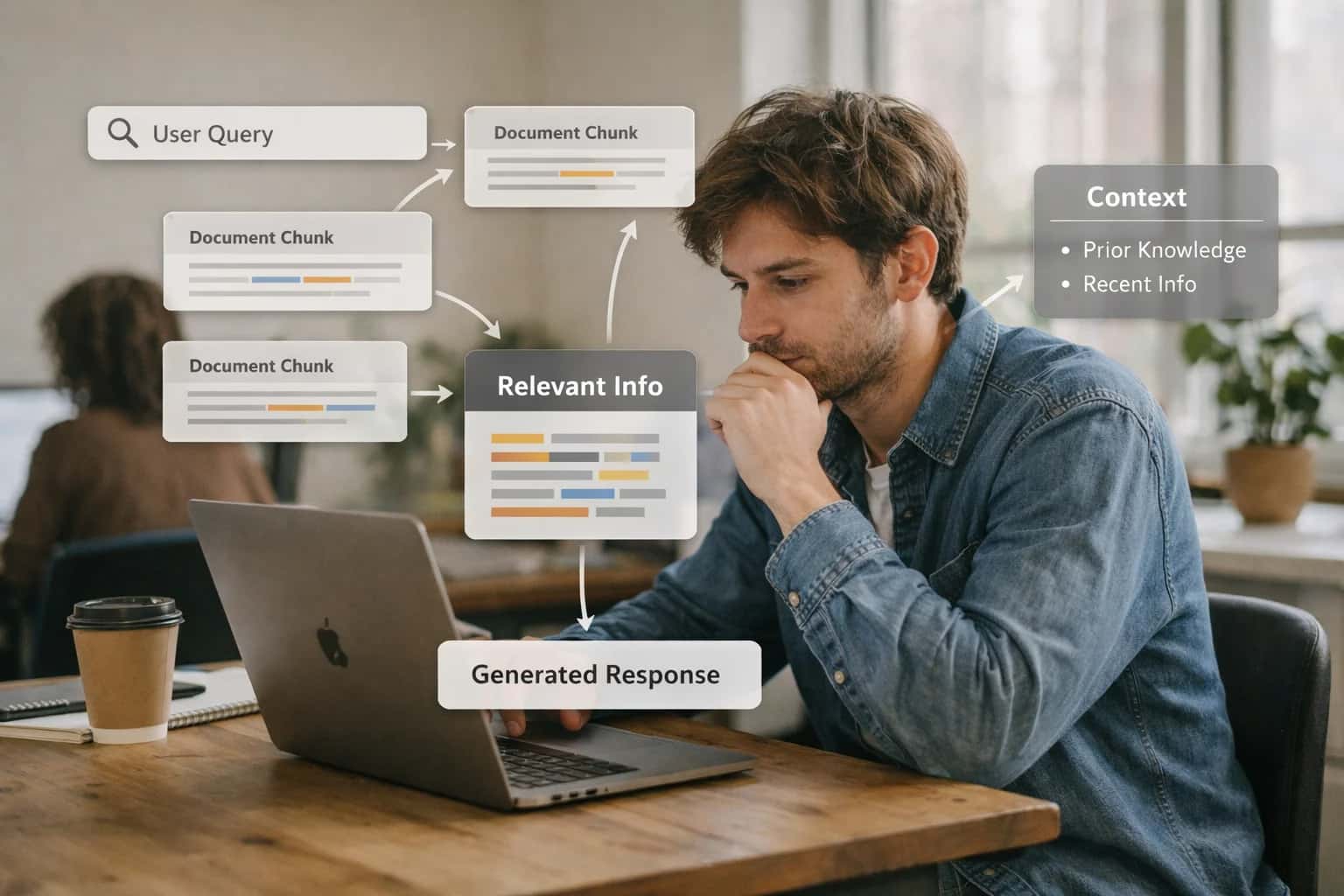
A chunk graph is a data structure that links discrete text segments based on shared entities, explicit references, or sequential order to enable graph-based traversal and multi-hop retrieval in RAG systems.
This architecture enables multi-hop retrieval, where an initial query retrieves one chunk, and the graph is traversed to fetch connected chunks that provide supplementary context. Edges are typically defined by entity co-occurrence, document hierarchy, or cross-reference links, transforming a linear corpus into a navigable knowledge structure that improves factual grounding and reduces fragmentation in retrieval-augmented generation pipelines.
GRAPH-BASED RETRIEVAL
Core Properties of Chunk Graphs
A chunk graph transforms a flat list of text segments into an interconnected network, enabling multi-hop reasoning and context-aware traversal that linear retrieval cannot achieve.
01
Nodes: The Atomic Units
Each node in a chunk graph represents a discrete text segment—typically a paragraph, section, or atomic fact. Nodes carry metadata (source document, position, heading level) and the raw text payload. Unlike flat vector indexes where chunks float in isolation, graph nodes maintain explicit adjacency relationships to their neighbors, preserving the document's original narrative structure alongside any semantic cross-references.
02
Edges: Explicit Relationships
Edges define the typed connections between chunks. Common edge types include:
- Sequential: Links to the next and previous chunk in the source document
- Referential: Links between chunks that cite the same entity, definition, or figure
- Hierarchical: Parent-child links reflecting heading structure (H2 contains H3)
- Semantic: Links derived from high cosine similarity in embedding space These explicit relationships allow traversal algorithms to follow precise paths rather than relying solely on vector proximity.
03
Multi-Hop Traversal
The defining capability of a chunk graph is multi-hop retrieval. When a query requires synthesizing information spread across disconnected sections—such as 'How does the pricing model affect the SLA terms?'—the graph enables traversal from a chunk about pricing, across a referential edge to a definitions chunk, and onward to the SLA section. This chain-of-chunks traversal mirrors how a human analyst navigates a document, dramatically improving recall for complex, compound questions.
04
Graph Construction Pipeline
Building a chunk graph involves a multi-stage pipeline:
- Chunking: Segment documents using semantic or structural strategies
- Entity Extraction: Identify named entities, key terms, and citations within each chunk
- Relationship Extraction: Detect co-references, shared entities, and cross-references between chunks
- Edge Weighting: Assign confidence scores to edges based on relationship strength
- Indexing: Store both the vector embeddings and the graph adjacency list for hybrid retrieval
05
GraphRAG Integration
Chunk graphs serve as the retrieval backbone for GraphRAG (Graph Retrieval-Augmented Generation) architectures. Unlike standard RAG that retrieves the top-k most similar chunks, GraphRAG uses the chunk graph to perform community detection and subgraph extraction around a query's seed nodes. This produces a context package that includes not just the most relevant chunks but also their structural neighbors, definitions, and related concepts—providing the LLM with a comprehensive, coherent context window.
06
Comparison: Graph vs. Flat Retrieval
| Property | Flat Vector Retrieval | Chunk Graph Retrieval |
|---|---|---|
| Context awareness | Limited to top-k similarity | Preserves document structure and cross-references |
| Multi-hop queries | Requires multiple round-trips | Single traversal resolves complex paths |
| Redundancy handling | May retrieve duplicate information | Graph deduplication via node identity |
| Explainability | Opaque similarity scores | Traceable edge paths for citations |
| Indexing complexity | Low | Moderate to high |
CHUNK GRAPH ARCHITECTURE
Frequently Asked Questions
Explore the mechanics of linking discrete text segments into traversable knowledge structures for advanced multi-hop retrieval and reasoning.
A Chunk Graph is a data structure that links discrete text segments based on shared entities, explicit references, or sequential order to enable graph-based traversal and multi-hop retrieval. Unlike flat vector indexes that treat chunks as isolated points in space, a Chunk Graph establishes explicit edges between nodes. These edges can represent semantic similarity, hyperlink connections, co-citation, or sequential document order. When a retrieval query is executed, the system doesn't just return the top-k similar chunks; it traverses the graph to fetch neighboring nodes, parent contexts, or entity-linked information. This structure is critical for Retrieval-Augmented Generation (RAG) systems handling complex queries that require synthesizing information distributed across multiple document sections.
STRUCTURAL COMPARISON
Chunk Graph vs. Knowledge Graph vs. Vector Index
A comparison of three distinct data structures used for organizing and retrieving information in RAG architectures, highlighting their core mechanisms, relationships, and optimal use cases.
| Feature | Chunk Graph | Knowledge Graph | Vector Index |
|---|---|---|---|
Core Data Unit | Text chunk with edges to related chunks | Entity-relationship triple (subject, predicate, object) | High-dimensional embedding vector |
Primary Relationship Type | Sequential, referential, or entity-shared links between chunks | Semantic, ontological, or factual relationships between entities | Cosine similarity or Euclidean distance in embedding space |
Retrieval Mechanism | Graph traversal and multi-hop expansion | SPARQL or Cypher query with logical reasoning | Approximate Nearest Neighbor (ANN) search |
Supports Multi-Hop Reasoning | |||
Handles Unstructured Text Natively | |||
Typical Query Latency | 10-100 ms | 5-50 ms | 1-10 ms |
Ideal Use Case | Multi-document synthesis requiring cross-reference traversal | Factual grounding and entity-centric question answering | Semantic similarity search over large document corpora |
Susceptible to Hallucination Without Grounding |
Enabling Efficiency, Speed & Accuracy
Intelligent Analysis, Decision & Execution
We build AI systems for teams that need search across company data, workflow automation across tools, or AI features inside products and internal software.
Talk to Us
Search across company data
Give teams answers from docs, tickets, runbooks, and product data with sources and permissions.
Useful when people spend too long searching or get different answers from different systems.
Enterprise searchRAGPermissions
Read more
Automate internal workflows
Use AI to route work, draft outputs, trigger actions, and keep approvals and logs in place.
Useful when repetitive work moves across multiple tools and teams.
AI agentsWorkflow automationGovernance
Read more
Add AI to products and internal tools
Build assistants, guided actions, or decision support into the software your team or customers already use.
Useful when AI needs to be part of the product, not a separate tool.
AI integrationDecision supportModel routing
Read more
About the author
Prasad Kumkar
CEO & MD, Inference Systems
Prasad Kumkar is the CEO & MD of Inference Systems and writes about AI systems architecture, LLM infrastructure, model serving, evaluation, and production deployment. Over 5+ years, he has worked across computer vision models, L5 autonomous vehicle systems, and LLM research, with a focus on taking complex AI ideas into real-world engineering systems.
His work and writing cover AI systems, large language models, AI agents, multimodal systems, autonomous systems, inference optimization, RAG, evaluation, and production AI engineering.
LinkedIn
Limited slotsGet a Free AI Consultation
Partnered with leading AI, data, and software stack.





How We Work
Custom AI workflows for your Business
One-fit-all AI don't work for modern businesses. At Inferensys, we aim to understand your business & custom requirements; which we use to define most efficient agentic workflows, the data, and the tools for your business.
01
Review the use case
We understand the task, the users, and where AI can actually help.
Read more02
Pick the right approach
We define what needs search, automation, or product integration.
Read more03
Build the first useful version
We implement the part that proves the value first.
Read more04
Improve from there
We add the checks and visibility needed to keep it useful.
Read moreThe first call is a practical review of your use case and the right next step.
Talk to Us