A staleness threshold is a predefined point in time or a quantitative decay score at which a piece of data is deemed too old to be trustworthy, resulting in its automatic exclusion from AI retrieval-augmented generation (RAG) pipelines. This mechanism prevents language models from grounding their outputs in obsolete information, directly mitigating the risk of temporal hallucinations. The threshold is typically implemented as a hard filter on a last_updated timestamp or a soft decay function integrated into a freshness-aware ranking algorithm, ensuring that only data within its temporal validity window is considered for in-context retrieval.

Glossary
Staleness Threshold
A predefined point in time or a decay score at which data is considered too old to be reliable, triggering its exclusion from AI retrieval or generation processes.
DATA FRESHNESS GOVERNANCE
What is Staleness Threshold?
A staleness threshold is a predefined temporal boundary or decay score that determines when data is too old to be considered reliable, triggering its automatic exclusion from AI retrieval or generation processes.
Configuring the staleness threshold requires balancing recency against completeness. A highly aggressive threshold maximizes data freshness but may create knowledge gaps, while a lenient one risks incorporating stale facts that contradict current ground truth. In dynamic knowledge base architectures, the threshold is often paired with a confidence decay function, where a document's retrieval score diminishes as it ages, rather than being abruptly removed. This is a critical component of confidence calibration, as it provides an explicit signal to the AI model that the reliability of the information is inversely correlated with its age.
Staleness Threshold Mechanics
Core Characteristics
The staleness threshold is a critical governance parameter that defines the boundary between actionable intelligence and unreliable noise in AI-driven retrieval systems.
01
Temporal Validity Window
A staleness threshold is fundamentally defined by a temporal validity window—a predefined period during which data is considered trustworthy. Once this window closes, the data's confidence score is automatically decayed or the record is flagged for exclusion.
- Static windows: Fixed durations (e.g., 24 hours for stock prices, 1 year for legal precedents)
- Dynamic windows: Context-aware durations that adjust based on data volatility (e.g., shorter windows for breaking news, longer for encyclopedic facts)
- Implementation: Typically enforced via a data freshness stamp compared against the current system timestamp at query time
24h
Typical financial data window
< 1s
Real-time threshold check latency
02
Confidence Decay Function
Rather than a binary fresh/stale switch, sophisticated systems apply a confidence decay function that gradually reduces a data point's reliability score as it ages. This prevents abrupt information loss and allows for nuanced ranking.
- Linear decay: Confidence decreases at a constant rate over time
- Exponential decay: Confidence drops rapidly after a critical point, modeled as
C(t) = C₀ * e^(-λt) - Step functions: Confidence remains at 100% until the threshold, then drops to zero
- Application: Used in freshness-aware ranking algorithms to demote rather than eliminate aging content
03
Epistemic vs. Aleatoric Staleness
Staleness can arise from two distinct types of uncertainty that require different handling:
- Epistemic staleness: Data is outdated because the world has changed and new information exists. This is reducible—a fresh crawl or update can restore confidence. Example: A CEO change after an article was published.
- Aleatoric staleness: Data is inherently time-bound due to the stochastic nature of the domain. This is irreducible—no amount of re-measurement helps. Example: A weather forecast for a past date.
Understanding this distinction informs whether to trigger a re-indexing or simply apply a temporal validity window.
04
Staleness in RAG Architectures
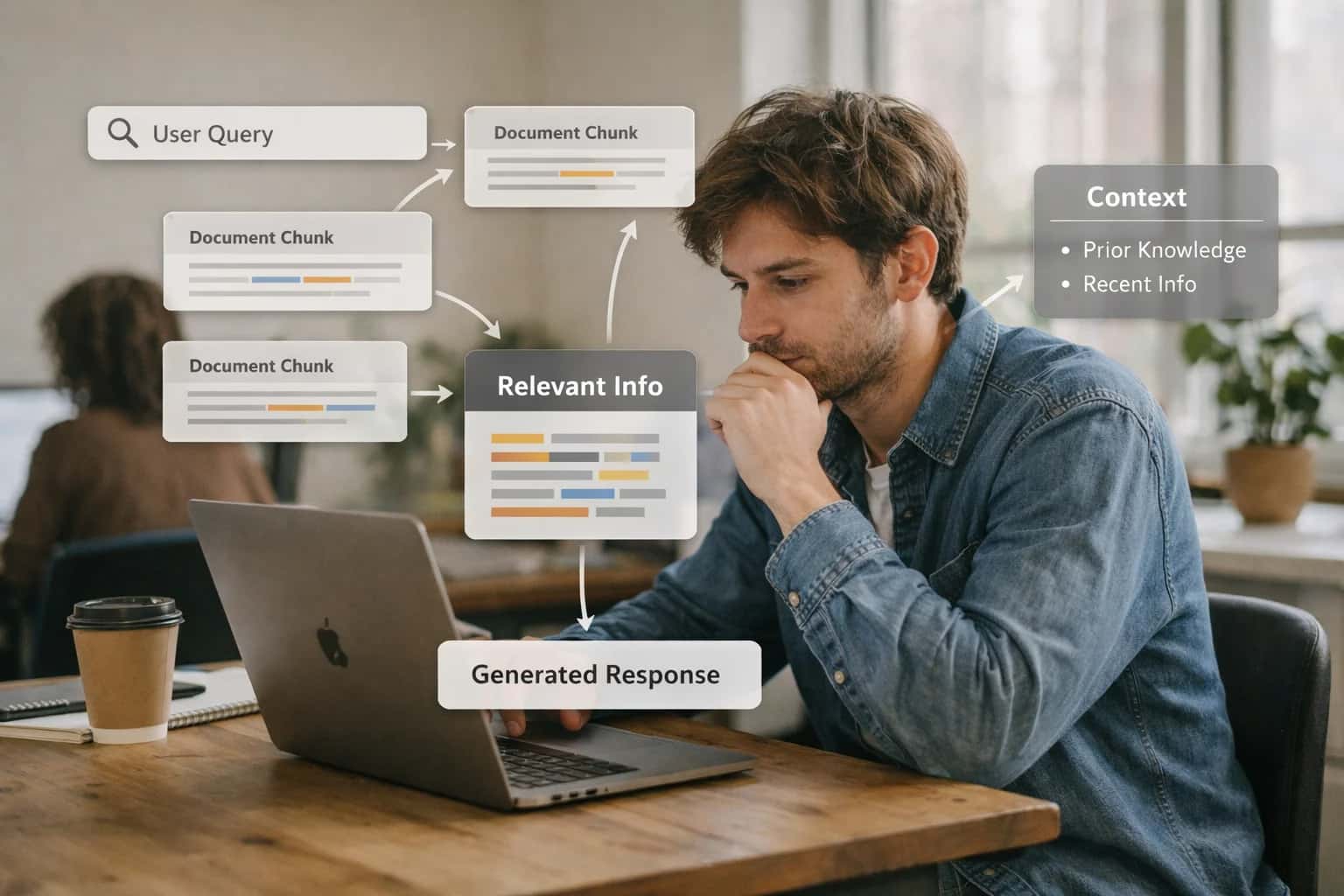
In Retrieval-Augmented Generation systems, the staleness threshold directly impacts factual grounding quality. When a retriever surfaces documents exceeding their threshold, the generator risks producing hallucinations based on obsolete facts.
- Chunk-level staleness: Individual document chunks carry independent freshness stamps, allowing partial invalidation
- Corpus-level staleness: An entire knowledge base is flagged when a critical mass of documents expire
- Mitigation: Combining staleness checks with contradiction detection—if fresh sources contradict a stale chunk, the stale chunk is suppressed even if within its nominal window
05
Staleness vs. Calibration Drift
While related, staleness and calibration drift are distinct failure modes:
- Staleness: The input data is too old to be reliable. The model itself may be perfectly calibrated, but it's operating on expired information.
- Calibration drift: The model's confidence estimates no longer match its actual accuracy due to distribution shift in the world, even if the input data is fresh.
A robust system monitors both: staleness thresholds for data inputs and Expected Calibration Error (ECE) for model outputs. A model can be confidently wrong if fed stale data, or uncertainly right if suffering from drift.
06
Provenance Chain Integration
A staleness threshold is only as reliable as the metadata it evaluates. Integrating with a provenance chain ensures the timestamp itself hasn't been tampered with.
- Cryptographic timestamps: Using source attestation techniques to verify that a data freshness stamp is genuine and hasn't been backdated
- Content integrity chains: Hash-linked version histories that prove a document hasn't been silently updated without updating its timestamp
- Trust discounting: If a source has a history of serving stale data as fresh, its source authority rank is discounted, effectively tightening its staleness threshold
STALENESS THRESHOLD
Frequently Asked Questions
Explore the mechanics of temporal data reliability and how predefined expiration points prevent AI models from generating outputs based on obsolete information.
A staleness threshold is a predefined point in time or a decay score at which data is considered too old to be reliable, triggering its exclusion from AI retrieval or generation processes. It functions as a temporal gatekeeper within Retrieval-Augmented Generation (RAG) architectures and knowledge bases. When a document's Data Freshness Stamp exceeds this threshold, the system either re-fetches the source, reduces its Confidence Score, or purges it from the active context window. This mechanism directly combats temporal misinformation, ensuring that a model does not cite a deprecated API endpoint or a superseded financial regulation as current fact. The threshold is typically implemented as a comparison between the current system time and a validUntil metadata field, or by applying a Confidence Decay Function that gradually reduces the weight of aging data in semantic search results.
Enabling Efficiency, Speed & Accuracy
Intelligent Analysis, Decision & Execution
We build AI systems for teams that need search across company data, workflow automation across tools, or AI features inside products and internal software.
Talk to Us
Search across company data
Give teams answers from docs, tickets, runbooks, and product data with sources and permissions.
Useful when people spend too long searching or get different answers from different systems.
Enterprise searchRAGPermissions
Read more
Automate internal workflows
Use AI to route work, draft outputs, trigger actions, and keep approvals and logs in place.
Useful when repetitive work moves across multiple tools and teams.
AI agentsWorkflow automationGovernance
Read more
Add AI to products and internal tools
Build assistants, guided actions, or decision support into the software your team or customers already use.
Useful when AI needs to be part of the product, not a separate tool.
AI integrationDecision supportModel routing
Read more
About the author
Prasad Kumkar
CEO & MD, Inference Systems
Prasad Kumkar is the CEO & MD of Inference Systems and writes about AI systems architecture, LLM infrastructure, model serving, evaluation, and production deployment. Over 5+ years, he has worked across computer vision models, L5 autonomous vehicle systems, and LLM research, with a focus on taking complex AI ideas into real-world engineering systems.
His work and writing cover AI systems, large language models, AI agents, multimodal systems, autonomous systems, inference optimization, RAG, evaluation, and production AI engineering.
LinkedIn
Limited slotsGet a Free AI Consultation
Partnered with leading AI, data, and software stack.





How We Work
Custom AI workflows for your Business
One-fit-all AI don't work for modern businesses. At Inferensys, we aim to understand your business & custom requirements; which we use to define most efficient agentic workflows, the data, and the tools for your business.
01
Review the use case
We understand the task, the users, and where AI can actually help.
Read more02
Pick the right approach
We define what needs search, automation, or product integration.
Read more03
Build the first useful version
We implement the part that proves the value first.
Read more04
Improve from there
We add the checks and visibility needed to keep it useful.
Read moreThe first call is a practical review of your use case and the right next step.
Talk to Us