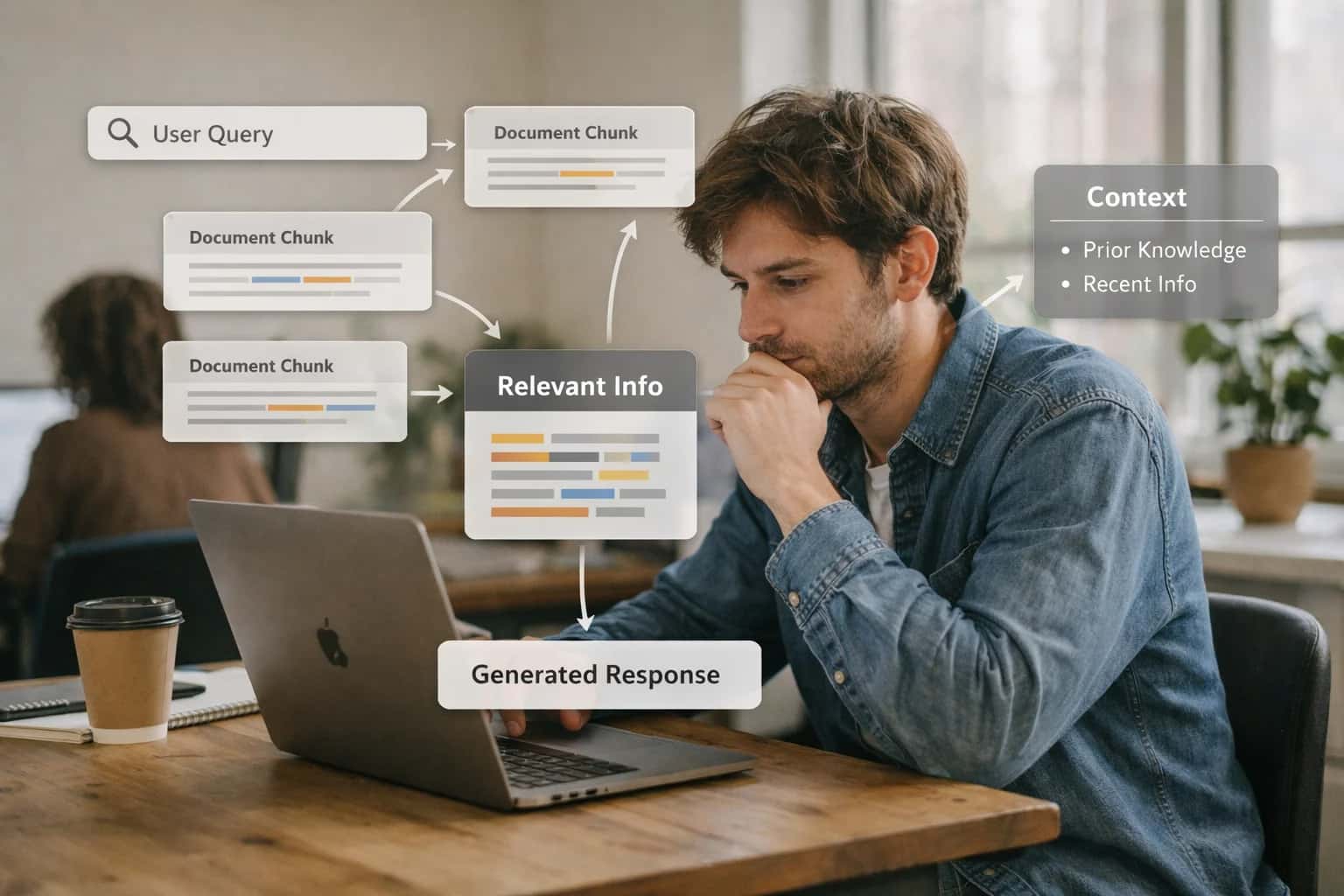
Source-of-Truth Anchoring is the architectural practice of designating a single, authoritative data repository as the definitive source for all downstream AI retrieval and citation tasks. This ensures that every Retrieval-Augmented Generation (RAG) system, agent, and model within an enterprise ecosystem queries the same validated dataset, eliminating conflicts between siloed databases and preventing attribution drift.

Glossary
Source-of-Truth Anchoring
The architectural practice of designating a single, authoritative data repository as the definitive source for all downstream AI retrieval and citation tasks.
DEFINITIVE DATA ARCHITECTURE
What is Source-of-Truth Anchoring?
The architectural practice of designating a single, authoritative data repository as the definitive source for all downstream AI retrieval and citation tasks.
By enforcing a strict provenance graph from the anchor point, organizations guarantee citation integrity across all generative outputs. This technical constraint requires robust provenance APIs and source verification protocols to validate that the anchored data remains the unaltered, canonical record, directly supporting confidence calibration in AI-generated answers.
ARCHITECTURAL PRINCIPLES
Key Characteristics of Source-of-Truth Anchoring
The foundational attributes that distinguish a true Source-of-Truth from a simple data silo, ensuring deterministic reliability for AI retrieval and citation tasks.
01
Singular Authority
The system is designated as the sole authoritative endpoint for a specific data domain. All other systems, including caches, data warehouses, and AI retrieval indexes, are considered derived replicas. This eliminates the data provenance ambiguity that causes AI models to cite conflicting or stale information. In practice, this means decommissioning legacy databases and enforcing a strict write-master policy where the Source-of-Truth is the only system accepting original creates, updates, and deletes.
02
Transactional Integrity
The repository must guarantee ACID compliance (Atomicity, Consistency, Isolation, Durability) to prevent the ingestion of partial or corrupt records into the AI pipeline. Without atomic transactions, a failure mid-write could leave a fact in an inconsistent state, causing an LLM to hallucinate based on a half-formed record. This characteristic mandates the use of databases with strong consistency guarantees rather than eventually consistent NoSQL stores for critical master data.
03
Immutable Data Lineage
Every fact in the source must carry a complete, queryable provenance trail including its origin timestamp, authoring system, and transformation history. This is distinct from standard logging; the lineage is a first-class property of the data itself, often implemented via bitemporal modeling that tracks both the valid time of the fact in the real world and the transaction time when it was recorded in the system. This allows an AI to cite not just the fact, but the specific temporal context of its truth.
04
Strict Schema Enforcement
The Source-of-Truth enforces a closed-world assumption through a rigid, versioned schema that validates all inbound data at write-time. Unlike a data lake that accepts raw, unstructured blobs, the anchoring system rejects any data that does not conform to its defined ontological model. This prevents semantic drift, where the meaning of a field changes over time, which is a primary cause of entity disambiguation failure in downstream AI retrieval tasks.
05
Programmatic Accessibility
The system must expose a high-performance, versioned API—typically gRPC or GraphQL—that serves as the exclusive channel for AI retrieval. Direct database access is forbidden. This abstraction layer allows the underlying physical model to evolve without breaking the AI's ability to cite it. The API also enforces authentication and rate limiting, ensuring that retrieval-augmented generation queries do not overwhelm the transactional system and cause latency spikes in operational applications.
06
Conflict-Free Replicated Data Types
For distributed architectures, the Source-of-Truth must implement CRDTs or similar deterministic conflict-resolution strategies to maintain a single, consistent view of data across geographic regions. This ensures that an AI model querying a local read-replica receives the exact same factual state as a model querying the primary node, preventing citation divergence where two AI instances provide different answers based on the same source due to replication lag.
SOURCE-OF-TRUTH ANCHORING
Frequently Asked Questions
Clear, concise answers to the most common questions about establishing a definitive data source for AI retrieval and citation.
Source-of-truth anchoring is the architectural practice of designating a single, authoritative data repository as the definitive source for all downstream AI retrieval and citation tasks. It works by establishing a canonical data endpoint—such as a specific database, API, or content management system—that all retrieval-augmented generation (RAG) pipelines and AI agents are forced to query first. This prevents the common problem of conflicting information arising from multiple, unsynchronized data copies. The anchor acts as a logical 'single source' that enforces data consistency across all AI-generated outputs. When a model needs to ground a claim, it retrieves from the anchored source, ensuring every citation traces back to a verified, managed origin rather than a stale cache or an unauthorized copy. This is implemented through strict retrieval routing rules in the AI orchestration layer, which programmatically deny access to non-anchored data silos for specific query types.
Enabling Efficiency, Speed & Accuracy
Intelligent Analysis, Decision & Execution
We build AI systems for teams that need search across company data, workflow automation across tools, or AI features inside products and internal software.
Talk to Us
Search across company data
Give teams answers from docs, tickets, runbooks, and product data with sources and permissions.
Useful when people spend too long searching or get different answers from different systems.
Enterprise searchRAGPermissions
Read more
Automate internal workflows
Use AI to route work, draft outputs, trigger actions, and keep approvals and logs in place.
Useful when repetitive work moves across multiple tools and teams.
AI agentsWorkflow automationGovernance
Read more
Add AI to products and internal tools
Build assistants, guided actions, or decision support into the software your team or customers already use.
Useful when AI needs to be part of the product, not a separate tool.
AI integrationDecision supportModel routing
Read more
About the author
Prasad Kumkar
CEO & MD, Inference Systems
Prasad Kumkar is the CEO & MD of Inference Systems and writes about AI systems architecture, LLM infrastructure, model serving, evaluation, and production deployment. Over 5+ years, he has worked across computer vision models, L5 autonomous vehicle systems, and LLM research, with a focus on taking complex AI ideas into real-world engineering systems.
His work and writing cover AI systems, large language models, AI agents, multimodal systems, autonomous systems, inference optimization, RAG, evaluation, and production AI engineering.
LinkedIn
Limited slotsGet a Free AI Consultation
Partnered with leading AI, data, and software stack.





How We Work
Custom AI workflows for your Business
One-fit-all AI don't work for modern businesses. At Inferensys, we aim to understand your business & custom requirements; which we use to define most efficient agentic workflows, the data, and the tools for your business.
01
Review the use case
We understand the task, the users, and where AI can actually help.
Read more02
Pick the right approach
We define what needs search, automation, or product integration.
Read more03
Build the first useful version
We implement the part that proves the value first.
Read more04
Improve from there
We add the checks and visibility needed to keep it useful.
Read moreThe first call is a practical review of your use case and the right next step.
Talk to Us