A Kalman Filter is a recursive algorithm that estimates the evolving state of a dynamic system from a series of noisy measurements over time. It operates in a two-step cycle: a prediction step, where the system's next state and uncertainty are projected forward using a process model, and an update step, where this prediction is corrected by incorporating a new, noisy observation using a statistically optimal weighting factor called the Kalman Gain.

Glossary
Kalman Filter
A recursive algorithm that optimally estimates the evolving state of a dynamic system from a series of noisy measurements, providing a predicted baseline for expected transaction behavior against which actual activity is compared for anomaly detection.
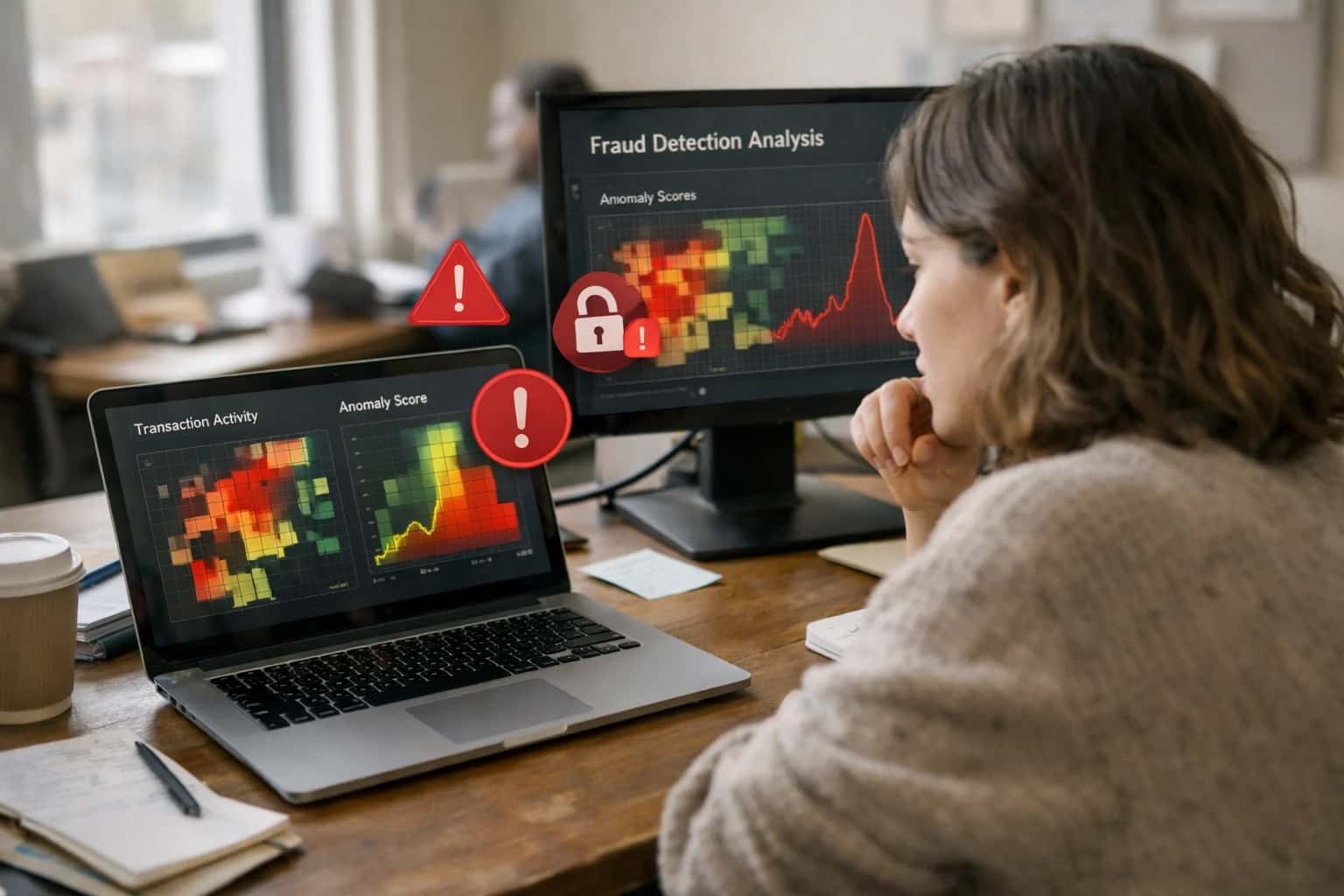
RECURSIVE STATE ESTIMATION
What is a Kalman Filter?
A foundational algorithm for optimal estimation in dynamic systems, widely used in financial fraud detection to predict expected transaction behavior from noisy observations.
In financial fraud anomaly detection, the Kalman Filter provides an optimal, dynamic baseline for a user's expected transaction amount. By modeling the transaction sequence as a linear dynamic system with Gaussian noise, the filter continuously adapts its estimate of a user's spending mean and variance. A significant deviation between the predicted amount and an actual transaction, measured against the filter's own estimated uncertainty, generates a robust, probabilistic anomaly score for real-time risk assessment.
RECURSIVE STATE ESTIMATION
Core Characteristics of the Kalman Filter
The Kalman filter is a recursive algorithm that estimates the evolving state of a dynamic system from a series of noisy measurements over time. In fraud detection, it provides an optimal prediction of a user's expected transaction amount against which to compare actual activity.
01
Recursive Prediction-Correction Cycle
The Kalman filter operates through a continuous two-step recursive loop. In the prediction step, the filter projects the current state estimate and its uncertainty forward to the next time step using a process model. In the update (correction) step, it incorporates a new noisy measurement, weighting it against the prediction based on their relative uncertainties via the Kalman gain. This gain dynamically balances trust between the model's forecast and the actual observation, making the filter optimal for linear Gaussian systems.
02
Optimality Under Gaussian Noise
The Kalman filter is the minimum mean-square error (MMSE) estimator for linear dynamic systems with additive white Gaussian noise. It assumes that both the process noise (model uncertainty) and measurement noise (sensor or data noise) follow zero-mean Gaussian distributions. Under these conditions, no other algorithm can produce a more accurate state estimate. For financial transaction monitoring, this means the filter provides the statistically optimal baseline for expected spending behavior when the underlying dynamics are approximately linear.
03
State Space Representation
The filter models a system using a state space formulation with two equations:
- State transition equation:
x_k = F * x_{k-1} + w_k— describes how the hidden state evolves over time. - Observation equation:
z_k = H * x_k + v_k— maps the hidden state to the observable measurement.
In fraud detection, the state x_k might represent a user's latent spending propensity, while z_k is the observed transaction amount. The matrices F and H define the linear dynamics and measurement mapping respectively.
04
Uncertainty Quantification via Covariance
A defining feature of the Kalman filter is that it maintains and propagates a covariance matrix P alongside the state estimate. This matrix quantifies the uncertainty in every dimension of the estimated state. After each update, the covariance shrinks, reflecting increased confidence. During prediction, it grows, reflecting accumulated uncertainty. This provides a principled, probabilistic anomaly score: if an observed transaction falls far outside the predicted distribution defined by the state and its covariance, it is flagged as suspicious.
05
Kalman Gain Dynamics
The Kalman gain K is the critical computational heart of the filter, calculated as:
K = P_pred * H^T * (H * P_pred * H^T + R)^{-1}
It determines the weight given to the new measurement versus the prediction. When measurement noise R is high, the gain is low, and the filter trusts its prediction more. When prediction uncertainty P_pred is high, the gain is high, and the filter rapidly adapts to new measurements. This adaptive behavior is essential for tracking users whose spending patterns gradually shift over time.
06
Extensions for Non-Linear Finance
Standard Kalman filters assume linear dynamics, which may not hold for complex financial behavior. Two key extensions address this:
- Extended Kalman Filter (EKF): Linearizes the system around the current estimate using Jacobian matrices, suitable for mildly non-linear transaction patterns.
- Unscented Kalman Filter (UKF): Uses a deterministic sampling technique (the unscented transform) to propagate sigma points through the non-linear function, avoiding linearization errors and providing superior accuracy for highly non-linear spending models.
KALMAN FILTER ESSENTIALS
Frequently Asked Questions
Concise answers to the most common technical questions about the Kalman filter and its application in financial fraud anomaly detection.
A Kalman filter is a recursive algorithm that estimates the evolving state of a dynamic system from a series of noisy measurements over time. It operates in a two-step cycle: the prediction step projects the current state and uncertainty forward using a process model, and the update step corrects that prediction by incorporating a new, noisy measurement, weighted by the Kalman gain. The gain optimally balances trust between the model's prediction and the actual observation based on their respective covariances. In fraud detection, the filter maintains a running estimate of a user's expected transaction amount and its variance, flagging a transaction as anomalous when the actual value deviates significantly from the predicted distribution.
SEQUENTIAL STATE ESTIMATION COMPARISON
Kalman Filter vs. Alternative Temporal Models
A technical comparison of the Kalman filter against other temporal sequence modeling approaches for financial fraud anomaly detection, evaluating their suitability for real-time state estimation and behavioral baselining.
| Feature | Kalman Filter | LSTM | Hidden Markov Model | Temporal Point Process |
|---|---|---|---|---|
Core Mechanism | Recursive Bayesian state estimation with predict-update cycle | Gated recurrent neural network with cell state memory | Probabilistic finite state machine with hidden states and emissions | Stochastic process modeling event timing in continuous time |
State Representation | Continuous latent state vector (e.g., mean transaction amount, velocity) | High-dimensional learned hidden state via gating mechanisms | Discrete categorical hidden states with emission probabilities | Conditional intensity function over time |
Handles Noisy Observations | ||||
Real-Time Online Inference | ||||
Explicit Uncertainty Quantification | ||||
Captures Long-Range Dependencies | ||||
Interpretability | High — state covariance matrix and Kalman gain are directly inspectable | Low — black-box hidden state with limited explainability | Moderate — discrete states map to interpretable behavioral modes | Moderate — intensity function parameters are interpretable |
Computational Complexity | O(d²) per step where d is state dimension | High — requires backpropagation through time for training | O(N²) for N hidden states with full transition matrix | O(n log n) for n events with parametric intensity |
Enabling Efficiency, Speed & Accuracy
Intelligent Analysis, Decision & Execution
We build AI systems for teams that need search across company data, workflow automation across tools, or AI features inside products and internal software.
Talk to Us
Search across company data
Give teams answers from docs, tickets, runbooks, and product data with sources and permissions.
Useful when people spend too long searching or get different answers from different systems.
Enterprise searchRAGPermissions
Read more
Automate internal workflows
Use AI to route work, draft outputs, trigger actions, and keep approvals and logs in place.
Useful when repetitive work moves across multiple tools and teams.
AI agentsWorkflow automationGovernance
Read more
Add AI to products and internal tools
Build assistants, guided actions, or decision support into the software your team or customers already use.
Useful when AI needs to be part of the product, not a separate tool.
AI integrationDecision supportModel routing
Read more
About the author
Prasad Kumkar
CEO & MD, Inference Systems
Prasad Kumkar is the CEO & MD of Inference Systems and writes about AI systems architecture, LLM infrastructure, model serving, evaluation, and production deployment. Over 5+ years, he has worked across computer vision models, L5 autonomous vehicle systems, and LLM research, with a focus on taking complex AI ideas into real-world engineering systems.
His work and writing cover AI systems, large language models, AI agents, multimodal systems, autonomous systems, inference optimization, RAG, evaluation, and production AI engineering.
LinkedIn
Limited slotsGet a Free AI Consultation
Partnered with leading AI, data, and software stack.





How We Work
Custom AI workflows for your Business
One-fit-all AI don't work for modern businesses. At Inferensys, we aim to understand your business & custom requirements; which we use to define most efficient agentic workflows, the data, and the tools for your business.
01
Review the use case
We understand the task, the users, and where AI can actually help.
Read more02
Pick the right approach
We define what needs search, automation, or product integration.
Read more03
Build the first useful version
We implement the part that proves the value first.
Read more04
Improve from there
We add the checks and visibility needed to keep it useful.
Read moreThe first call is a practical review of your use case and the right next step.
Talk to Us