Device fingerprinting is the process of aggregating numerous client-side attributes—including browser type, installed fonts, operating system version, screen resolution, timezone, and WebGL rendering parameters—to construct a unique hash or identifier. Unlike cookies, this identifier is stateless and persists even when local storage is cleared, making it a critical signal for persistent session linking in real-time fraud scoring pipelines.

Glossary
Device Fingerprinting
A technique that collects attributes of a remote computing device, such as browser configuration and operating system, to generate a unique identifier for fraud detection and session linking.
PASSIVE IDENTIFICATION
What is Device Fingerprinting?
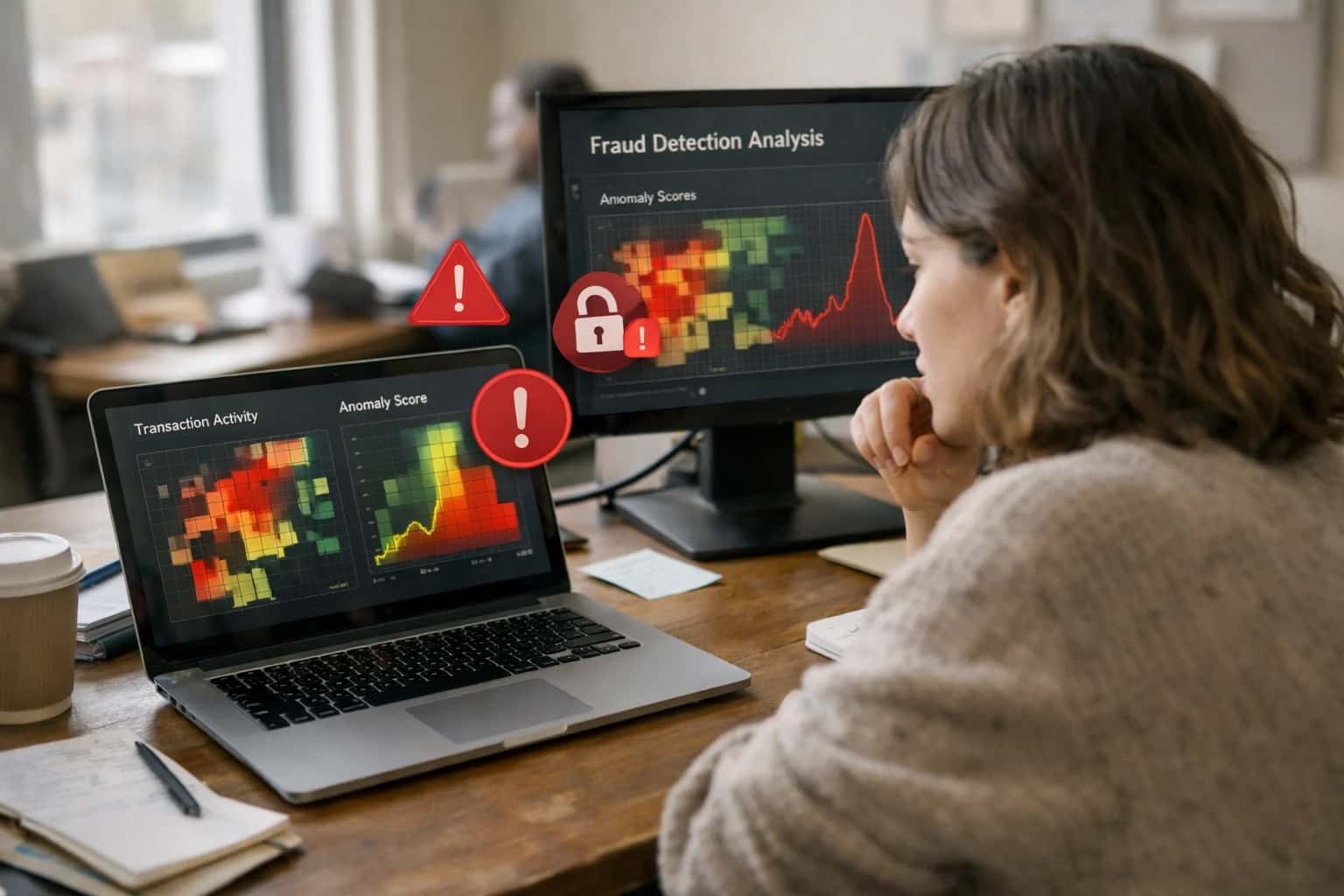
Device fingerprinting is a passive identification technique that collects and analyzes the unique attributes of a remote computing device to generate a stable, quasi-unique identifier for fraud detection and session linking.
In financial fraud anomaly detection, the fingerprint is ingested during the authorization flow via a lightweight JavaScript snippet or mobile SDK. The collected entropy is transmitted to a risk scoring engine, where it is joined with streaming transaction data to detect mismatches, such as a known device suddenly operating behind a proxy or exhibiting bot-like behavioral biometrics, enabling the circuit breaker to block the transaction before authorization.
PASSIVE IDENTIFICATION
Core Characteristics of Device Fingerprinting
Device fingerprinting constructs a unique identifier from the composite attributes of a remote device, enabling persistent session linking and fraud detection without relying on cookies or explicit user input.
01
Passive Attribute Collection
The process gathers over 100 distinct signals from the browser, operating system, and hardware stack without user awareness.
- Browser Attributes: User-agent string, HTTP headers, installed fonts, and plugin lists.
- Hardware Fingerprints: Canvas rendering output, WebGL vendor strings, and audio stack characteristics.
- Network Context: IP address, timezone offset, and WebRTC leak detection. This silent collection creates a rich data vector that is extremely difficult to spoof consistently.
02
Entropy and Uniqueness Calculation
The effectiveness of a fingerprint depends on its entropy, or the amount of identifying information it contains.
- Bits of Entropy: A single attribute like the user-agent may provide ~10 bits, while a full fingerprint can exceed 30 bits, uniquely identifying millions of devices.
- Hash Generation: The collected attributes are concatenated and passed through a cryptographic hash function to produce a stable, compact identifier.
- Probabilistic Matching: Advanced systems use fuzzy logic to re-identify a device even when some attributes change due to software updates.
03
Canvas and WebGL Fingerprinting
These advanced techniques exploit subtle differences in how graphics hardware renders images.
- Canvas Fingerprinting: The browser is instructed to draw a hidden text string or shape. Variations in anti-aliasing, sub-pixel rendering, and GPU drivers produce a unique pixel output.
- WebGL Probing: The system queries the device's GPU model and driver version, which are often highly unique, especially on corporate-managed hardware.
- AudioContext Analysis: Minute differences in audio signal processing hardware create a unique waveform signature.
04
Session Linking and Velocity Checks
The primary operational use of a fingerprint is to link a current session to a known history.
- Cross-Session Identity: A returning device is recognized even if cookies are cleared, incognito mode is used, or the IP address changes.
- Velocity Rules: The fingerprint becomes a key for velocity checks, counting how many transactions, account creations, or login attempts originate from a single device in a short time window.
- Bot Detection: Automated scripts often fail to execute JavaScript rendering tasks correctly, making fingerprinting a powerful tool for distinguishing bots from human-operated browsers.
05
Anti-Spoofing and Consistency Checks
Sophisticated fraudsters attempt to randomize attributes to evade fingerprinting, requiring robust countermeasures.
- Inconsistency Detection: The system cross-references signals, such as a Linux user-agent string paired with a Windows-only font set, to flag spoofed environments.
- Browser Integrity Tests: Checks for the presence of automation tools like Puppeteer, Selenium, or PhantomJS by detecting modified JavaScript properties.
- Reputation Scoring: A device fingerprint is assigned a long-term reputation score based on its historical association with chargebacks, policy abuse, or confirmed fraud.
06
Privacy and Hash Salting
To balance fraud prevention with privacy regulations, raw attributes are never stored in plaintext.
- Salted Hashes: A secret, rotating salt is added to the fingerprint before hashing, preventing the identifier from being used as a cross-site tracking supercookie.
- Ephemeral Identifiers: Some implementations generate a new fingerprint hash for each session or merchant, limiting the scope of tracking.
- Data Minimization: Only the final hash and a minimal set of risk-relevant metadata are persisted; the raw browser attributes are discarded after computation.
DEVICE FINGERPRINTING
Frequently Asked Questions
Explore the technical mechanisms behind device fingerprinting, a critical passive signal for linking sessions and detecting sophisticated fraud in real-time scoring pipelines.
Device fingerprinting is a stateless identification technique that collects publicly available attributes from a remote computing device—such as browser type, operating system, installed fonts, screen resolution, and TCP/IP stack parameters—to generate a unique, persistent identifier without storing cookies. The process works by executing a JavaScript snippet or analyzing network headers to assemble a hash of configuration data. Because the combination of these seemingly generic attributes is highly unique, the resulting fingerprint can re-identify a device across sessions, incognito modes, and even after cookie clearing. In fraud detection, this identifier links a current transaction to a known history of risky behavior, enabling velocity checks and session linking even when the user attempts to appear anonymous.
IDENTIFICATION METHOD COMPARISON
Device Fingerprinting vs. Other Identification Methods
A technical comparison of device fingerprinting against cookies, browser fingerprinting, and behavioral biometrics for session linking and fraud detection
| Feature | Device Fingerprinting | Browser Fingerprinting | Cookies | Behavioral Biometrics |
|---|---|---|---|---|
Data Source | OS, hardware, network stack, installed fonts, canvas rendering | Browser configuration, user agent, screen resolution, plugins | HTTP headers set by server and stored client-side | Keystroke dynamics, mouse movement, touch pressure, scroll patterns |
Persistence Across Sessions | ||||
Survives Cookie Clearing | ||||
Cross-Browser Identification | ||||
User Consent Required Under GDPR | ||||
Spoofing Resistance | High (hardware-level entropy) | Medium (canvas fingerprinting mitigations exist) | Low (trivially deleted or modified) | Very High (requires mimicking unique motor patterns) |
Uniqueness Entropy | ~18-20 bits | ~10-15 bits | ~5-10 bits | ~12-16 bits |
Typical Latency for Identification | < 100 ms | < 50 ms | < 5 ms | 2-10 seconds (requires interaction data) |
Enabling Efficiency, Speed & Accuracy
Intelligent Analysis, Decision & Execution
We build AI systems for teams that need search across company data, workflow automation across tools, or AI features inside products and internal software.
Talk to Us
Search across company data
Give teams answers from docs, tickets, runbooks, and product data with sources and permissions.
Useful when people spend too long searching or get different answers from different systems.
Enterprise searchRAGPermissions
Read more
Automate internal workflows
Use AI to route work, draft outputs, trigger actions, and keep approvals and logs in place.
Useful when repetitive work moves across multiple tools and teams.
AI agentsWorkflow automationGovernance
Read more
Add AI to products and internal tools
Build assistants, guided actions, or decision support into the software your team or customers already use.
Useful when AI needs to be part of the product, not a separate tool.
AI integrationDecision supportModel routing
Read more
About the author
Prasad Kumkar
CEO & MD, Inference Systems
Prasad Kumkar is the CEO & MD of Inference Systems and writes about AI systems architecture, LLM infrastructure, model serving, evaluation, and production deployment. Over 5+ years, he has worked across computer vision models, L5 autonomous vehicle systems, and LLM research, with a focus on taking complex AI ideas into real-world engineering systems.
His work and writing cover AI systems, large language models, AI agents, multimodal systems, autonomous systems, inference optimization, RAG, evaluation, and production AI engineering.
LinkedIn
Limited slotsGet a Free AI Consultation
Partnered with leading AI, data, and software stack.





How We Work
Custom AI workflows for your Business
One-fit-all AI don't work for modern businesses. At Inferensys, we aim to understand your business & custom requirements; which we use to define most efficient agentic workflows, the data, and the tools for your business.
01
Review the use case
We understand the task, the users, and where AI can actually help.
Read more02
Pick the right approach
We define what needs search, automation, or product integration.
Read more03
Build the first useful version
We implement the part that proves the value first.
Read more04
Improve from there
We add the checks and visibility needed to keep it useful.
Read moreThe first call is a practical review of your use case and the right next step.
Talk to Us