Data enrichment is the real-time process of joining a sparse transaction event with supplementary contextual data from external services to create a comprehensive risk profile. This involves performing stream-table joins against reference data stores, calling third-party APIs for device fingerprinting or IP geolocation, and checking entities against sanctions and watchlist databases, all before the model scores the event.

Glossary
Data Enrichment
The process of augmenting a raw transaction event in real-time with additional contextual data from external services, such as device fingerprints, geolocation, or watchlist status, to improve fraud detection accuracy.
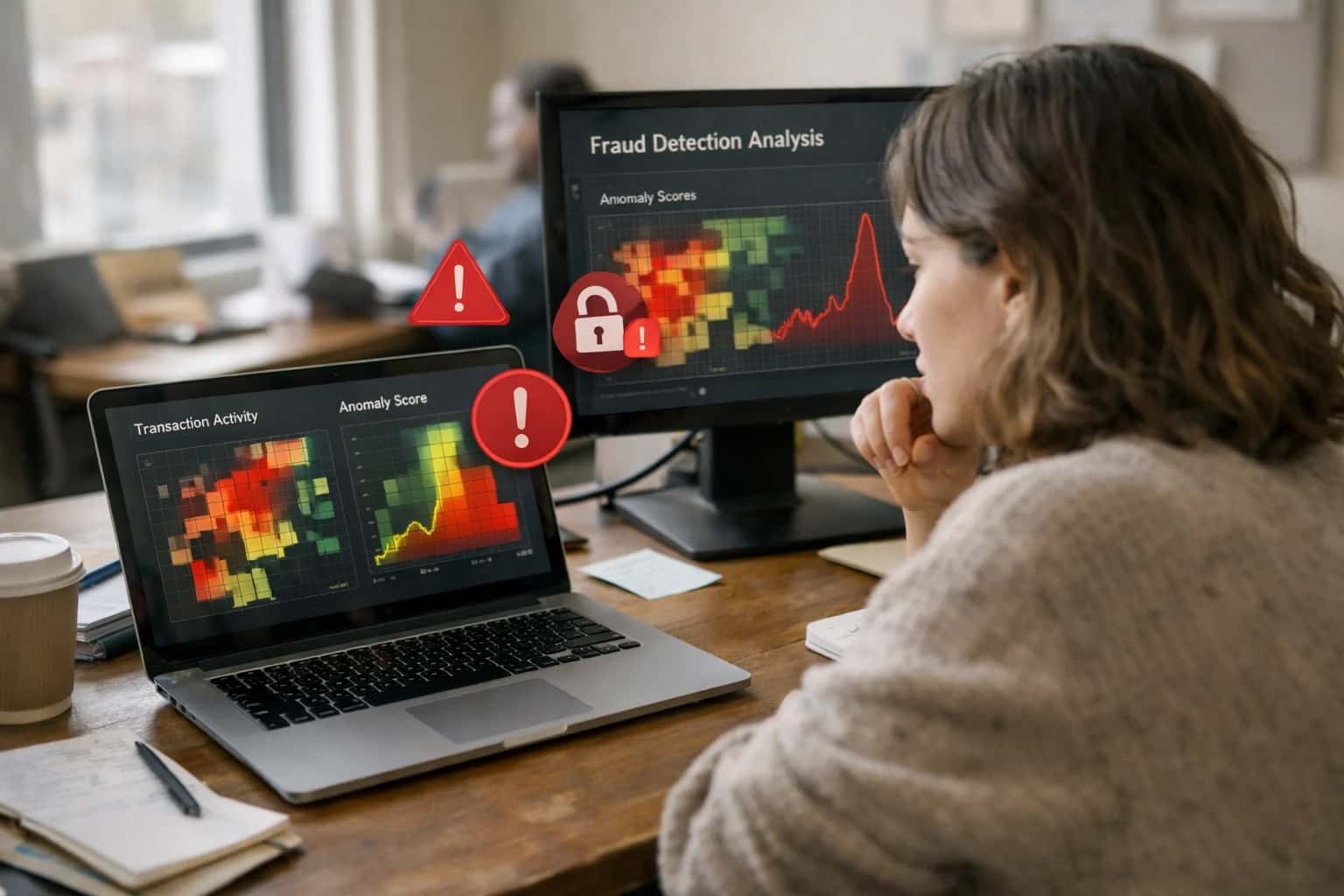
REAL-TIME CONTEXT AUGMENTATION
What is Data Enrichment?
Data enrichment is the process of augmenting a raw transaction event in real-time with additional contextual data from external services, such as device fingerprints, geolocation, or watchlist status, to enhance the accuracy of downstream fraud detection models.
The primary engineering challenge is executing these lookups within the strict P99 latency budget of the authorization flow, typically under 50 milliseconds. To prevent cascading failures, implementations rely on the circuit breaker pattern to gracefully degrade when an external enrichment service is unavailable, ensuring the core scoring pipeline remains operational even with partial data.
REAL-TIME CONTEXTUAL AUGMENTATION
Key Characteristics of Data Enrichment
Data enrichment transforms a raw, sparse transaction event into a rich, multi-dimensional profile by joining it with external reference data and derived features in real-time. This process is critical for providing machine learning models with the necessary context to distinguish legitimate behavior from sophisticated fraud.
01
External Service Integration
The core mechanism involves calling external, specialized APIs during the authorization flow to fetch contextual data not present in the base transaction message. This must occur within the strict P99 latency budget.
- Device Fingerprinting: Ingests browser, OS, and TCP/IP stack attributes to generate a persistent visitor ID, detecting session hijacking.
- Geolocation Services: Translates raw IP addresses into coarse geographic coordinates and network types (e.g., hosting center vs. residential ISP).
- Watchlist & Sanctions Screening: Checks transacting entities against global AML, PEP, and sanctions databases in real-time.
< 50 ms
Typical API Call Budget
02
Stream-Table Join Mechanics
A fundamental pattern in stream processing where a fast-moving event stream (transactions) is joined against a slowly changing reference table (account profiles, merchant category codes).
- State Store: A local, in-memory database (often RocksDB) holds the reference table to avoid network calls for every join.
- Change Data Capture (CDC): Keeps the state store synchronized with the source-of-truth database in near real-time, ensuring enrichment data is fresh.
- Example: Joining a transaction stream with a merchant table to add the merchant's historical fraud rate and business category.
03
Probabilistic Data Structures for Velocity
To compute high-cardinality velocity checks without massive memory overhead, enrichment layers use space-efficient, probabilistic data structures.
- Bloom Filter: Efficiently checks if a credit card has been seen on a specific device in the last 24 hours. It guarantees 'definitely not seen' but allows for a tunable false-positive rate.
- Count-Min Sketch: Estimates the frequency of events (e.g., transactions per IP address) in a sub-linear space, providing an approximate count that is always an overestimate.
- HyperLogLog: Accurately estimates the cardinality of unique elements (e.g., distinct email addresses per device) with minimal memory.
04
Feature Store Serving
A feature store acts as a centralized platform to serve pre-computed, governed features for online enrichment, preventing training-serving skew.
- Online Store: A low-latency key-value store (e.g., Redis, DynamoDB) optimized for point lookups during inference.
- Feature Reuse: Features like 'average transaction amount over 7 days' are computed once and served consistently to both training pipelines and the real-time scoring engine.
- Point-in-Time Correctness: Ensures that the enrichment data used for online inference perfectly mirrors the historical data logic used during model training.
05
Graph-Based Contextual Enrichment
Beyond flat attributes, enrichment can involve querying a Graph Neural Network (GNN) backend to add relational context.
- Entity Resolution: Links the incoming transaction to a unified customer 360-degree profile, resolving identity across multiple cards or accounts.
- Link Prediction: Queries a pre-computed graph to determine the shortest path or connection strength between the current buyer and known fraudulent entities.
- Community Detection: Tags the transaction with an identifier for the broader behavioral cluster or fraud ring the entity belongs to, enabling ring-level risk assessment.
06
Resiliency and Graceful Degradation
A critical characteristic of a robust enrichment pipeline is its ability to handle external service failure without blocking the transaction.
- Circuit Breaker Pattern: If a geolocation service starts timing out, the circuit breaker trips and stops calling it, preventing cascading latency.
- Fallback Defaults: When an external call fails, the pipeline injects a safe, neutral default value (e.g., 'unknown location') so the model can still score the event.
- Dead Letter Queue (DLQ): Malformed or un-enrichable messages are shunted to a DLQ for offline analysis, ensuring the main hot path remains clear.
DATA ENRICHMENT
Frequently Asked Questions
Explore the core concepts behind augmenting raw transaction events with contextual intelligence in real-time fraud detection pipelines.
Data enrichment is the process of augmenting a raw transaction event with additional contextual data from external services in real-time, before it reaches the risk scoring engine. A raw authorization request contains minimal fields like card number, amount, and merchant ID. Enrichment transforms this sparse event into a rich profile by joining it with device fingerprints, geolocation databases, watchlist statuses, and historical velocity counters. This contextual layering provides the machine learning model with the necessary features to distinguish a legitimate transaction from a sophisticated fraud attempt, all within the strict latency budget of the authorization flow.
REAL-TIME CONTEXTUAL AUGMENTATION
Examples of Data Enrichment in Fraud Detection
Data enrichment transforms a raw transaction event into a rich, multi-dimensional profile by joining it with external data sources in real-time. This process provides the critical context needed to distinguish legitimate behavior from sophisticated fraud.
01
Device Fingerprinting & Session Linkage
Augments a transaction with a persistent device identifier derived from browser attributes, operating system, and installed fonts. This enrichment links a new transaction to a known device history, enabling the detection of account takeover when a familiar account is accessed from a new device fingerprint. It also identifies bot activity by detecting headless browser configurations and emulated environments.
- Key attributes: Canvas hash, WebGL renderer, audio stack fingerprint
- Fraud signal: Mismatch between device geolocation and shipping address
- Velocity check: Number of accounts accessed from a single device in 24 hours
99.5%
Device Identification Accuracy
< 5 ms
Fingerprint Lookup Latency
02
Geolocation & IP Intelligence
Enriches the raw IP address with geospatial coordinates, autonomous system number (ASN) , and connection type (hosting, residential proxy, mobile carrier). This data exposes location spoofing via VPNs and proxy services. Cross-referencing the geolocation with the shipping address and billing zip code creates a distance-based risk factor.
- Proxy detection: Identifies traffic originating from known anonymization networks
- Impossible travel: Flags logins from locations physically unreachable within the time elapsed
- BIN geo-match: Verifies the issuing bank country matches the transaction origin
03
Watchlist & Sanctions Screening
Enriches transaction entities—payer name, beneficiary, business registration number—against global regulatory databases in real-time. This includes OFAC SDN lists, PEP (Politically Exposed Person) registries, and adverse media archives. The enrichment returns a match score and the specific list triggered, enabling automated blocking or manual review routing.
- Fuzzy matching: Handles transliteration variations and name permutations
- Batch screening: Re-screens entire customer bases when sanctions lists are updated
- Adverse media: Scans unstructured news for negative mentions linked to the entity
04
Merchant Category & Risk Profiling
Enriches the merchant ID or acquiring bank identifier with a MCC (Merchant Category Code) , historical chargeback ratios, and business reputation scores. This context identifies high-risk verticals such as crypto exchanges or online gaming. It also detects transaction laundering where a legitimate merchant processes payments for a hidden, prohibited business.
- Chargeback velocity: Compares merchant's dispute rate to industry benchmarks
- MCC mismatch: Flags when the purchase category contradicts the customer's historical behavior
- Shell company indicators: Checks business registration age and physical address validity
05
Behavioral Biometrics & Historical Profiling
Enriches the session with a behavioral profile built from historical transaction patterns: typical transaction amounts, preferred device types, average typing speed, and mouse dynamics. A deviation from this learned baseline—such as a sudden high-value wire transfer—triggers a step-up authentication challenge.
- Spend velocity: Compares current transaction amount to the user's 90-day rolling average
- Time-of-day anomaly: Flags transactions occurring outside the user's normal activity window
- Payee network analysis: Checks if the recipient is a known counterparty in the user's transaction graph
06
Phone & Email Reputation Scoring
Enriches contact details with carrier lookup, line type (VoIP, mobile, landline), email domain age, and breach database status. A phone number registered to a disposable VoIP service or an email address found in multiple data breaches is a strong indicator of synthetic identity fraud.
- SIM swap detection: Correlates recent carrier changes with high-risk transactions
- Email first-seen date: Flags email addresses created within the last 30 days
- Tenure mismatch: Compares the age of the email domain with the claimed account creation date
Enabling Efficiency, Speed & Accuracy
Intelligent Analysis, Decision & Execution
We build AI systems for teams that need search across company data, workflow automation across tools, or AI features inside products and internal software.
Talk to Us
Search across company data
Give teams answers from docs, tickets, runbooks, and product data with sources and permissions.
Useful when people spend too long searching or get different answers from different systems.
Enterprise searchRAGPermissions
Read more
Automate internal workflows
Use AI to route work, draft outputs, trigger actions, and keep approvals and logs in place.
Useful when repetitive work moves across multiple tools and teams.
AI agentsWorkflow automationGovernance
Read more
Add AI to products and internal tools
Build assistants, guided actions, or decision support into the software your team or customers already use.
Useful when AI needs to be part of the product, not a separate tool.
AI integrationDecision supportModel routing
Read moreDATA PREPARATION TECHNIQUES
Data Enrichment vs. Feature Engineering vs. Data Augmentation
A comparison of three distinct data preparation methodologies used in machine learning pipelines, clarifying their objectives, timing, and application in fraud detection systems.
| Feature | Data Enrichment | Feature Engineering | Data Augmentation |
|---|---|---|---|
Primary Objective | Add external context to existing records | Transform raw data into predictive signals | Artificially expand training dataset size |
Data Source | External services, third-party APIs, reference databases | Existing raw attributes within the dataset | Existing training samples (synthetic derivation) |
Timing in Pipeline | Pre-inference, real-time during transaction | Pre-training, offline batch processing | Pre-training, offline batch processing |
Adds New Information? | |||
Typical Latency Budget | < 50 ms (real-time lookup) | Batch hours (offline) | Batch hours (offline) |
Example in Fraud Detection | Appending device fingerprint risk score to a transaction | Calculating transaction velocity over a 10-minute window | Generating synthetic fraudulent transactions via SMOTE |
Output Artifact | Augmented event with external fields | Feature vector for model training | Expanded training dataset |
Dependency on External Services |

About the author
Prasad Kumkar
CEO & MD, Inference Systems
Prasad Kumkar is the CEO & MD of Inference Systems and writes about AI systems architecture, LLM infrastructure, model serving, evaluation, and production deployment. Over 5+ years, he has worked across computer vision models, L5 autonomous vehicle systems, and LLM research, with a focus on taking complex AI ideas into real-world engineering systems.
His work and writing cover AI systems, large language models, AI agents, multimodal systems, autonomous systems, inference optimization, RAG, evaluation, and production AI engineering.
LinkedIn
Limited slotsGet a Free AI Consultation
Partnered with leading AI, data, and software stack.





How We Work
Custom AI workflows for your Business
One-fit-all AI don't work for modern businesses. At Inferensys, we aim to understand your business & custom requirements; which we use to define most efficient agentic workflows, the data, and the tools for your business.
01
Review the use case
We understand the task, the users, and where AI can actually help.
Read more02
Pick the right approach
We define what needs search, automation, or product integration.
Read more03
Build the first useful version
We implement the part that proves the value first.
Read more04
Improve from there
We add the checks and visibility needed to keep it useful.
Read moreThe first call is a practical review of your use case and the right next step.
Talk to Us