Vendor Model Risk Management is the structured process of identifying, assessing, and mitigating the risks introduced by relying on third-party models for critical business decisions. It mandates that procured models undergo the same due diligence as internal builds, including independent validation of the vendor's development methodology, data provenance, and ongoing performance monitoring capabilities to ensure the model remains fit for purpose within the institution's specific operating context.

Glossary
Vendor Model Risk Management
The extension of the model risk framework to third-party supplied models, requiring due diligence on the vendor's development, validation, and data practices to ensure the procured model meets the same internal governance standards.
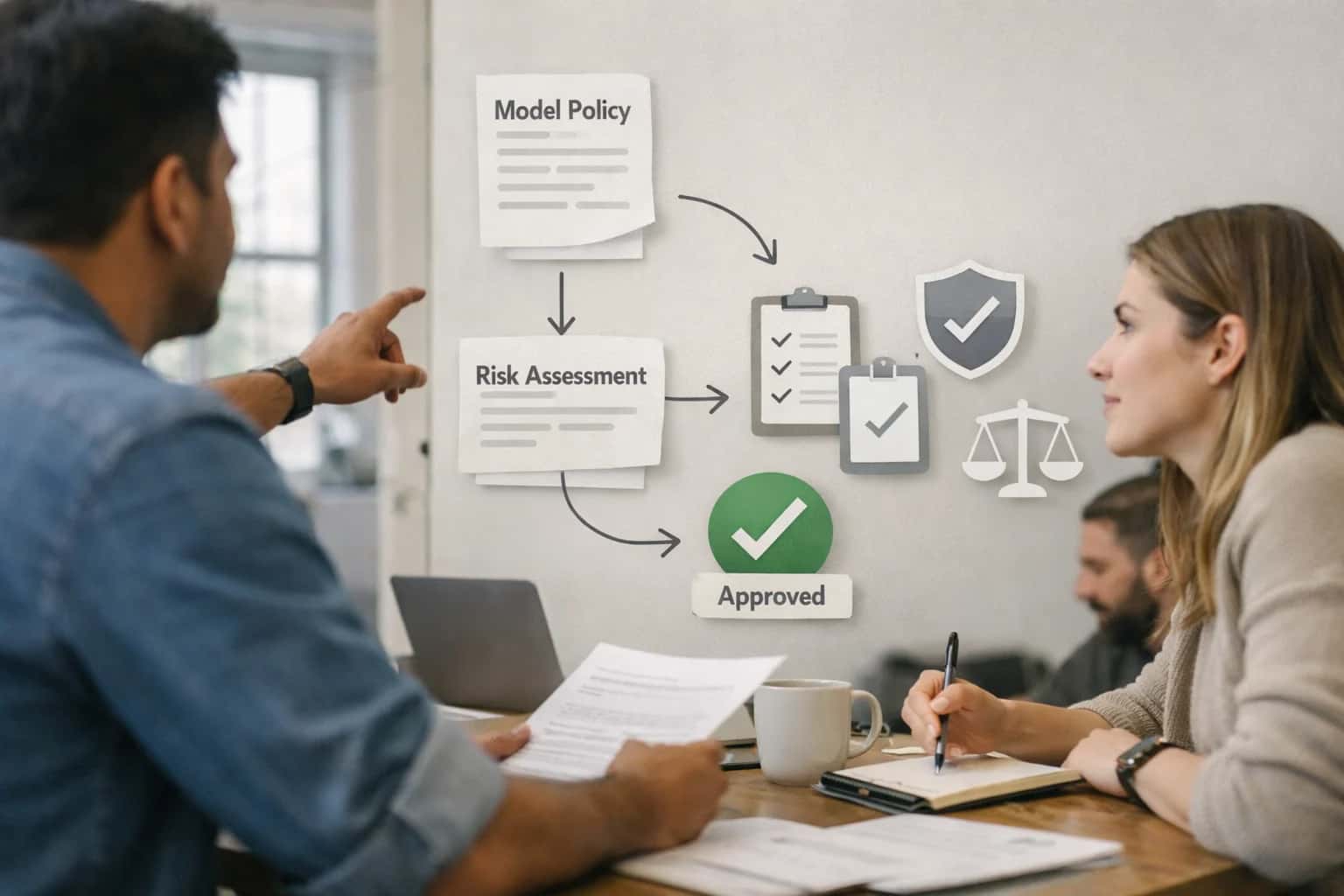
THIRD-PARTY MODEL GOVERNANCE
What is Vendor Model Risk Management?
Vendor Model Risk Management is the extension of an institution's internal model risk framework to third-party supplied models, algorithms, and data services, ensuring procured solutions meet the same rigorous governance, validation, and monitoring standards as internally developed models.
A robust framework requires contractual access to the vendor's model documentation, stress testing results, and data lineage records to prevent 'black-box' dependency. This governance extends to monitoring the vendor's own organizational stability and concentration risk, ensuring that a critical fraud detection pipeline does not fail due to a supplier's operational disruption or a change in their underlying modeling philosophy.
THIRD-PARTY MODEL OVERSIGHT
Key Components of Vendor MRM
A robust Vendor Model Risk Management framework extends internal governance standards to third-party supplied models, ensuring procured algorithms meet the same rigorous requirements for conceptual soundness, validation, and ongoing monitoring.
01
Vendor Due Diligence & Selection
The foundational process of evaluating a third-party model provider's development capabilities, validation practices, and data governance before procurement. This includes assessing the vendor's adherence to SR 11-7 equivalent standards, the transparency of their model documentation, and their willingness to support independent backtesting. A critical output is a risk-tiering assessment that classifies the vendor model based on its materiality and complexity, dictating the intensity of ongoing oversight required.
Tier 1-3
Risk Classification Levels
02
Contractual & SLA Governance
The legal and operational framework that codifies the vendor's obligations to support a rigorous MRM lifecycle. Contracts must explicitly guarantee access to model source code for internal validation, mandate notification triggers for concept drift or material changes, and define service-level agreements for latency and uptime in real-time scoring pipelines. This component ensures the vendor is contractually bound to facilitate shadow deployment testing and provide the data lineage necessary for internal audit trails.
99.99%
Typical Scoring Uptime SLA
03
Independent Outcome Validation
The technical process of independently verifying a vendor model's performance claims using the procuring institution's own holdout datasets and population stability indexes. This goes beyond accepting a vendor's model card to include rigorous disparate impact testing and fair lending analysis. The validation must benchmark the vendor model against an internally developed champion-challenger framework to empirically prove the third-party solution provides superior or equivalent efficacy without introducing new biases.
PSI < 0.1
Target Stability Index
04
Continuous Monitoring & Data Quality
The automated infrastructure for tracking vendor model health in production, which is complicated by the 'black box' nature of external supply. This requires monitoring both data drift on input features and concept drift on prediction distributions using real-time telemetry. A critical sub-component is the validation of the vendor's data quality dimensions—ensuring the accuracy, completeness, and timeliness of any external data feeds the model consumes do not silently degrade performance.
24/7
Monitoring Cadence
05
Contingency & Offboarding Planning
The pre-planned operational strategy for model failure or vendor termination, a critical regulatory expectation. This includes maintaining a fully validated champion-challenger alternative that can be activated immediately, ensuring no loss of lineage tracking on decisions made by the vendor model, and executing a secure data destruction protocol. The plan must detail how the institution will manage the audit trail and historical model attestation records after the vendor relationship ends.
< 4 hours
Maximum Failover Time
06
Regulatory Compliance Alignment
The systematic mapping of the vendor model's functionality to specific regulatory mandates such as the EU AI Act, SR 11-7, and fair lending requirements. This involves conducting a Fundamental Rights Impact Assessment for high-risk vendor AI and ensuring the vendor's algorithmic explainability methods—such as SHAP values or counterfactual explanations—meet the standard for human-in-the-loop review. It ensures the vendor's solution does not create an un-auditable gap in the institution's GRC posture.
VENDOR MODEL RISK
Frequently Asked Questions
Clear, technically precise answers to the most common questions about extending model risk management frameworks to third-party supplied models, including due diligence, validation, and ongoing monitoring requirements.
Vendor model risk management is the systematic extension of an institution's model risk management (MRM) framework to third-party supplied models, ensuring procured models meet the same governance, validation, and monitoring standards as internally developed models. The primary distinction lies in information asymmetry: the purchasing institution lacks direct access to the vendor's full development data, source code, and training pipelines. This necessitates a heavier reliance on proxy testing, documentation review, and contractual controls. Vendor MRM requires evaluating the supplier's own model development lifecycle, their data sourcing and lineage practices, and their ongoing maintenance commitments. The framework must also address concentration risk—where multiple institutions rely on the same vendor model, creating systemic vulnerability—and vendor lock-in risk, where switching costs become prohibitive. Regulatory guidance, including SR 11-7, explicitly holds the purchasing institution accountable for vendor model performance, meaning the responsibility cannot be outsourced alongside the model itself.
Enabling Efficiency, Speed & Accuracy
Intelligent Analysis, Decision & Execution
We build AI systems for teams that need search across company data, workflow automation across tools, or AI features inside products and internal software.
Talk to Us
Search across company data
Give teams answers from docs, tickets, runbooks, and product data with sources and permissions.
Useful when people spend too long searching or get different answers from different systems.
Enterprise searchRAGPermissions
Read more
Automate internal workflows
Use AI to route work, draft outputs, trigger actions, and keep approvals and logs in place.
Useful when repetitive work moves across multiple tools and teams.
AI agentsWorkflow automationGovernance
Read more
Add AI to products and internal tools
Build assistants, guided actions, or decision support into the software your team or customers already use.
Useful when AI needs to be part of the product, not a separate tool.
AI integrationDecision supportModel routing
Read more
About the author
Prasad Kumkar
CEO & MD, Inference Systems
Prasad Kumkar is the CEO & MD of Inference Systems and writes about AI systems architecture, LLM infrastructure, model serving, evaluation, and production deployment. Over 5+ years, he has worked across computer vision models, L5 autonomous vehicle systems, and LLM research, with a focus on taking complex AI ideas into real-world engineering systems.
His work and writing cover AI systems, large language models, AI agents, multimodal systems, autonomous systems, inference optimization, RAG, evaluation, and production AI engineering.
LinkedIn
Limited slotsGet a Free AI Consultation
Partnered with leading AI, data, and software stack.





How We Work
Custom AI workflows for your Business
One-fit-all AI don't work for modern businesses. At Inferensys, we aim to understand your business & custom requirements; which we use to define most efficient agentic workflows, the data, and the tools for your business.
01
Review the use case
We understand the task, the users, and where AI can actually help.
Read more02
Pick the right approach
We define what needs search, automation, or product integration.
Read more03
Build the first useful version
We implement the part that proves the value first.
Read more04
Improve from there
We add the checks and visibility needed to keep it useful.
Read moreThe first call is a practical review of your use case and the right next step.
Talk to Us