MLOps is the intersection of machine learning, DevOps, and data engineering, applying continuous integration and continuous delivery (CI/CD) principles to automate the ML pipeline. It orchestrates the reproducible training, rigorous validation, secure packaging, and low-latency deployment of models as scalable, maintainable production services.

Glossary
MLOps
MLOps (Machine Learning Operations) is a set of standardized engineering practices and tooling that streamlines the end-to-end lifecycle of machine learning models, from development and deployment to continuous monitoring and governance in production environments.
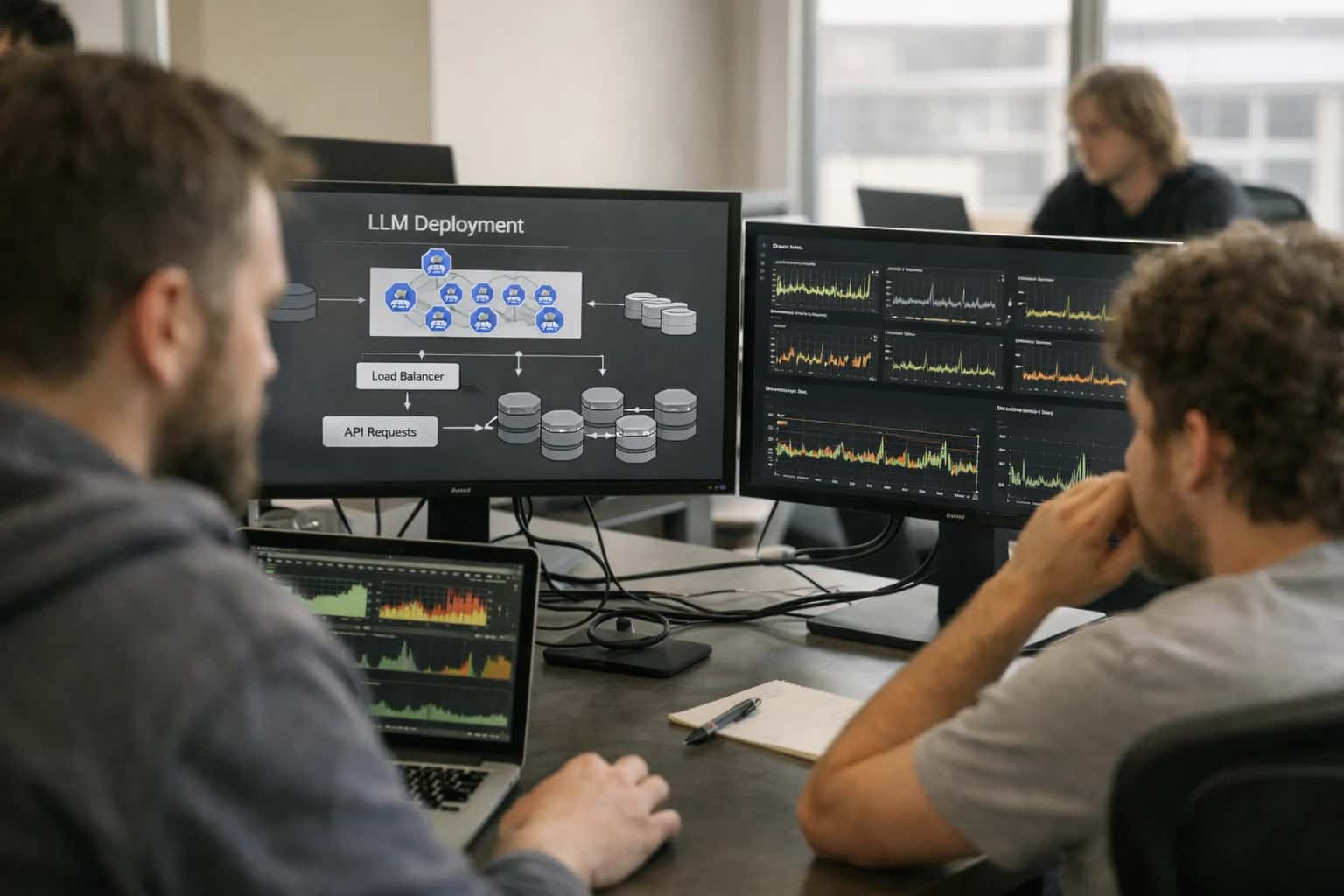
MACHINE LEARNING OPERATIONS
What is MLOps?
MLOps is the engineering discipline that standardizes and streamlines the end-to-end lifecycle of machine learning models, from initial development and training to reliable deployment, continuous monitoring, and governance in production environments.
The practice enforces model governance through automated monitoring for data drift and concept drift, triggering retraining or rollback workflows. By codifying infrastructure as code and tracking lineage, MLOps provides the auditable, repeatable processes required for high-stakes domains like financial fraud anomaly detection.
PRODUCTION MACHINE LEARNING ENGINEERING
Core Components of MLOps
MLOps standardizes the end-to-end lifecycle of machine learning models—from development and deployment to continuous monitoring and governance—ensuring reproducibility, scalability, and auditability in production environments.
01
Continuous Integration & Delivery (CI/CD) for ML
Extends traditional DevOps CI/CD pipelines to handle the unique artifacts of machine learning: datasets, model binaries, and experiment metadata. Unlike pure software CI/CD, ML pipelines must validate data schemas, run automated retraining jobs, and promote validated models to production. Key practices include:
- Automated testing of data quality and feature distributions before training
- Versioned build artifacts for both code and trained model weights
- Canary deployments that route a small percentage of inference traffic to new models
- Rollback mechanisms triggered by performance degradation alerts
< 1 hour
Target Lead Time for Model Updates
04
Continuous Monitoring & Drift Detection
Production monitoring systems that track the operational health and predictive quality of deployed models. They detect silent failures caused by changing data distributions. Key monitoring dimensions:
- Data drift: Statistical divergence of input features from the training baseline, measured via PSI or KS statistics
- Concept drift: Degradation in the relationship between inputs and the target variable
- Prediction drift: Shifts in the output distribution that may indicate model staleness
- Performance monitoring: Tracking precision, recall, and business KPIs against ground truth as labels become available
- Automated alerting and integration with retraining pipelines
24/7
Continuous Surveillance
06
Infrastructure & Environment Management
The provisioning and management of scalable, reproducible compute environments for training and inference. This component enforces environmental parity between development, staging, and production. Core elements:
- Containerization of model code and dependencies using Docker
- Orchestration of distributed training jobs across GPU clusters via Kubernetes
- Infrastructure-as-Code (IaC) for declarative, version-controlled resource provisioning
- Model serving frameworks that handle autoscaling, load balancing, and API exposure
- Secure secret management for accessing data sources and model registries
MLOPS IN FINANCIAL FRAUD DETECTION
Frequently Asked Questions
Clear, technically precise answers to the most common questions about operationalizing machine learning models for fraud detection in audited, high-stakes banking environments.
MLOps (Machine Learning Operations) is the set of standardized engineering practices and tooling that streamlines the end-to-end lifecycle of machine learning models—from development and deployment to continuous monitoring and governance in production environments. In financial fraud detection, MLOps is critical because fraud patterns are highly dynamic and adversarial. A model that is accurate today can be obsolete tomorrow due to concept drift as fraudsters adapt their techniques. MLOps provides the automated pipelines for:
- Continuous retraining on fresh transaction data to capture emerging fraud patterns
- Real-time model monitoring for data drift and performance degradation using metrics like the Population Stability Index (PSI)
- Auditable deployment trails that satisfy SR 11-7 regulatory requirements for model risk management
- Champion-challenger frameworks that allow safe A/B testing of new model variants against production traffic
Without mature MLOps, fraud detection models become stale, false positive rates climb, and the institution faces both financial loss and regulatory scrutiny for ungoverned model risk.
Enabling Efficiency, Speed & Accuracy
Intelligent Analysis, Decision & Execution
We build AI systems for teams that need search across company data, workflow automation across tools, or AI features inside products and internal software.
Talk to Us
Search across company data
Give teams answers from docs, tickets, runbooks, and product data with sources and permissions.
Useful when people spend too long searching or get different answers from different systems.
Enterprise searchRAGPermissions
Read more
Automate internal workflows
Use AI to route work, draft outputs, trigger actions, and keep approvals and logs in place.
Useful when repetitive work moves across multiple tools and teams.
AI agentsWorkflow automationGovernance
Read more
Add AI to products and internal tools
Build assistants, guided actions, or decision support into the software your team or customers already use.
Useful when AI needs to be part of the product, not a separate tool.
AI integrationDecision supportModel routing
Read moreOPERATIONAL PARADIGMS
MLOps vs. DevOps: Key Distinctions
A comparison of the core principles, artifacts, and monitoring requirements that distinguish traditional software delivery from production machine learning systems.
| Feature | DevOps | MLOps |
|---|---|---|
Primary Artifact | Compiled binary or container image | Trained model artifact with weights, hyperparameters, and data lineage |
Versioning Scope | Source code and environment configuration | Code, training data, hyperparameters, and model evaluation metrics |
Testing Paradigm | Unit, integration, and end-to-end functional tests | Functional tests plus model validation, fairness evaluation, and adversarial robustness checks |
Deployment Trigger | Code merge or release tag | Code merge, data change, model retraining completion, or performance degradation alert |
Continuous Integration Scope | Build, package, and validate software artifacts | Build, package, validate data schemas, and execute automated model retraining pipelines |
Production Monitoring | System health: latency, throughput, error rates, resource utilization | System health plus data drift, concept drift, prediction distribution skew, and model staleness |
Rollback Mechanism | Redeploy previous stable artifact version | Revert to a prior registered model version with its associated data and configuration snapshot |
Team Composition | Software engineers, release managers, SREs | Data scientists, ML engineers, data engineers, and domain experts alongside DevOps roles |

About the author
Prasad Kumkar
CEO & MD, Inference Systems
Prasad Kumkar is the CEO & MD of Inference Systems and writes about AI systems architecture, LLM infrastructure, model serving, evaluation, and production deployment. Over 5+ years, he has worked across computer vision models, L5 autonomous vehicle systems, and LLM research, with a focus on taking complex AI ideas into real-world engineering systems.
His work and writing cover AI systems, large language models, AI agents, multimodal systems, autonomous systems, inference optimization, RAG, evaluation, and production AI engineering.
LinkedIn
Limited slotsGet a Free AI Consultation
Partnered with leading AI, data, and software stack.





How We Work
Custom AI workflows for your Business
One-fit-all AI don't work for modern businesses. At Inferensys, we aim to understand your business & custom requirements; which we use to define most efficient agentic workflows, the data, and the tools for your business.
01
Review the use case
We understand the task, the users, and where AI can actually help.
Read more02
Pick the right approach
We define what needs search, automation, or product integration.
Read more03
Build the first useful version
We implement the part that proves the value first.
Read more04
Improve from there
We add the checks and visibility needed to keep it useful.
Read moreThe first call is a practical review of your use case and the right next step.
Talk to Us