Fraud ring detection is the computational process of identifying coordinated groups of malicious actors who collude to commit financial crime by analyzing the relational structure of a transaction graph. Unlike isolated fraud, rings exhibit synchronized behaviors, shared digital attributes, or cyclical money flows that form dense subgraphs. Community detection algorithms and graph neural networks are employed to surface these hidden clusters by examining multi-hop connections between seemingly unrelated accounts, devices, and merchants.

Glossary
Fraud Ring Detection
The application of graph algorithms and community detection to identify tightly-knit, coordinated groups of malicious actors who share resources or exhibit synchronized behavior to perpetrate organized financial crime.
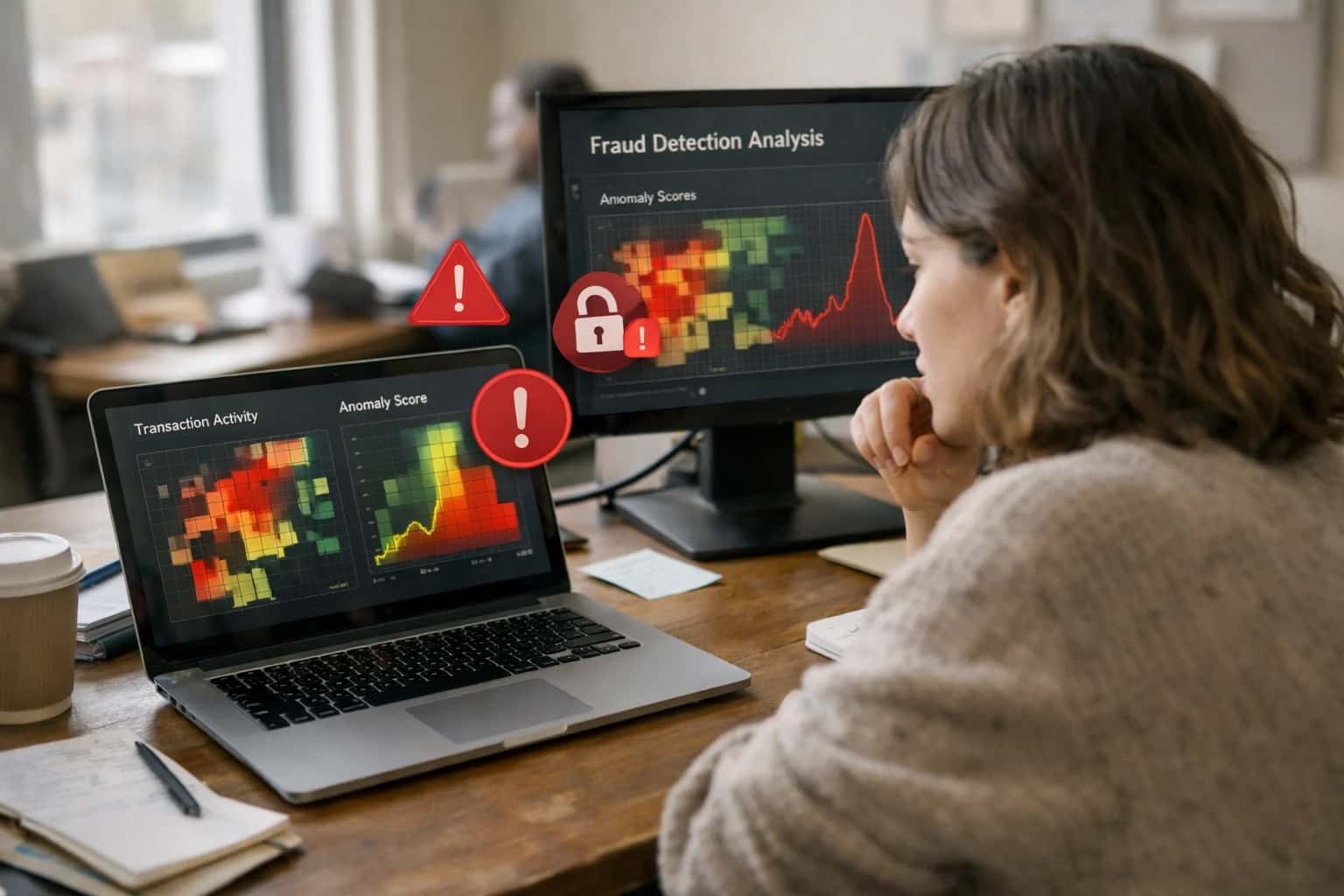
ORGANIZED FINANCIAL CRIME
What is Fraud Ring Detection?
Fraud ring detection is the application of graph algorithms and community detection techniques to identify tightly-knit, coordinated groups of malicious actors who share resources or exhibit synchronized behavior to perpetrate organized financial crime.
The core technical challenge lies in distinguishing legitimate dense communities—such as families or corporate departments—from fraudulent collusion rings. Advanced detection systems leverage link prediction to infer hidden conspirator relationships and graph anomaly detection to flag subgraphs whose structural patterns deviate from normal financial behavior. By modeling the topology of relationships rather than individual transactions, these systems dismantle the coordinated infrastructure underlying application fraud, bust-out schemes, and synthetic identity farms.
ARCHITECTURAL CAPABILITIES
Key Characteristics of Fraud Ring Detection Systems
Effective fraud ring detection systems must move beyond individual transaction scoring to model the coordinated, relational structure of organized financial crime. These systems leverage graph algorithms and community detection to surface tightly-knit groups exhibiting synchronized malicious behavior.
01
Community Detection Algorithms
The core engine for partitioning a transaction graph into densely connected clusters. Algorithms like Louvain, Label Propagation, and Infomap operate on the principle of modularity maximization, iteratively grouping nodes that share more edges with each other than with the rest of the network.
- Louvain Method: A hierarchical greedy algorithm that optimizes modularity to reveal communities at different scales of resolution.
- Statistical Significance: Effective systems filter out random clusters by comparing detected communities against a null model (e.g., a configuration model) to ensure the density is not a product of chance.
- Dynamic Re-computation: In production, communities must be re-calculated on sliding time windows to capture the ephemeral, fast-burning nature of modern fraud rings.
O(n log n)
Louvain Complexity
02
Shared Attribute Analysis
Fraud rings often coordinate using shared digital exhaust. Detection systems must correlate non-transactional attributes across seemingly separate accounts to establish covert links.
- Device Fingerprint Clustering: Identifying multiple accounts logging in from the same physical device or a common set of virtual machine fingerprints.
- Shared PII Fragments: Detecting the re-use of identical email domains, phone numbers, or physical address components across accounts with different names.
- Velocity of Attribute Change: Monitoring the rapid, synchronized updating of profile information (e.g., resetting passwords or changing shipping addresses) across a cohort of accounts within a short time window.
03
Synchronized Behavioral Patterns
Coordinated fraud manifests as temporal and behavioral lockstep. Systems must analyze the rate and rhythm of events across the network, not just the events themselves.
- Temporal Correlation: Detecting accounts that initiate transactions, log in, or trigger specific API calls within a tight, statistically improbable time delta.
- Identical Navigation Sequences: Identifying bots or scripted attacks by clustering users who traverse the same unique sequence of application pages with identical inter-event timings.
- Value Distribution Matching: Flagging rings that test stolen credentials by processing transactions of identical or systematically varied monetary amounts across a distributed set of merchant accounts.
04
Money Mule Network Topology
Sophisticated rings use layered networks of intermediary accounts (mules) to distance the fraudster from the final cash-out point. Detection requires analyzing the graph for specific structural signatures.
- Bipartite Core Detection: Identifying dense subgraphs where a set of "source" accounts funnels funds exclusively to a set of "sink" accounts, a classic money laundering pattern.
- Short-Path Centrality: Flagging newly created accounts that rapidly become central bridges between otherwise disconnected clusters, indicating a mule being positioned for value transfer.
- Fan-Out/Fan-In Patterns: Detecting a single source dispersing funds to many mules (fan-out) followed by many mules consolidating funds into a single destination (fan-in) within a compressed timeframe.
05
Graph-Based Feature Engineering
Raw graph topology is converted into predictive signals for downstream machine learning models. These features quantify an entity's role and risk within the network.
- Ego-Network Metrics: Calculating the density, triangle count, and average neighbor degree of an account's immediate 1-hop neighborhood to measure local cohesion.
- Centrality Scores: Using PageRank, betweenness centrality, and eigenvector centrality to identify influential nodes that act as hubs or critical bridges in the fraud ring's communication or transaction flow.
- Graphlet Degree Vectors: Counting the frequency of specific small subgraph patterns (graphlets) around a node to create a high-dimensional topological signature that distinguishes fraud ring members from normal users.
06
Holistic Ring Scoring & Alerting
The final output is not a list of individual risk scores but a consolidated, prioritized view of entire fraud rings. This reduces alert fatigue and enables decisive action.
- Subgraph Anomaly Scoring: Assigning a single risk score to an entire detected community based on its collective density, attribute coherence, and behavioral anomaly, rather than scoring members in isolation.
- Ring Leader Identification: Using centrality metrics within the suspicious subgraph to pinpoint the most structurally important nodes, guiding investigators to the orchestrators first.
- Explainable Ring Summaries: Generating a natural language or visual summary of the ring's structure, shared attributes, and synchronized actions to provide investigators with immediate, actionable context for the alert.
FRAUD RING DETECTION
Frequently Asked Questions
Explore the core concepts behind using graph algorithms and community detection to identify coordinated groups of malicious actors in financial networks.
A fraud ring is a coordinated group of malicious actors who collude to perpetrate organized financial crime by sharing resources, synthetic identities, or executing synchronized transaction patterns to evade individual detection. Unlike isolated fraudsters, rings operate as a cohesive unit, often distributing attack vectors across multiple accounts, devices, and geographies to mimic legitimate behavior. They exploit the weakness of siloed, rule-based systems that analyze entities in isolation. Structurally, a fraud ring manifests in a transaction graph as a densely connected subgraph or a bipartite core where a set of fraudulent accounts rapidly transacts with a set of controlled merchant accounts. Detection relies on identifying these anomalous topological structures, such as near-cliques or unusually high edge density, that deviate from the sparse, power-law distribution of normal financial networks. Their synchronized behavior—like simultaneous account creation, identical device fingerprints, or burst transactions—creates detectable temporal and structural signatures that graph algorithms are uniquely positioned to surface.
DETECTION PARADIGM COMPARISON
Fraud Ring Detection vs. Individual Anomaly Detection
A structural comparison of graph-based collusion analysis versus point-based behavioral scoring in financial crime detection systems.
| Feature | Fraud Ring Detection | Individual Anomaly Detection |
|---|---|---|
Primary Data Structure | Graph (nodes and edges) | Tabular feature vectors |
Core Analytical Unit | Relationships, communities, and subgraphs | Isolated entity behavior |
Key Algorithm Families | GNNs, community detection, link prediction | Isolation forests, autoencoders, one-class SVMs |
Temporal Modeling | Dynamic graph evolution and edge chronology | Sequential transaction vectors per entity |
Detection of Coordinated Activity | ||
Sensitivity to Shared Resources | ||
False Positive Rate on Sophisticated Rings | < 5% | 15-40% |
Interpretability Mechanism | Subgraph highlighting via GNNExplainer | Feature attribution via SHAP or LIME |
Computational Complexity | O(N²) for dense graphs | O(N log N) for tree-based methods |
Cold Start Performance | Degraded until graph density matures | Operational with minimal history |
Enabling Efficiency, Speed & Accuracy
Intelligent Analysis, Decision & Execution
We build AI systems for teams that need search across company data, workflow automation across tools, or AI features inside products and internal software.
Talk to Us
Search across company data
Give teams answers from docs, tickets, runbooks, and product data with sources and permissions.
Useful when people spend too long searching or get different answers from different systems.
Enterprise searchRAGPermissions
Read more
Automate internal workflows
Use AI to route work, draft outputs, trigger actions, and keep approvals and logs in place.
Useful when repetitive work moves across multiple tools and teams.
AI agentsWorkflow automationGovernance
Read more
Add AI to products and internal tools
Build assistants, guided actions, or decision support into the software your team or customers already use.
Useful when AI needs to be part of the product, not a separate tool.
AI integrationDecision supportModel routing
Read more
About the author
Prasad Kumkar
CEO & MD, Inference Systems
Prasad Kumkar is the CEO & MD of Inference Systems and writes about AI systems architecture, LLM infrastructure, model serving, evaluation, and production deployment. Over 5+ years, he has worked across computer vision models, L5 autonomous vehicle systems, and LLM research, with a focus on taking complex AI ideas into real-world engineering systems.
His work and writing cover AI systems, large language models, AI agents, multimodal systems, autonomous systems, inference optimization, RAG, evaluation, and production AI engineering.
LinkedIn
Limited slotsGet a Free AI Consultation
Partnered with leading AI, data, and software stack.





How We Work
Custom AI workflows for your Business
One-fit-all AI don't work for modern businesses. At Inferensys, we aim to understand your business & custom requirements; which we use to define most efficient agentic workflows, the data, and the tools for your business.
01
Review the use case
We understand the task, the users, and where AI can actually help.
Read more02
Pick the right approach
We define what needs search, automation, or product integration.
Read more03
Build the first useful version
We implement the part that proves the value first.
Read more04
Improve from there
We add the checks and visibility needed to keep it useful.
Read moreThe first call is a practical review of your use case and the right next step.
Talk to Us