Community detection algorithms identify densely connected subgraphs where internal edge density significantly exceeds external connections to the rest of the network. Unlike classification, this is an unsupervised learning task that discovers latent topological structures without predefined labels, using modularity optimization, spectral clustering, or label propagation to partition the graph into cohesive groups.

Glossary
Community Detection
The unsupervised partitioning of a graph into clusters of densely connected nodes, used to identify functional modules or suspiciously isolated groups within a larger financial transaction network.
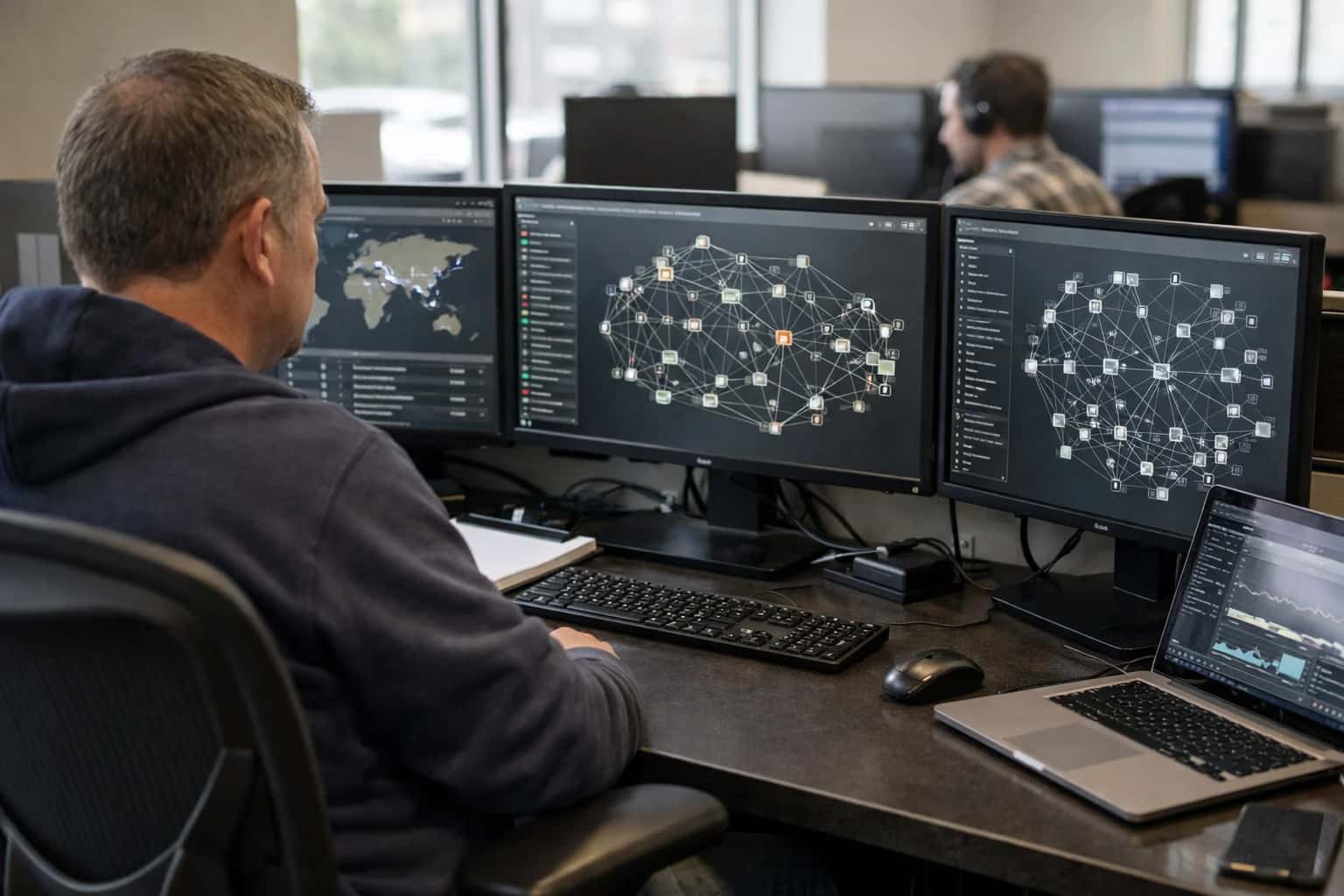
GRAPH PARTITIONING
What is Community Detection?
Community detection is the unsupervised process of partitioning a network graph into clusters of densely connected nodes, revealing functional modules or suspiciously isolated groups within complex systems like financial transaction networks.
In financial fraud anomaly detection, community detection isolates tightly-knit fraud rings exhibiting synchronized behavior, money laundering layering loops, or synthetic identity clusters that share device fingerprints. These algorithms serve as a critical preprocessing step for graph neural networks, enabling analysts to decompose massive transaction graphs into manageable, high-risk subgraphs for focused investigation.
STRUCTURAL PATTERNS
Key Characteristics of Community Detection
Community detection algorithms partition financial transaction graphs into densely connected clusters, revealing functional modules, fraud rings, and suspiciously isolated groups that would remain invisible in tabular data analysis.
01
Modularity Maximization
The foundational optimization approach that measures the density of intra-community edges compared to a randomized null model. Algorithms like the Louvain method iteratively merge nodes to maximize the modularity score Q, where higher values indicate stronger community structure. In financial graphs, high-modularity partitions often expose tightly-knit fraud rings with anomalous internal transaction density relative to the broader network.
02
Spectral Clustering on Graph Laplacians
A mathematically rigorous approach that computes the eigenvectors of the graph Laplacian matrix to embed nodes into a low-dimensional space where traditional clustering becomes effective. The Fiedler vector (second smallest eigenvector) provides an optimal bipartition. This technique excels at detecting subtle community boundaries in transaction networks where modularity-based methods struggle with resolution limits.
03
Hierarchical vs. Overlapping Detection
- Hierarchical methods (e.g., Girvan-Newman) produce dendrograms revealing nested community structures, useful for identifying sub-rings within larger fraud organizations.
- Overlapping methods (e.g., Clique Percolation) allow nodes to belong to multiple communities simultaneously, critical for detecting money mule accounts that bridge legitimate and fraudulent clusters.
- The choice depends on whether the fraud topology is strictly nested or exhibits cross-community bridging behavior.
04
Conductance and Cut-Based Metrics
Community quality is often evaluated using conductance—the ratio of edges leaving a community to total edges within it. Low conductance indicates a well-separated, insular group. In anti-money laundering, accounts forming communities with extremely low conductance relative to the overall graph may indicate deliberate isolation from legitimate financial activity, a hallmark of layering schemes.
05
Label Propagation for Scalability
A near-linear time algorithm where nodes iteratively adopt the majority label of their neighbors, converging to a stable community partition without requiring a pre-specified number of clusters. Its computational efficiency makes it suitable for real-time community detection on streaming transaction graphs with millions of edges, though it can produce non-deterministic results across runs.
06
Community Evolution and Temporal Tracking
In dynamic transaction graphs, communities are not static. Techniques like evolutionary clustering track community birth, death, merging, splitting, and resurgence over time. Monitoring these events enables detection of fraud rings that deliberately restructure to evade static detection—a community that suddenly splits into multiple sub-communities may be attempting to disperse suspicious activity patterns.
COMMUNITY DETECTION
Frequently Asked Questions
Clear, technically precise answers to the most common questions about applying community detection algorithms to financial transaction graphs for fraud ring identification and collusion analysis.
Community detection is the unsupervised algorithmic process of partitioning a graph into clusters (communities) of nodes that are more densely connected to each other than to the rest of the network. In a financial transaction graph, a community represents a group of accounts, merchants, or entities that exhibit disproportionately high interaction rates. The objective is to uncover latent organizational structures—such as fraud rings, money laundering cells, or coordinated bot networks—without prior labels. Algorithms optimize for high intra-community edge density and sparse inter-community connectivity. The foundational metric is modularity, which quantifies the strength of the partition by comparing observed edge density within communities against a random null model. High-modularity partitions in a transaction graph often correspond to functionally or maliciously coordinated groups operating in isolation from normal economic flow.
Enabling Efficiency, Speed & Accuracy
Intelligent Analysis, Decision & Execution
We build AI systems for teams that need search across company data, workflow automation across tools, or AI features inside products and internal software.
Talk to Us
Search across company data
Give teams answers from docs, tickets, runbooks, and product data with sources and permissions.
Useful when people spend too long searching or get different answers from different systems.
Enterprise searchRAGPermissions
Read more
Automate internal workflows
Use AI to route work, draft outputs, trigger actions, and keep approvals and logs in place.
Useful when repetitive work moves across multiple tools and teams.
AI agentsWorkflow automationGovernance
Read more
Add AI to products and internal tools
Build assistants, guided actions, or decision support into the software your team or customers already use.
Useful when AI needs to be part of the product, not a separate tool.
AI integrationDecision supportModel routing
Read more
About the author
Prasad Kumkar
CEO & MD, Inference Systems
Prasad Kumkar is the CEO & MD of Inference Systems and writes about AI systems architecture, LLM infrastructure, model serving, evaluation, and production deployment. Over 5+ years, he has worked across computer vision models, L5 autonomous vehicle systems, and LLM research, with a focus on taking complex AI ideas into real-world engineering systems.
His work and writing cover AI systems, large language models, AI agents, multimodal systems, autonomous systems, inference optimization, RAG, evaluation, and production AI engineering.
LinkedIn
Limited slotsGet a Free AI Consultation
Partnered with leading AI, data, and software stack.





How We Work
Custom AI workflows for your Business
One-fit-all AI don't work for modern businesses. At Inferensys, we aim to understand your business & custom requirements; which we use to define most efficient agentic workflows, the data, and the tools for your business.
01
Review the use case
We understand the task, the users, and where AI can actually help.
Read more02
Pick the right approach
We define what needs search, automation, or product integration.
Read more03
Build the first useful version
We implement the part that proves the value first.
Read more04
Improve from there
We add the checks and visibility needed to keep it useful.
Read moreThe first call is a practical review of your use case and the right next step.
Talk to Us