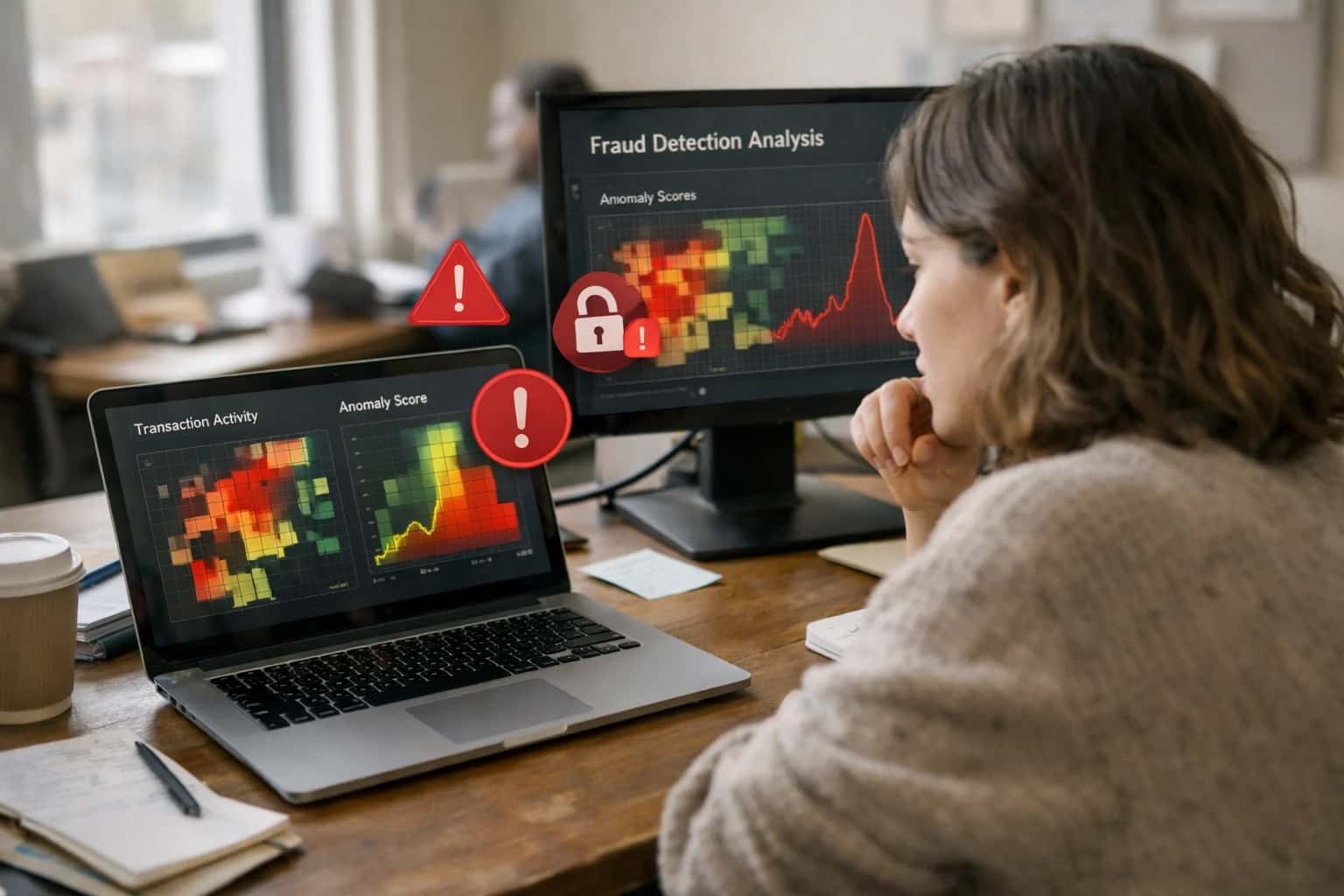
Alert fatigue is a critical operational failure state in fraud detection systems where the ratio of false positive alerts to genuine threats becomes so skewed that human analysts are cognitively overwhelmed. This desensitization occurs when a false positive rate (FPR) is poorly optimized, forcing investigators to manually triage a high volume of low-probability noise. The direct consequence is a measurable degradation in investigator vigilance, where genuine fraud signals are dismissed or overlooked due to eroded trust in the alerting system.

Glossary
Alert Fatigue
The desensitization of fraud analysts caused by an overwhelming volume of false positive alerts, leading to slower response times and missed genuine threats.
OPERATIONAL RISK
What is Alert Fatigue?
Alert fatigue is the desensitization and degraded performance of fraud analysts resulting from an overwhelming volume of false positive alerts, leading to slower response times and missed genuine threats.
Mitigating alert fatigue requires a shift from static thresholds to risk-based prioritization and ML-based alert scoring. By implementing a secondary suppression layer that applies confidence thresholding and contextual suppression, organizations can suppress benign anomalies before they reach a human. Integrating a closed feedback loop—where investigator dispositions are ingested to retrain models—ensures that the system continuously adapts to reduce noise, restoring analyst trust and accelerating the detection of true financial crime.
OPERATIONAL RISK
Core Characteristics of Alert Fatigue
Alert fatigue is the progressive desensitization of fraud analysts caused by an overwhelming volume of false positive alerts, leading to slower response times, cognitive overload, and missed genuine threats.
01
Desensitization Threshold
The point at which an analyst's cognitive capacity is exceeded by alert volume, causing a measurable decline in investigation quality. When false positive rates exceed 90%, analysts begin to distrust the system entirely. Key indicators include:
- Alert-to-Investigation Ratio: Analysts spending less than 30 seconds per alert
- Skip Rate: The percentage of alerts dismissed without full review
- Confirmation Bias: Tendency to confirm the system's classification rather than critically evaluate evidence
- Decision Fatigue: Degradation of judgment quality over a shift, peaking in the final two hours
74%
Analysts reporting fatigue
< 60s
Avg. time per alert at threshold
02
False Positive Cascade
A compounding effect where high false positive rates trigger a vicious cycle: analysts mark alerts as false positives faster to clear queues, reducing the quality of feedback loop integration data. This degraded feedback retrains models with noisy labels, further increasing false positive rates. The cascade accelerates when:
- Alert volumes grow faster than investigator headcount
- Alert deduplication mechanisms fail to collapse related events
- Contextual suppression rules become stale and unmaintained
- Business pressure to reduce queue depth overrides quality controls
3-5x
Volume amplification per cycle
03
Mean Time to Detect Degradation
The measurable increase in mean time to detect genuine fraud as alert fatigue sets in. Research shows that after processing 50+ alerts in a session, analyst accuracy drops by 15-20%. Critical metrics include:
- Dwell Time: The gap between fraud occurrence and analyst discovery, which can extend from minutes to days under fatigue conditions
- True Positive Miss Rate: The percentage of genuine fraud alerts that are incorrectly dismissed as false positives
- Queue Aging: The average time an alert sits unexamined, directly correlated with fatigue-induced avoidance behavior
15-20%
Accuracy drop after 50 alerts
4-6 hrs
Extended dwell time under fatigue
04
Alert Storm Vulnerability
A systemic failure mode where a data pipeline error, schema change, or infrastructure malfunction generates a massive spike in alerts. Without alert storm management circuit breakers, analysts face thousands of spurious alerts within minutes. Consequences include:
- Complete operational paralysis as queues become unmanageable
- Genuine fraud alerts buried under the noise, often unrecoverable
- Analyst burnout and turnover, with replacement costs averaging 6-9 months of salary
- Permanent erosion of trust in the detection system, even after the storm is resolved
10,000+
Alerts per minute during storms
05
Cognitive Tunneling
A psychological phenomenon where fatigued analysts fixate on a narrow set of alert attributes while ignoring broader contextual signals. This manifests as:
- Pattern Blindness: Over-reliance on familiar fraud patterns, missing novel attack vectors
- Feature Neglect: Ignoring alert enrichment data such as device fingerprints or IP reputation when overloaded
- Heuristic Override: Defaulting to simplistic rules like 'always approve below $X' rather than evaluating each case on its full risk profile
- Confirmation Seeking: Searching only for evidence that supports the initial alert classification rather than conducting a balanced investigation
40%
Contextual data ignored under load
06
Operational Recovery Cost
The total organizational cost of restoring analyst effectiveness after fatigue-induced degradation. Recovery requires more than hiring additional staff; it demands systemic intervention:
- Queue Remediation: Manual review and reclassification of aged or storm-affected alerts
- Model Retraining: Rebuilding detection models with corrected labels from the fatigue period
- Threshold Recalibration: Adjusting decision threshold tuning and confidence thresholding parameters to sustainable levels
- Analyst Rehabilitation: Retraining investigators on proper procedures after they've developed fatigue-driven shortcuts
- Typical recovery timeline spans 4-8 weeks after root cause resolution
4-8 wks
Typical recovery timeline
$250K+
Cost per major fatigue event
ALERT FATIGUE
Frequently Asked Questions
Alert fatigue is the desensitization of fraud analysts caused by an overwhelming volume of false positive alerts, leading to slower response times and missed genuine threats. Below are the most common questions operations managers and analytics leads ask about diagnosing and mitigating this critical operational risk.
Alert fatigue is the progressive desensitization of fraud analysts caused by an overwhelming volume of false positive alerts, leading to slower response times, increased error rates, and missed genuine threats. When a detection system generates excessive noise—often with False Positive Rates (FPR) exceeding 90%—analysts become conditioned to dismiss alerts rapidly. This psychological habituation directly undermines the Precision-Recall Trade-off by negating the benefits of high recall. The operational impact is quantifiable: mean time to detect (MTTD) genuine fraud increases, investigator turnover accelerates, and the Feedback Loop Integration breaks down because disposition data becomes unreliable. Ultimately, alert fatigue transforms a sensitive detection pipeline into a high-cost, low-efficacy filtering exercise.
Enabling Efficiency, Speed & Accuracy
Intelligent Analysis, Decision & Execution
We build AI systems for teams that need search across company data, workflow automation across tools, or AI features inside products and internal software.
Talk to Us
Search across company data
Give teams answers from docs, tickets, runbooks, and product data with sources and permissions.
Useful when people spend too long searching or get different answers from different systems.
Enterprise searchRAGPermissions
Read more
Automate internal workflows
Use AI to route work, draft outputs, trigger actions, and keep approvals and logs in place.
Useful when repetitive work moves across multiple tools and teams.
AI agentsWorkflow automationGovernance
Read more
Add AI to products and internal tools
Build assistants, guided actions, or decision support into the software your team or customers already use.
Useful when AI needs to be part of the product, not a separate tool.
AI integrationDecision supportModel routing
Read more
About the author
Prasad Kumkar
CEO & MD, Inference Systems
Prasad Kumkar is the CEO & MD of Inference Systems and writes about AI systems architecture, LLM infrastructure, model serving, evaluation, and production deployment. Over 5+ years, he has worked across computer vision models, L5 autonomous vehicle systems, and LLM research, with a focus on taking complex AI ideas into real-world engineering systems.
His work and writing cover AI systems, large language models, AI agents, multimodal systems, autonomous systems, inference optimization, RAG, evaluation, and production AI engineering.
LinkedIn
Limited slotsGet a Free AI Consultation
Partnered with leading AI, data, and software stack.





How We Work
Custom AI workflows for your Business
One-fit-all AI don't work for modern businesses. At Inferensys, we aim to understand your business & custom requirements; which we use to define most efficient agentic workflows, the data, and the tools for your business.
01
Review the use case
We understand the task, the users, and where AI can actually help.
Read more02
Pick the right approach
We define what needs search, automation, or product integration.
Read more03
Build the first useful version
We implement the part that proves the value first.
Read more04
Improve from there
We add the checks and visibility needed to keep it useful.
Read moreThe first call is a practical review of your use case and the right next step.
Talk to Us