A Federated Learning Orchestrator is the central server-side software platform that automates the entire lifecycle of a federated learning job. It coordinates a distributed network of clients—such as mobile phones or institutional servers—by selecting participants, distributing the global model, collecting encrypted updates, and performing secure aggregation. This orchestration abstracts the complexity of managing thousands of heterogeneous, unreliable devices into a single, automated workflow.

Glossary
Federated Learning Orchestrator
A Federated Learning Orchestrator is the central software component that manages the lifecycle, coordination, and aggregation of a federated learning job across a distributed network of edge devices or siloed servers.
GLOSSARY
What is a Federated Learning Orchestrator?
A Federated Learning Orchestrator is the central software component that manages the lifecycle, coordination, and aggregation of a federated learning job across a distributed network of edge devices or siloed servers.
Key components include a Round Coordinator for iterative training cycles, a Client Manager for device profiling, and a Configuration Manager for hyperparameter distribution. The orchestrator ensures fault tolerance against client dropouts and manages resource heterogeneity to maintain training stability. It is the critical control plane enabling privacy-preserving, decentralized model training at scale.
ARCHITECTURAL BREAKDOWN
Core Components of an Orchestrator
A Federated Learning Orchestrator is a complex software system composed of specialized modules that manage the decentralized training lifecycle. These components work in concert to coordinate devices, aggregate knowledge, and ensure the system's privacy, efficiency, and reliability.
01
Client Manager
The Client Manager is the orchestrator's registry and lifecycle controller for all participating edge devices. It handles:
- Device Registration & Authentication: Enrolling and verifying clients (e.g., smartphones, IoT sensors).
- Capability Profiling: Cataloging device specifications like compute power, memory, and network status.
- State Tracking: Monitoring client availability, participation history, and current status (idle, training, offline). This component is foundational for the Round Coordinator to make informed selection decisions.
02
Round Coordinator
The Round Coordinator executes the iterative heartbeat of federated learning. For each training round, it:
- Triggers the Round Cycle: Initiates a new global training iteration.
- Invokes the Client Selection Module: Chooses a subset of available devices based on criteria like resource state or data relevance.
- Dispatches Tasks: Sends the current global model and training instructions to selected clients.
- Manages Timeouts: Waits for client updates and handles stragglers or dropouts.
- Triggers Aggregation: Passes collected updates to the Central Aggregator once a sufficient quorum is met.
03
Central Aggregator
The Central Aggregator is the core algorithmic engine that combines knowledge from decentralized clients. Its primary function is to execute an aggregation algorithm, most commonly Federated Averaging (FedAvg), which computes a weighted average of client model updates. It works in tandem with privacy and security modules:
- Integrates with Secure Aggregation: Combines encrypted updates without decrypting individual contributions.
- Applies Differential Privacy: May add calibrated noise to the aggregated result to provide formal privacy guarantees. The output is an updated global model, which is then stored in the Model Registry.
04
Model Registry & Configuration Manager
This dual-purpose component acts as the single source of truth for all model and training artifacts.
- Model Registry: Stores versioned global models, client checkpoints, and associated metadata (performance, creation time). It enables rollback and model lineage tracking.
- Configuration Manager: Centrally manages and distributes all hyperparameters (learning rate, batch size), the model architecture definition, and environment variables to ensure consistency across potentially millions of heterogeneous clients. This is critical for deterministic execution.
05
Heterogeneity & Fault Tolerance Handler
This module ensures stable operation across a wildly variable fleet of devices. It addresses two key challenges:
- Device Heterogeneity: Manages variations in compute speed, memory, and battery life. Strategies include adaptive computation assignments and compression for constrained devices.
- System Fault Tolerance: Implements resilience mechanisms such as:
- Checkpointing: Saving model state to recover from failures.
- Client Dropout Handling: Proceeding with aggregation even if some clients fail mid-round.
- Retry Logic: For transient network failures. This handler is essential for Cross-Device Orchestrators managing smartphones or sensors.
06
Workflow Engine & API Gateway
These components manage the macro and micro flows of communication and process.
- Workflow Engine: Automates the multi-step Federated Job lifecycle using a directed acyclic graph (DAG). It sequences model initialization, repeated round execution, validation, and final deployment, enabling complex, conditional pipelines.
- API Gateway: Serves as the secure, unified entry point for all client-server communication. It handles:
- Protocol Translation: Between client SDKs and the orchestrator's internal APIs.
- Authentication & Rate Limiting: For each client connection.
- Request Routing: Directing client updates to the correct processing components.
SYSTEM ARCHITECTURE
How a Federated Learning Orchestrator Works
A Federated Learning Orchestrator is the central control plane that manages the decentralized training lifecycle, coordinating hundreds to millions of edge devices to collaboratively improve a machine learning model without sharing raw data.
The orchestrator initiates a federated job by distributing an initial global model and training configuration to a selected cohort of clients via a Client Selection Module. Each client trains locally on its private data. The Round Coordinator then manages the synchronous or asynchronous collection of the resulting encrypted model updates, which are passed to the Secure Aggregation Orchestrator for privacy-preserving combination.
This aggregated update refines the global model in the Model Registry. A Convergence Monitor evaluates performance, triggering subsequent rounds until criteria are met. Throughout, a Heterogeneity Handler and Fault Tolerance Manager mitigate device variability and failures, while an Audit Logger records all actions for compliance. The final model is deployed via an Edge Inference Manager.
FEDERATED LEARNING ORCHESTRATOR
Orchestrator Deployment Models
The deployment model of a Federated Learning Orchestrator defines its architectural topology, communication patterns, and resource management strategy, directly impacting scalability, fault tolerance, and suitability for different environments.
01
Centralized Server Orchestrator
The most common deployment model, featuring a single, powerful central server that coordinates all federated learning activities. This server houses the Central Aggregator, Model Registry, and Round Coordinator. All edge clients communicate directly with this central hub to receive tasks and submit updates.
- Pros: Simple to implement and manage; provides a single point of control and monitoring.
- Cons: Creates a single point of failure; communication bottlenecks can occur with massive client counts; may not comply with strict data sovereignty laws requiring regional processing.
- Use Case: Ideal for cross-silo federated learning among a limited number of institutional data centers.
02
Hierarchical (Edge-Cloud) Orchestrator
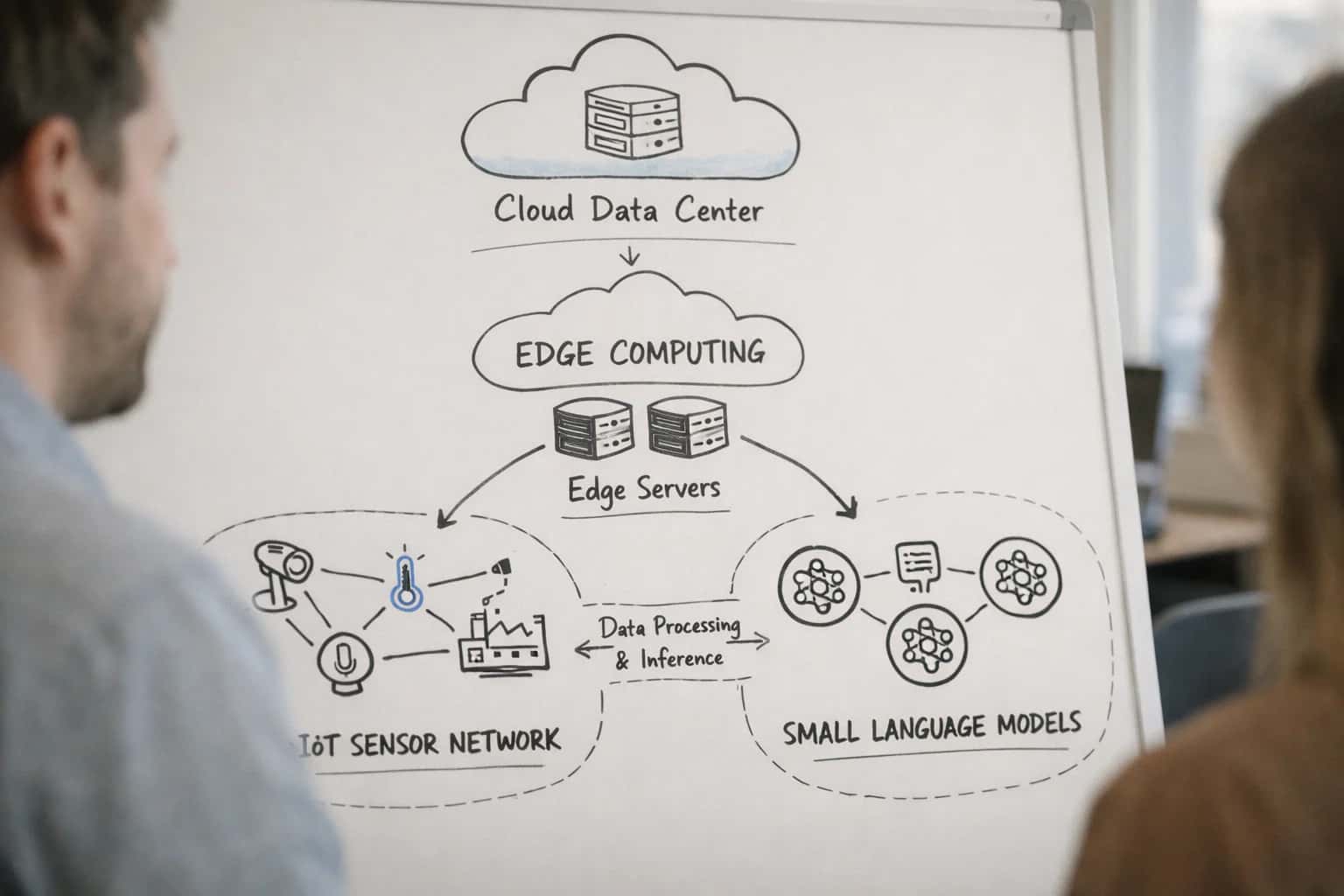
A multi-tiered architecture that introduces intermediate aggregation nodes between end devices and a central cloud server. Edge servers or fog nodes act as local aggregators, combining updates from a subset of nearby devices before forwarding a summarized update upstream.
- Key Mechanism: Implements Hierarchical Aggregation to drastically reduce upstream bandwidth and latency.
- Pros: Scalable to massive cross-device deployments (e.g., millions of IoT sensors); reduces WAN traffic; can provide lower latency for client updates.
- Cons: Increases system complexity; requires deployment and management of the intermediate layer.
- Use Case: Smart city networks, large-scale mobile device fleets, and industrial IoT where regional data processing is beneficial.
03
Peer-to-Peer (Decentralized) Orchestrator
A fully decentralized model that eliminates the central server. Clients communicate directly with each other in a peer-to-peer network to exchange and aggregate model updates using consensus algorithms or gossip protocols.
- Key Mechanism: Relies on decentralized aggregation where each client iteratively improves its model by averaging with its neighbors' models.
- Pros: Maximum resilience with no single point of failure; naturally aligns with data sovereignty requirements.
- Cons: Convergence can be slower and less stable; coordination and consensus are complex; managing global state (e.g., model versions) is challenging.
- Use Case: Scenarios requiring extreme censorship resistance or where no trusted central entity exists, such as certain collaborative research networks.
04
Federated Learning as a Service (FLaaS)
A cloud-based, managed service model where the orchestrator platform is hosted and operated by a third-party provider (e.g., major cloud vendors). Clients connect to the service via a provided Federated SDK and API.
- Key Components: The provider manages the API Gateway, Workflow Engine, and underlying infrastructure, offering scalability and reduced operational overhead for the enterprise.
- Pros: Low initial setup cost; automatic scaling and maintenance; integrates with other cloud AI services.
- Cons: Potential vendor lock-in; all metadata and aggregated model updates traverse the provider's infrastructure, which may be a concern for highly sensitive industries.
- Use Case: Organizations wanting to experiment with or deploy federated learning without building and maintaining the core orchestration infrastructure.
05
On-Premises / Sovereign Orchestrator
The orchestrator is deployed entirely within an organization's private data center or sovereign cloud, ensuring absolute control over the entire software stack, data flow, and hardware.
- Key Driver: Sovereign Artificial Intelligence Infrastructure and compliance with regulations mandating data residency (e.g., GDPR, EU AI Act).
- Deployment: Often implemented using a Kubernetes Operator for Federated Learning for containerized, scalable management on private clusters.
- Pros: Maximum control, security, and compliance; no data or model artifacts leave the private environment.
- Cons: Highest capital and operational expense; requires in-house expertise to deploy and manage.
- Use Case: Highly regulated industries like healthcare (Healthcare Federated Learning), defense, and finance where data cannot be exposed to external clouds.
06
Hybrid & Multi-Cloud Orchestrator
A deployment that spans multiple environments, such as a combination of on-premises data centers, private clouds, and public clouds. The orchestrator's components are distributed across these environments to meet specific requirements.
- Key Mechanism: The Configuration Manager and Workflow Engine must coordinate across heterogeneous infrastructures. A central Convergence Monitor may run in a neutral zone.
- Pros: Flexibility to place aggregators close to data silos in different jurisdictions; can leverage public cloud scalability for non-sensitive components.
- Cons: Extremely high complexity in networking, security, and synchronization; requires sophisticated Fault Tolerance Managers.
- Use Case: Global enterprises with data silos in different geographic regions subject to varying local regulations, requiring a unified federated learning strategy.
FEDERATED LEARNING ORCHESTRATOR
Frequently Asked Questions
A Federated Learning Orchestrator is the central software platform that manages the lifecycle, coordination, and aggregation of a federated learning job across a distributed network of edge devices or siloed servers. These FAQs address its core functions, architecture, and operational considerations.
A Federated Learning Orchestrator is the central server-side software platform that coordinates the entire lifecycle of a federated learning job across a distributed network of clients (e.g., edge devices, institutional servers). It works by managing an iterative, multi-round training process without centralizing raw data.
Core Workflow:
- Job Initialization: The orchestrator defines the federated job, including the initial global model, training hyperparameters, and client selection criteria.
- Round Coordination: For each training round, the Round Coordinator selects a subset of available clients via the Client Selection Module and dispatches the current global model.
- Client-Side Training: Selected clients train the model locally on their private data.
- Update Aggregation: Clients send only their model updates (e.g., gradients, weights) back to the orchestrator. The Central Aggregator (often using the Federated Averaging algorithm) combines these updates to form a new, improved global model.
- Convergence & Deployment: The Convergence Monitor evaluates progress. Once criteria are met, the Deployment Manager distributes the final model for inference.
Enabling Efficiency, Speed & Accuracy
Intelligent Analysis, Decision & Execution
We build AI systems for teams that need search across company data, workflow automation across tools, or AI features inside products and internal software.
Talk to Us
Search across company data
Give teams answers from docs, tickets, runbooks, and product data with sources and permissions.
Useful when people spend too long searching or get different answers from different systems.
Enterprise searchRAGPermissions
Read more
Automate internal workflows
Use AI to route work, draft outputs, trigger actions, and keep approvals and logs in place.
Useful when repetitive work moves across multiple tools and teams.
AI agentsWorkflow automationGovernance
Read more
Add AI to products and internal tools
Build assistants, guided actions, or decision support into the software your team or customers already use.
Useful when AI needs to be part of the product, not a separate tool.
AI integrationDecision supportModel routing
Read more
About the author
Prasad Kumkar
CEO & MD, Inference Systems
Prasad Kumkar is the CEO & MD of Inference Systems and writes about AI systems architecture, LLM infrastructure, model serving, evaluation, and production deployment. Over 5+ years, he has worked across computer vision models, L5 autonomous vehicle systems, and LLM research, with a focus on taking complex AI ideas into real-world engineering systems.
His work and writing cover AI systems, large language models, AI agents, multimodal systems, autonomous systems, inference optimization, RAG, evaluation, and production AI engineering.
LinkedIn
Limited slotsGet a Free AI Consultation
Partnered with leading AI, data, and software stack.





How We Work
Custom AI workflows for your Business
One-fit-all AI don't work for modern businesses. At Inferensys, we aim to understand your business & custom requirements; which we use to define most efficient agentic workflows, the data, and the tools for your business.
01
Review the use case
We understand the task, the users, and where AI can actually help.
Read more02
Pick the right approach
We define what needs search, automation, or product integration.
Read more03
Build the first useful version
We implement the part that proves the value first.
Read more04
Improve from there
We add the checks and visibility needed to keep it useful.
Read moreThe first call is a practical review of your use case and the right next step.
Talk to Us