An Edge Inference Manager coordinates the lifecycle of trained models—often from a federated learning orchestrator's model registry—on remote hardware. It handles secure model distribution, version control, and runtime execution, enabling low-latency predictions without cloud dependency. This component is critical for deploying the final product of a federated training pipeline to production edge environments.

Glossary
Edge Inference Manager
An Edge Inference Manager is a software component that coordinates the deployment, versioning, and execution of trained federated models on edge devices for local prediction.
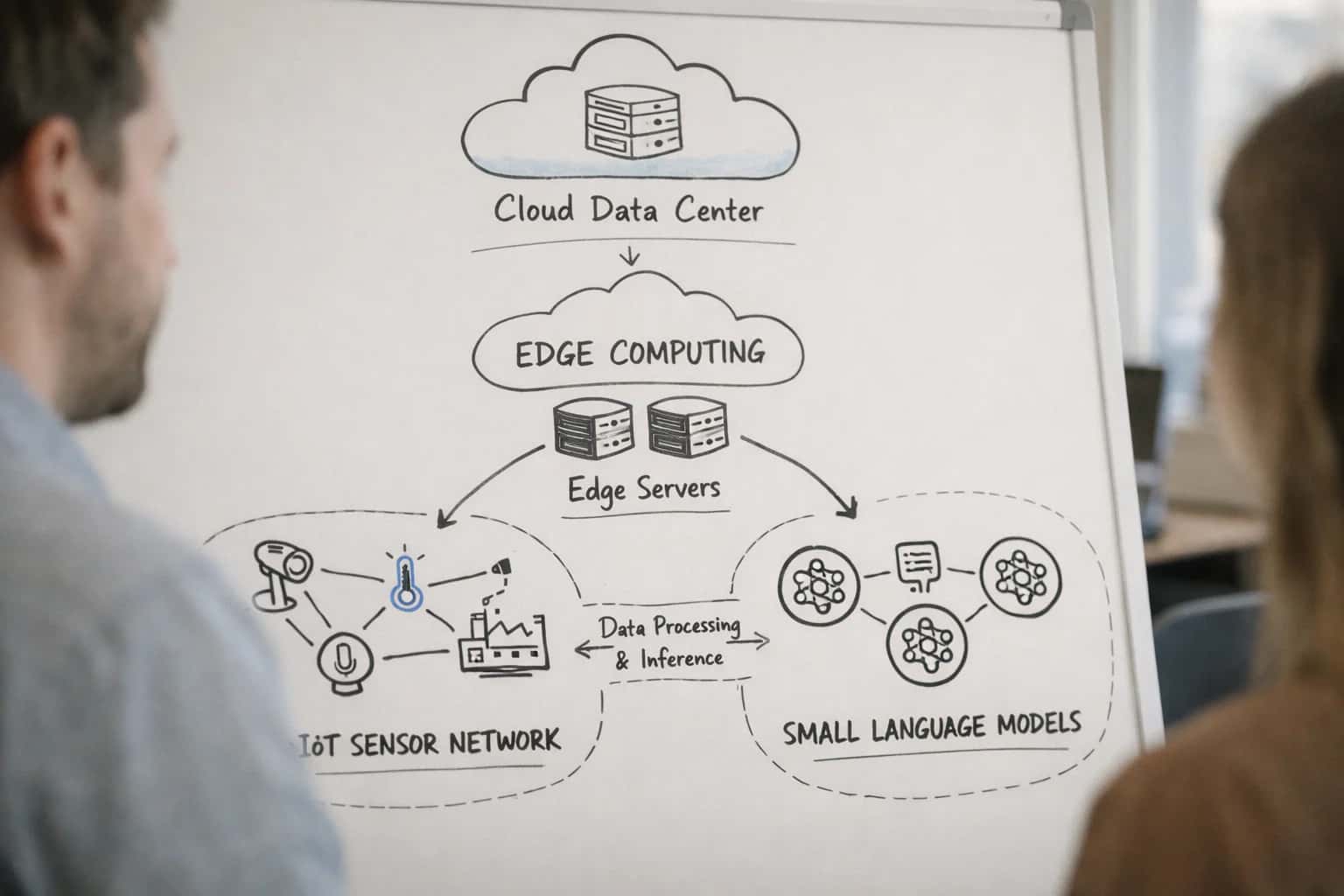
FEDERATED LEARNING ORCHESTRATORS
What is an Edge Inference Manager?
An Edge Inference Manager is the software component responsible for deploying, versioning, and executing trained machine learning models on distributed edge devices for local prediction.
The manager ensures deterministic execution by managing device-specific optimizations like quantization and hardware acceleration. It monitors inference performance, manages canary rollouts and A/B testing, and can trigger model retraining based on data drift detection. This bridges the gap between centralized model development and decentralized, real-time application.
FEDERATED LEARNING ORCHESTRATORS
Core Functions of an Edge Inference Manager
An Edge Inference Manager coordinates the deployment and execution of trained federated models on edge devices. It is a critical bridge between the training orchestration system and real-time, local prediction.
01
Model Deployment & Versioning
The manager handles the distribution and lifecycle of trained global models from the central Model Registry to the edge fleet. This includes:
- Canary Rollouts: Staged deployment to a subset of devices to monitor performance before full release.
- A/B Testing: Managing multiple model versions concurrently to compare metrics like accuracy or latency.
- Atomic Rollbacks: Rapid reversion to a previous stable model version if a new deployment fails or degrades.
- Version Stitching: Ensuring client SDKs and device runtimes are compatible with the deployed model artifact.
02
Inference Orchestration & Scheduling
It manages the execution of inference tasks on devices, optimizing for resource constraints and latency requirements. Key capabilities include:
- Dynamic Batching: Grouping inference requests on-device to maximize hardware accelerator (e.g., NPU, GPU) utilization.
- Priority Queuing: Ensuring high-priority, latency-sensitive predictions (e.g., anomaly detection) are processed before background tasks.
- Conditional Execution: Triggering model inference based on specific sensor data thresholds or events to conserve power.
- Workload Offloading: Deciding, based on policy, whether to compute locally or offload to a nearby edge server or the cloud when local resources are saturated.
03
Performance Monitoring & Telemetry
The manager collects real-time operational metrics from the edge to ensure inference service quality and inform model updates. Monitored data includes:
- Inference Latency: End-to-end prediction time, critical for real-time applications.
- Hardware Utilization: CPU, NPU, memory, and battery consumption per model version.
- Model Performance: Tracking prediction drift or accuracy decay by comparing inference outputs against ground truth labels where available.
- Device Health: Monitoring connectivity, storage, and thermal status to preemptively manage failing nodes. This telemetry feeds back into the Convergence Monitor and influences future Client Selection for training.
04
Local Data & Context Management
It interfaces with the device's local data pipeline to provide context-aware inference. This involves:
- Feature Engineering: Applying the same preprocessing transformations used during training to raw sensor or application data before inference.
- Context Window Management: For sequence models (e.g., LSTMs), maintaining the appropriate state or history of data points on the device.
- Secure Data Handling: Ensuring sensitive input data for inference is processed in a protected environment (e.g., a trusted execution environment) and not persisted unnecessarily.
- Result Caching: Storing frequent or recent inference results to serve identical subsequent requests without recomputing, reducing latency and power use.
05
Integration with the FL Orchestrator
The Edge Inference Manager is not a standalone system; it is a subordinate component to the Federated Learning Orchestrator. Key integration points are:
- Model Update Pipeline: Receiving new global models post-aggregation from the Central Aggregator via the Model Registry.
- Feedback Loop: Sending aggregated, anonymized inference performance and data distribution metrics back to the orchestrator to inform the next Federated Job. This closes the Continuous Learning loop.
- Policy Enforcement: Applying governance and compliance rules (e.g., data residency, model licensing) defined centrally by the Compliance Checker.
- Unified Observability: Streaming logs and metrics to the central Audit Logger and Resource Monitor for a holistic system view.
06
Security & Access Control
It enforces security protocols at the inference endpoint to protect the model and the data. This includes:
- Model Integrity Verification: Using cryptographic signatures to ensure deployed model artifacts have not been tampered with.
- Authenticated Inference APIs: Ensuring only authorized applications or services on the device can request predictions from the managed model.
- Inference Logging & Audit: Recording which data was processed by which model version for compliance with regulations like the EU AI Act.
- Adversarial Input Detection: Implementing basic filters or anomaly detectors to shield the model from evasion attacks designed to force incorrect predictions.
FEDERATED LEARNING ORCHESTRATORS
How an Edge Inference Manager Works
An Edge Inference Manager is the software component responsible for deploying, versioning, and executing trained machine learning models on distributed edge devices for local prediction, acting as the critical bridge between federated training and real-time, private inference.
An Edge Inference Manager coordinates the lifecycle of inference models on remote devices. It pulls a trained model from a central Model Registry, packages it with necessary dependencies, and securely deploys it to a fleet of edge clients. The manager handles version control, canary rollouts, and A/B testing to ensure reliable updates. It also monitors inference performance and resource consumption, reporting metrics back to the orchestrator for continuous evaluation and potential model retraining.
During operation, the manager provides a local API on the device, enabling applications to request predictions without cloud connectivity. It manages the model's execution environment, often leveraging hardware accelerators like Neural Processing Units (NPUs). For federated learning systems, it is tightly integrated with the orchestrator, enabling a closed loop where inference data or performance drift can trigger new federated training rounds, ensuring models remain accurate in dynamic, real-world conditions.
ARCHITECTURAL COMPARISON
Edge vs. Cloud Inference: Key Differences
A technical comparison of where and how trained models perform prediction, focusing on the trade-offs relevant to deploying models managed by an Edge Inference Manager.
| Primary Feature | Edge Inference | Cloud Inference |
|---|---|---|
Inference Location | On the local device (e.g., smartphone, IoT sensor, gateway) | On remote, centralized data center servers |
Latency | < 10-100 milliseconds | 100-1000+ milliseconds (network-dependent) |
Bandwidth Consumption | Minimal to none (local processing) | High (requires sending raw data to cloud) |
Operational Continuity | Fully functional without network connectivity | Requires stable, high-bandwidth internet connection |
Data Privacy & Sovereignty | High (raw data never leaves the device) | Lower (raw data transmitted and processed externally) |
Infrastructure Cost Profile | Higher upfront device cost; minimal recurring cloud cost | Low upfront cost; pay-per-use API or compute costs |
Scalability Model | Horizontal (add more devices) | Vertical & Horizontal (scale server resources) |
Hardware Constraints | Constrained (limited CPU, memory, power, NPU/TPU) | Virtually unconstrained (access to latest GPUs/TPUs) |
Model Update & Deployment | Managed via Edge Inference Manager; can be staged/partial | Instant, atomic updates to a centralized endpoint |
Primary Use Case Fit | Real-time responsiveness, privacy-sensitive, offline-required | Batch processing, complex models, centralized data analysis |
EDGE INFERENCE MANAGER
Frequently Asked Questions
An Edge Inference Manager is the system component responsible for deploying, versioning, and executing trained machine learning models on edge devices for local prediction. It is a critical link between a federated learning orchestrator's model registry and the operational edge environment.
An Edge Inference Manager is a software component that coordinates the deployment, versioning, and execution of trained machine learning models on edge devices for local prediction. It acts as the bridge between a central model registry (often part of a federated learning orchestrator) and the distributed fleet of edge hardware, ensuring the correct model is delivered and run efficiently in a constrained environment. Its core functions include model distribution, version control, runtime orchestration, and performance monitoring on the edge node.
Enabling Efficiency, Speed & Accuracy
Intelligent Analysis, Decision & Execution
We build AI systems for teams that need search across company data, workflow automation across tools, or AI features inside products and internal software.
Talk to Us
Search across company data
Give teams answers from docs, tickets, runbooks, and product data with sources and permissions.
Useful when people spend too long searching or get different answers from different systems.
Enterprise searchRAGPermissions
Read more
Automate internal workflows
Use AI to route work, draft outputs, trigger actions, and keep approvals and logs in place.
Useful when repetitive work moves across multiple tools and teams.
AI agentsWorkflow automationGovernance
Read more
Add AI to products and internal tools
Build assistants, guided actions, or decision support into the software your team or customers already use.
Useful when AI needs to be part of the product, not a separate tool.
AI integrationDecision supportModel routing
Read more
About the author
Prasad Kumkar
CEO & MD, Inference Systems
Prasad Kumkar is the CEO & MD of Inference Systems and writes about AI systems architecture, LLM infrastructure, model serving, evaluation, and production deployment. Over 5+ years, he has worked across computer vision models, L5 autonomous vehicle systems, and LLM research, with a focus on taking complex AI ideas into real-world engineering systems.
His work and writing cover AI systems, large language models, AI agents, multimodal systems, autonomous systems, inference optimization, RAG, evaluation, and production AI engineering.
LinkedIn
Limited slotsGet a Free AI Consultation
Partnered with leading AI, data, and software stack.





How We Work
Custom AI workflows for your Business
One-fit-all AI don't work for modern businesses. At Inferensys, we aim to understand your business & custom requirements; which we use to define most efficient agentic workflows, the data, and the tools for your business.
01
Review the use case
We understand the task, the users, and where AI can actually help.
Read more02
Pick the right approach
We define what needs search, automation, or product integration.
Read more03
Build the first useful version
We implement the part that proves the value first.
Read more04
Improve from there
We add the checks and visibility needed to keep it useful.
Read moreThe first call is a practical review of your use case and the right next step.
Talk to Us