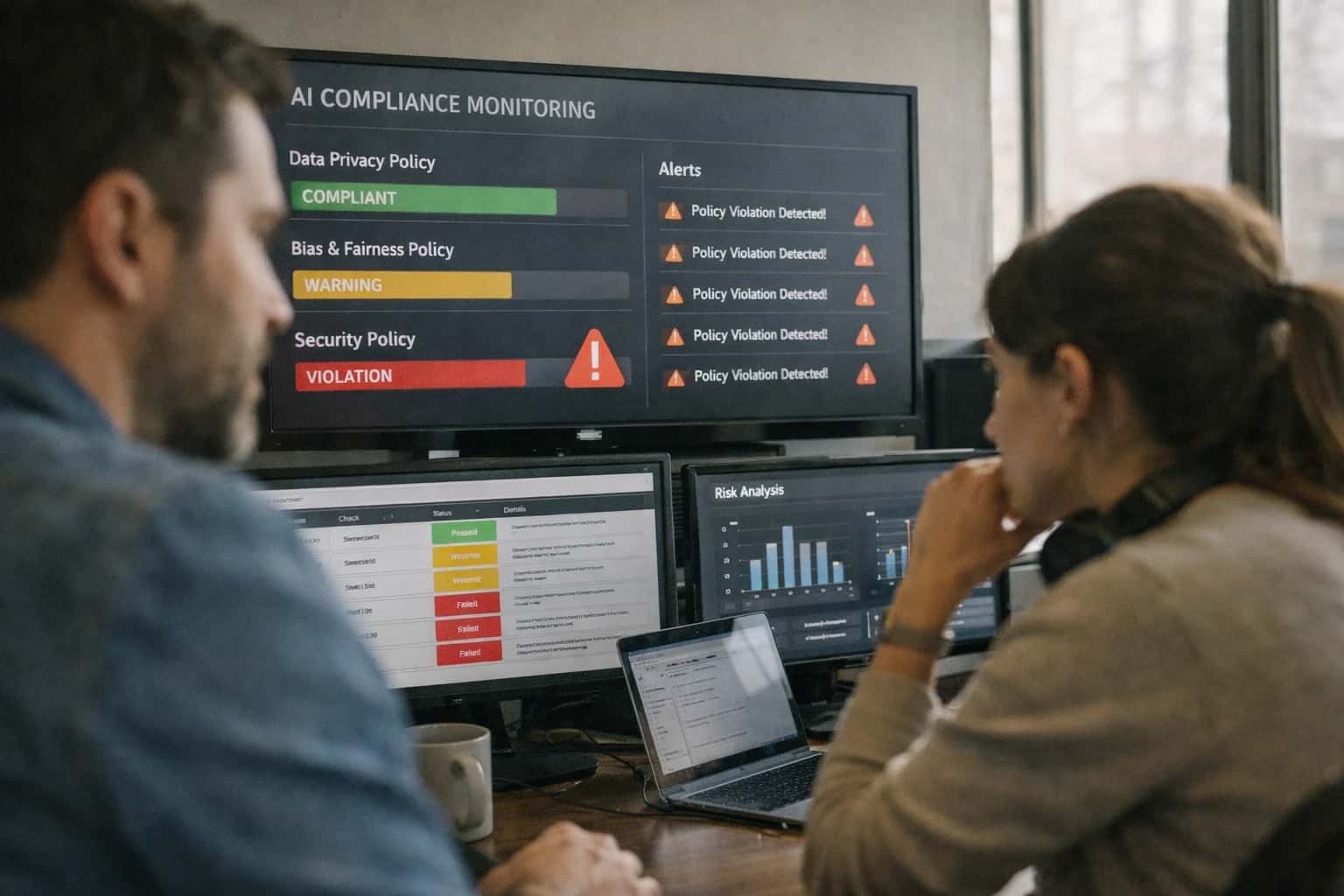
A Compliance Checker is a software module within a federated learning orchestrator that validates all operations against a defined set of regulatory constraints and organizational policies before allowing execution. It acts as a gatekeeper, ensuring that tasks like client selection, model distribution, update aggregation, and final model deployment adhere to rules concerning data residency, privacy budgets, approved model architectures, and ethical use guidelines. This preemptive validation is critical for operating in regulated industries like healthcare and finance.

Glossary
Compliance Checker
A Compliance Checker is a module that validates federated learning operations against regulatory and policy constraints, such as data residency rules, privacy budgets, or approved model architectures, before allowing execution.
FEDERATED LEARNING ORCHESTRATOR
What is a Compliance Checker?
A core component within a federated learning orchestrator that enforces regulatory and policy constraints before, during, and after decentralized training operations.
The checker operates by intercepting orchestration commands and comparing proposed actions against a policy engine or rules database. For instance, it can block a training round if selected clients reside in unauthorized geographical regions or if the cumulative privacy expenditure from differential privacy mechanisms exceeds a predefined limit. By integrating directly with components like the Client Manager and Secure Aggregation Orchestrator, it provides continuous assurance that the federated learning lifecycle maintains a verifiable compliance posture without compromising system autonomy or efficiency.
FEDERATED LEARNING ORCHESTRATORS
Core Functions of a Compliance Checker
A Compliance Checker is a critical governance module within a federated learning orchestrator. It acts as a policy enforcement point, validating all operations against a defined set of regulatory, security, and operational constraints before execution is permitted.
01
Policy Validation & Enforcement
The core function is to evaluate proposed federated learning actions against a codified policy engine. This engine contains rules derived from regulations (e.g., GDPR, HIPAA), organizational security policies, and technical constraints. Before a training round begins, the checker validates that the client selection, model architecture, and data access patterns comply with all active policies. It can block or modify requests that violate rules, such as attempting to train on data from a prohibited geographic region.
02
Privacy Budget Accounting
For systems using differential privacy, the Compliance Checker is responsible for tracking and enforcing privacy budgets. It acts as a ledger, decrementing the available privacy budget (epsilon, δ) for each client or data cohort as noisy updates are aggregated. Once a predefined budget is exhausted, the checker prevents further queries on that data source, ensuring formal privacy guarantees are not violated over the lifetime of the model. This requires stateful tracking across all federated learning rounds.
03
Data Residency & Sovereignty Verification
This function ensures that data never leaves a mandated legal or geographic boundary. The checker validates that:
- Model initialization weights are permissible for export to selected clients.
- Client updates are processed and aggregated only within approved jurisdictions (e.g., within an EU-based aggregator for EU data).
- Global model deployment targets comply with data origin rules. It integrates with metadata tagging for data provenance and geo-fencing for compute resources to enforce sovereign AI and data residency requirements.
04
Model Architecture & License Compliance
The checker validates that the model to be trained or deployed adheres to licensing and architectural guardrails. This includes:
- Verifying that the model license (e.g., Apache 2.0, GPL) permits federated training and commercial use.
- Ensuring the model architecture does not contain prohibited layers or operations (e.g., certain types of attention mechanisms for export control).
- Checking that the final aggregated model does not exceed size or complexity limits defined for target edge deployment environments.
05
Audit Trail Generation
To support regulatory audits and internal governance, the Compliance Checker generates an immutable, cryptographically signed audit log of all compliance decisions. Each log entry details the operation requested, the policies evaluated, the decision (allow/deny/modify), and a justification. This trail is essential for demonstrating due diligence to regulators (proving adherence to the EU AI Act or sectoral rules) and for post-hoc analysis of system behavior during incident response.
06
Integration with Secure Aggregation & DP
The checker does not operate in isolation; it integrates directly with secure aggregation protocols and differential privacy mechanisms. It configures parameters like gradient clipping norms and noise multipliers based on the active privacy policy. It also verifies that the cryptographic protocols used for secure aggregation are from an approved list and are correctly implemented, ensuring the technical privacy safeguards align with the declared policy framework.
FEDERATED LEARNING ORCHESTRATORS
How a Compliance Checker Works in Federated Learning
A Compliance Checker is a critical governance module within a federated learning orchestrator that enforces regulatory and organizational policies before any training operation proceeds.
A Compliance Checker is a software module that validates federated learning operations against a predefined set of regulatory, privacy, and organizational policy constraints before execution is permitted. It acts as a policy enforcement point, intercepting actions like client selection, model dispatch, and update aggregation to verify adherence to rules such as data residency, privacy budgets, approved model architectures, and participant eligibility. This preemptive validation is essential for maintaining auditability and trust in regulated industries like healthcare and finance.
The checker operates by referencing a policy engine containing formalized rules, often expressed in a domain-specific language. It evaluates the context of each federated learning round—including client metadata, model specifications, and aggregated update statistics—against these rules. If a violation is detected, such as a client from a restricted geographical region being selected or a differential privacy noise budget being exhausted, the checker can block the operation, trigger an alert to the Audit Logger, or route it for manual review, ensuring the entire federated process remains within its compliant operating envelope.
ENFORCEMENT MECHANISMS
Examples of Compliance Checks in Federated Learning
A Compliance Checker enforces policy by validating operations before execution. These are concrete examples of the constraints it verifies across the federated learning lifecycle.
01
Data Residency & Sovereignty
Validates that model training and data processing occur within approved geographic or jurisdictional boundaries. This is critical for regulations like the EU's General Data Protection Regulation (GDPR), which restricts cross-border data transfers.
- Check: Confirms the IP address and server location of the central aggregator and all participating clients are within a whitelisted set of countries or cloud regions.
- Enforcement: Blocks training rounds if a selected client's device is detected outside the permitted zone, or reroutes aggregation through a sovereign cloud instance.
- Example: A healthcare FL system operating across hospitals in Germany and France must ensure no model update ever transits through or is processed on a server in a non-EU country.
02
Privacy Budget Accounting
Tracks and enforces cumulative privacy loss across all training rounds to maintain a formal differential privacy (DP) guarantee. Prevents the privacy budget from being exhausted.
- Check: Before each round, calculates the potential privacy cost (epsilon, delta) of the planned noise addition and clipping parameters. Sums this with the spent budget from previous rounds.
- Enforcement: Halts training if the planned operation would exceed the total allowed budget (e.g., ε > 5.0). May trigger a switch to a more conservative noise addition mechanism.
- Example: A financial institution sets a total privacy budget of ε=3.0 for a fraud detection model. The checker prevents a 1000th training round if it would push the cumulative ε to 3.1.
03
Model Architecture & License Validation
Ensures only approved, licensed, or compliant model architectures are distributed to clients and that resulting models do not violate third-party intellectual property.
- Check: Verifies the hash of the global model sent to clients matches a pre-approved model blueprint in the Model Registry. Scans for the use of restricted layers (e.g., certain patented attention mechanisms) or unlicensed pre-trained components.
- Enforcement: Rejects aggregation of updates from clients that return models with an architecture signature mismatch, which could indicate tampering or corruption.
- Example: An FL platform for mobile keyboards must ensure all client models use a company's proprietary, privacy-safe architecture and not an unlicensed Transformer variant.
04
Client Eligibility & Certification
Verifies that participating devices or institutions meet required security postures, software versions, and attestation standards before they can join a training round.
- Check: Interrogates the Client Manager's profile for each selected device. Validates the presence of a Trusted Execution Environment (TEE) attestation, an up-to-date operating system, and required security patches.
- Enforcement: The Round Coordinator will skip uncertified clients, selecting only from a pool of compliant devices. Non-compliant devices are flagged for remediation.
- Example: In a cross-silo FL network for banks, each bank's server must provide a hardware security module (HSM) attestation and certification of ISO 27001 compliance before its updates are accepted.
05
Update Sanitization & Bias Guardrails
Applies pre-aggregation checks to client model updates to detect and mitigate potential policy violations, such as embedded biases or poisoned parameters.
- Check: Applies statistical tests to update vectors (e.g., norm bounding, outlier detection via multi-Krum or trimmed mean). May run a lightweight fairness evaluation on a client's local performance metrics across protected subgroups.
- Enforcement: Clips updates that exceed a norm threshold or discards updates identified as statistical outliers before they enter the Secure Aggregation pool. Triggers an alert for manual review.
- Example: For a loan approval model, the checker rejects a client update that shows a 50% higher false-negative rate for a specific demographic group compared to the cohort average, preventing the amplification of bias.
06
Audit Trail & Immutable Logging
Ensures all compliance decisions are recorded in an immutable ledger for regulatory review and internal auditing, providing non-repudiation.
- Check: The Audit Logger component is invoked by the Compliance Checker to record every validation event—pass or fail—along with timestamps, client IDs, rule IDs, and relevant data snapshots.
- Enforcement: Creates a cryptographically verifiable chain of evidence. Training rounds cannot proceed if the audit log write fails, ensuring a complete record.
- Example: During an external audit for a pharmaceutical FL trial, the company can provide a verifiable log proving that every model update was checked for HIPAA compliance and data residency before aggregation.
COMPLIANCE CHECKER
Frequently Asked Questions
A Compliance Checker is a critical component within a Federated Learning Orchestrator that programmatically enforces regulatory and policy constraints before, during, and after the decentralized training process.
A Compliance Checker is a software module within a federated learning orchestrator that validates all operations against a defined set of regulatory, organizational, and technical policy constraints before allowing execution. It acts as a gatekeeper, ensuring the federated learning process adheres to rules such as data residency, privacy budgets, approved model architectures, and participant eligibility. By performing these checks automatically, it prevents non-compliant actions from occurring, which is essential for operating in regulated industries like healthcare and finance where manual oversight is insufficient and auditability is mandatory.
Enabling Efficiency, Speed & Accuracy
Intelligent Analysis, Decision & Execution
We build AI systems for teams that need search across company data, workflow automation across tools, or AI features inside products and internal software.
Talk to Us
Search across company data
Give teams answers from docs, tickets, runbooks, and product data with sources and permissions.
Useful when people spend too long searching or get different answers from different systems.
Enterprise searchRAGPermissions
Read more
Automate internal workflows
Use AI to route work, draft outputs, trigger actions, and keep approvals and logs in place.
Useful when repetitive work moves across multiple tools and teams.
AI agentsWorkflow automationGovernance
Read more
Add AI to products and internal tools
Build assistants, guided actions, or decision support into the software your team or customers already use.
Useful when AI needs to be part of the product, not a separate tool.
AI integrationDecision supportModel routing
Read more
About the author
Prasad Kumkar
CEO & MD, Inference Systems
Prasad Kumkar is the CEO & MD of Inference Systems and writes about AI systems architecture, LLM infrastructure, model serving, evaluation, and production deployment. Over 5+ years, he has worked across computer vision models, L5 autonomous vehicle systems, and LLM research, with a focus on taking complex AI ideas into real-world engineering systems.
His work and writing cover AI systems, large language models, AI agents, multimodal systems, autonomous systems, inference optimization, RAG, evaluation, and production AI engineering.
LinkedIn
Limited slotsGet a Free AI Consultation
Partnered with leading AI, data, and software stack.





How We Work
Custom AI workflows for your Business
One-fit-all AI don't work for modern businesses. At Inferensys, we aim to understand your business & custom requirements; which we use to define most efficient agentic workflows, the data, and the tools for your business.
01
Review the use case
We understand the task, the users, and where AI can actually help.
Read more02
Pick the right approach
We define what needs search, automation, or product integration.
Read more03
Build the first useful version
We implement the part that proves the value first.
Read more04
Improve from there
We add the checks and visibility needed to keep it useful.
Read moreThe first call is a practical review of your use case and the right next step.
Talk to Us