Integer-only inference is the execution of a fully quantized neural network exclusively using integer arithmetic operations, completely eliminating the need for floating-point (FP) computation. This technique converts all model parameters (weights) and activation tensors from high-precision 32-bit floating-point formats into low-bit integer formats, typically 8-bit (INT8). The core mathematical operations—matrix multiplications, convolutions, and activations—are then performed using integer addition and multiplication, often followed by requantization steps to keep values within the target integer range. This shift from FP to integer (INT) arithmetic is the fundamental enabler for deploying models on microcontroller units (MCUs) and digital signal processors (DSPs) that lack dedicated FP hardware, unlocking orders-of-magnitude improvements in speed and energy efficiency.

Glossary
Integer-Only Inference
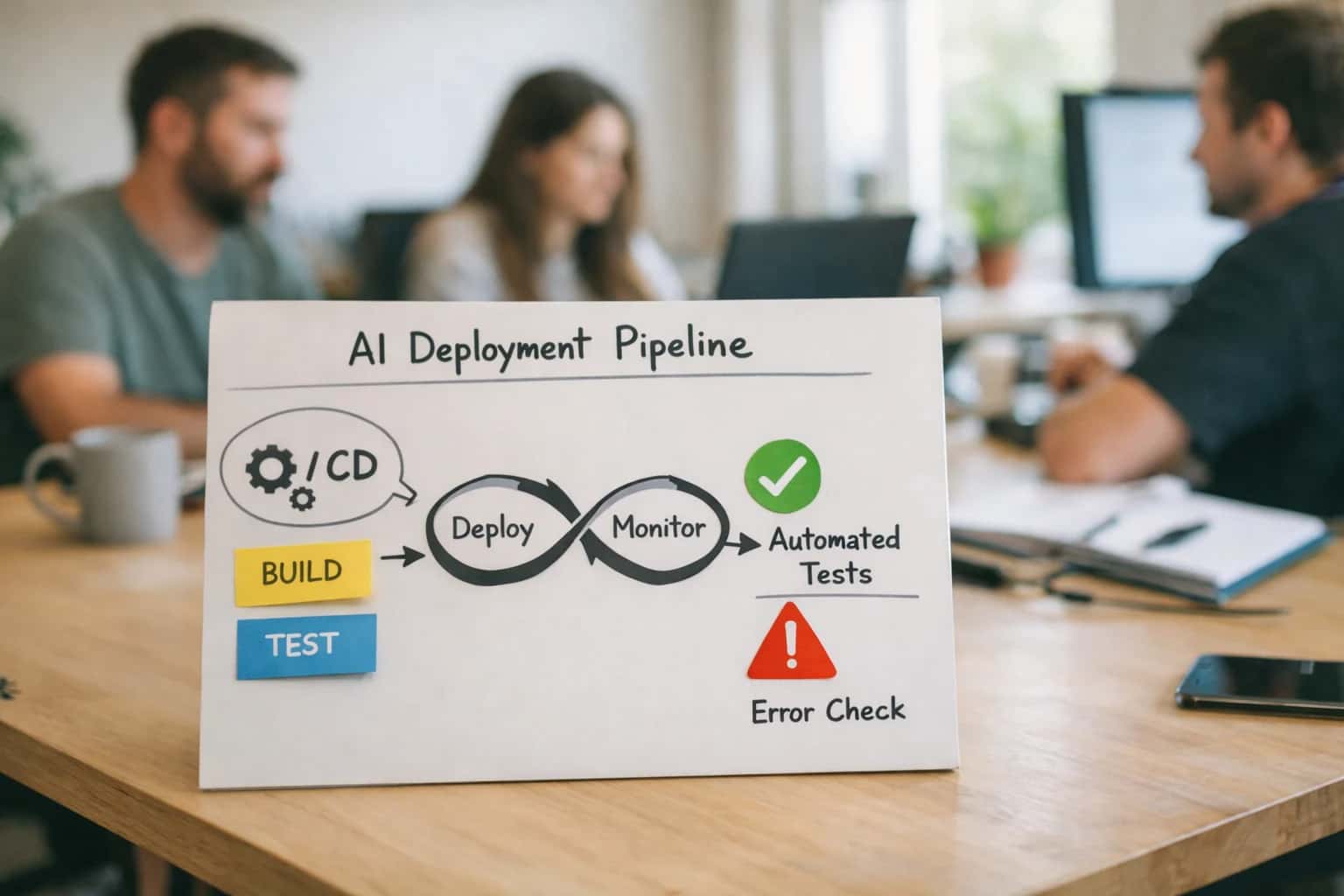
What is Integer-Only Inference?
Integer-only inference is a deployment technique for executing quantized neural networks using only integer arithmetic, eliminating floating-point hardware dependencies for extreme efficiency on microcontrollers.
The implementation relies on a quantization scheme that maps floating-point ranges to integer values. A critical component is the use of integer-only approximations for non-linear functions like ReLU, sigmoid, or softmax, which are implemented via lookup tables (LUTs) or fixed-point polynomial approximations. Frameworks like TensorFlow Lite for Microcontrollers and Apache TVM provide compilers that perform this graph transformation and optimization automatically. The primary benefit is drastically reduced memory footprint and latency, as integer operations are faster and consume less power on most low-end processors. This makes it the cornerstone technique for TinyML and enables on-device inference in battery-powered sensors and embedded systems where every microwatt and millisecond counts.
Key Technical Mechanisms
Integer-only inference executes quantized neural networks using only integer arithmetic, eliminating floating-point hardware dependencies. This is a foundational technique for deploying efficient AI on microcontrollers and low-power accelerators.
Quantization Fundamentals
Quantization maps continuous floating-point values (e.g., 32-bit floats) to a finite set of discrete integer levels. The core operation is:
- Scale (S): A floating-point multiplier that maps the integer range to the original float range.
- Zero-Point (Z): An integer offset that aligns the quantized range with the original, crucial for symmetric or asymmetric quantization. For a real value (r), its quantized integer (q) is calculated as: (q = \text{round}(r / S) + Z). Dequantization reconstructs an approximate value: (r' = S \cdot (q - Z)). This process introduces quantization error, which integer-only training aims to minimize.
Integer-Only Arithmetic
The core challenge is replacing all floating-point operations with integer equivalents. Key transformations include:
- Integer Matrix Multiplication: Accumulate products in higher-bit integers (e.g., int32) to avoid overflow before rescaling.
- Fused Operations: Combine scaling, biasing, and activation functions into single integer steps.
- Rescaling with Fixed-Point: Multiplication by the scale factor (S) is implemented using fixed-point arithmetic—multiplying by an integer mantissa followed by a bit-shift, avoiding floating-point division. For example, a layer's output is computed as: (Y_{int32} = X_{int8} \cdot W_{int8}), then rescaled to int8 via: (Y_{int8} = \text{Requantize}(Y_{int32}, S_x, S_w, S_y)).
Activation Function Approximation
Non-linear functions like ReLU, Sigmoid, and Tanh must be approximated using lookup tables (LUTs) or piecewise integer polynomials.
- Lookup Tables (LUTs): Pre-compute integer outputs for all possible quantized inputs. Efficient but memory-intensive for high-precision inputs.
- Piecewise Linear Approximation: Break the function into segments approximated by simple integer operations: (y = \alpha \cdot x + \beta), where (\alpha) and (\beta) are pre-calculated integers.
- Hardware Intrinsics: Some NPUs provide dedicated integer units for common non-linearities. The choice of approximation directly trades off accuracy, latency, and memory footprint.
Post-Training vs. Quantization-Aware Training
Two primary methodologies enable integer-only inference:
- Post-Training Quantization (PTQ): Converts a pre-trained FP32 model to integer using a small calibration dataset to determine scale/zero-point values. Faster but can incur accuracy loss, especially below 8-bit.
- Quantization-Aware Training (QAT): Simulates quantization during training by injecting fake quantization nodes. The model learns to compensate for quantization error, typically preserving higher accuracy. QAT is essential for complex models or aggressive quantization (e.g., to int4).
System-Level Benefits & Trade-offs
Deploying integer-only inference provides concrete system-level advantages:
- Reduced Memory Bandwidth: int8 weights occupy 4x less memory than FP32, cutting fetch energy.
- Lower Power Consumption: Integer ALUs are simpler, smaller, and more power-efficient than FPUs.
- Deterministic Latency: Integer ops have fixed cycle counts, unlike variable-latency FPUs.
- Broader Hardware Support: Runs on billions of microcontrollers lacking FPUs. Key Trade-off: The permanent introduction of quantization noise, which reduces model precision and must be managed via careful quantization strategy and training.
Integer-Only vs. Other Inference Techniques
A comparison of inference methods based on their arithmetic precision, hardware requirements, and suitability for deployment on resource-constrained TinyML devices.
| Feature / Metric | Integer-Only Inference | Floating-Point Inference | Mixed-Precision Inference |
|---|---|---|---|
Core Arithmetic | Pure integer (INT8/INT16) | Floating-point (FP32/FP16) | Hybrid (INT8/FP16) |
Hardware Dependency | None (runs on CPU/MCU) | FPU or GPU required | GPU/Tensor Core required |
Model Size Reduction | 75% vs. FP32 | 0% (FP32) / 50% (FP16) | 50-75% vs. FP32 |
Memory Bandwidth Use | < 25% of FP32 | Baseline (FP32) | 25-50% of FP32 |
Power Efficiency | Highest | Low | Medium-High |
Typical Latency | < 1 ms (MCU) | 10-100 ms | 1-10 ms |
Accuracy Drop (vs. FP32) | 0.5-2% (with QAT) | 0% | 0.1-1% |
MCU Deployment | |||
Required Calibration | Yes (for PTQ) | No | Yes |
Compiler Complexity | High | Low | Medium |
Frameworks and Target Hardware
Integer-only inference enables neural networks to run on hardware lacking floating-point units, a critical requirement for microcontrollers and specialized AI accelerators. This section details the frameworks that support it and the hardware it targets.
Hardware Accelerators (NPUs/TPUs)
Specialized processors designed to accelerate integer tensor operations with extreme power efficiency.
- Arm Ethos-U55/U65: MicroNPUs for Cortex-M/A systems, supporting int8 and int4.
- Cadence Tensilica Vision P6: DSP with AI extensions for vision workloads.
- Google Edge TPU: ASIC for int8 inference at the network edge.
- These accelerators require a specific compiler toolchain (e.g., Ethos-U Vela compiler) to map and schedule integer graph operations onto the hardware.
Microcontroller Targets
The primary hardware for integer-only inference, characterized by severe constraints.
- Cortex-M Series (Arm): Dominant architecture; M4, M7, M33, M55 (with Helium vector extension).
- ESP32 (Tensilica Xtensa LX6): Popular for IoT, often coupled with a separate ultra-low-power coprocessor.
- RISC-V Cores: Emerging open-source alternatives with custom AI instruction set extensions.
- Key Constraints: Often < 1 MB SRAM, < 10 MB Flash, clock speeds < 500 MHz, and no operating system.
The Compilation Pipeline
The multi-stage process of converting a floating-point model to executable integer code for a target device.
- Model Quantization: Weights and activations are converted to int8 (or lower) via PTQ or QAT.
- Graph Lowering & Optimization: The model graph is optimized (fusing ops, constant folding) for the target.
- Code Generation: Low-level C/C++ or specialized bytecode is generated for the kernels.
- Link & Deploy: The runtime and generated kernels are compiled with the device SDK into a single firmware binary.
Frequently Asked Questions
Integer-only inference is a cornerstone technique for deploying machine learning on microcontrollers. These questions address its core mechanisms, trade-offs, and practical implementation for embedded engineers.
Integer-only inference is the execution of a quantized neural network exclusively using integer arithmetic operations, eliminating the need for floating-point hardware. It works by converting a model's trained weights and activation tensors from 32-bit floating-point (FP32) formats into low-bit integer formats (typically int8). During inference, all calculations—matrix multiplications, convolutions, and activations like ReLU—are performed with integer math. This is enabled by scaling factors, determined during quantization, that map the integer values back to their original floating-point ranges. The process drastically reduces memory footprint, power consumption, and latency, making it essential for Microcontroller Units (MCUs).
Enabling Efficiency, Speed & Accuracy
Intelligent Analysis, Decision & Execution
We build AI systems for teams that need search across company data, workflow automation across tools, or AI features inside products and internal software.
Talk to Us
Search across company data
Give teams answers from docs, tickets, runbooks, and product data with sources and permissions.
Useful when people spend too long searching or get different answers from different systems.

Automate internal workflows
Use AI to route work, draft outputs, trigger actions, and keep approvals and logs in place.
Useful when repetitive work moves across multiple tools and teams.

Add AI to products and internal tools
Build assistants, guided actions, or decision support into the software your team or customers already use.
Useful when AI needs to be part of the product, not a separate tool.

About the author
Prasad Kumkar
CEO & MD, Inference Systems
Prasad Kumkar is the CEO & MD of Inference Systems and writes about AI systems architecture, LLM infrastructure, model serving, evaluation, and production deployment. Over 5+ years, he has worked across computer vision models, L5 autonomous vehicle systems, and LLM research, with a focus on taking complex AI ideas into real-world engineering systems.
His work and writing cover AI systems, large language models, AI agents, multimodal systems, autonomous systems, inference optimization, RAG, evaluation, and production AI engineering.
Partnered with leading AI, data, and software stack.





How We Work
Custom AI workflows for your Business
One-fit-all AI don't work for modern businesses. At Inferensys, we aim to understand your business & custom requirements; which we use to define most efficient agentic workflows, the data, and the tools for your business.
01
Review the use case
We understand the task, the users, and where AI can actually help.
Read more02
Pick the right approach
We define what needs search, automation, or product integration.
Read more03
Build the first useful version
We implement the part that proves the value first.
Read more04
Improve from there
We add the checks and visibility needed to keep it useful.
Read moreThe first call is a practical review of your use case and the right next step.
Talk to Us