A Federated Intermittent Connectivity Protocol is a communication standard that enables edge devices to reliably participate in federated learning despite unstable, low-bandwidth, or periodically available network links. It manages the caching of local model updates, the graceful resumption of interrupted training sessions, and the eventual synchronization of these updates with a central aggregation server. This protocol is a core component of elastic federated learning systems designed for real-world mobile and IoT deployments.

Glossary
Federated Intermittent Connectivity Protocol
A communication standard enabling edge devices to cache model updates, resume interrupted training, and synchronize reliably over unstable or periodically available network links in federated learning systems.
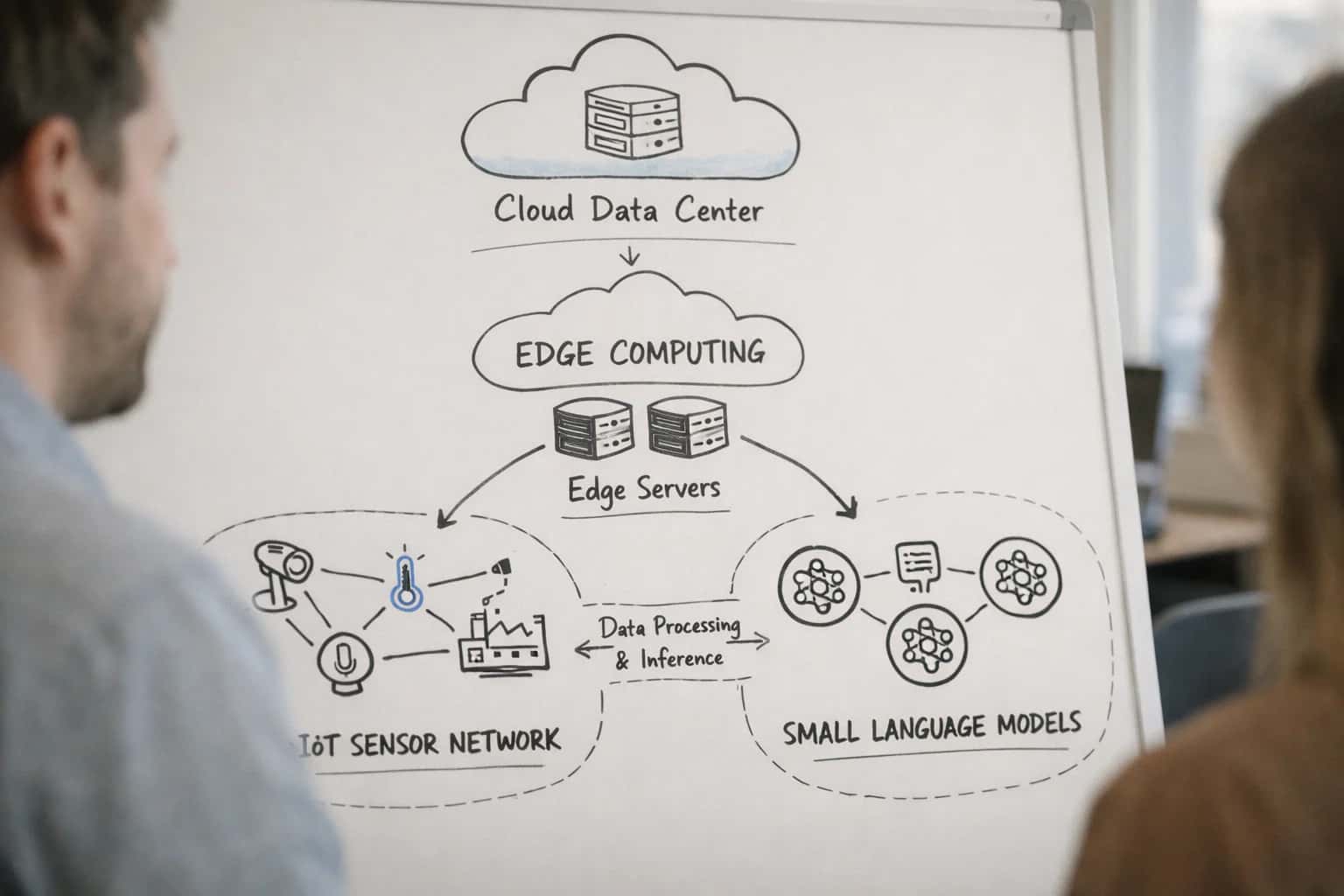
EDGE DEVICE HETEROGENEITY MANAGEMENT
What is Federated Intermittent Connectivity Protocol?
A communication standard for federated learning systems operating on devices with unstable or periodic network access.
The protocol implements mechanisms like checkpointing local training state, using efficient delta encoding for model updates, and employing acknowledgment-based retry logic to ensure update delivery. It works in tandem with availability-aware round scheduling and connectivity-aware compression to maintain system progress. This allows the federated process to continue seamlessly across dynamic batching windows and device sleep cycles, ensuring robust learning even in challenging network conditions.
FEDERATED INTERMITTENT CONNECTIVITY PROTOCOL
Core Protocol Mechanisms
A communication standard enabling edge devices to cache updates, resume interrupted sessions, and synchronize with a server over unstable or periodically available network links.
01
Stateful Session Management
The protocol's core mechanism for tracking training progress across disconnections. It assigns each client a unique session ID and maintains a server-side checkpoint of the last successfully aggregated model state. Clients cache their local gradients and model deltas. Key features include:
- Session Resumption: Clients can rejoin a training round by transmitting their session ID and last known gradient step.
- Checkpointing: The server periodically snapshots the global model, allowing clients to roll back to a known-good state after a prolonged outage.
- Progress Vectors: Clients send compact vectors indicating the number of local epochs completed and data samples processed, enabling the server to account for partial work.
02
Adaptive Heartbeat & Liveness Detection
A dynamic system for determining client availability without overwhelming poor connections. Instead of fixed intervals, the heartbeat rate adapts based on observed network quality and device type (e.g., smartphone vs. sensor).
- Exponential Backoff: If a heartbeat is missed, the polling interval increases to avoid flooding a temporarily unreachable device.
- Grace Periods: Devices entering predicted low-connectivity modes (e.g., airplane mode) can send a final status update, placing them in a suspended queue.
- Liveness Proxies: For deeply embedded devices, a gateway or neighboring device may send heartbeat proxies on its behalf.
03
Priority-Based Update Queuing
Manages the order in which cached client updates are transmitted upon reconnection. Updates are not treated equally; the protocol implements a queue prioritizing based on multiple factors:
- Staleness: Older updates may be deprioritized if the global model has advanced significantly.
- Client Contribution History: Devices that consistently provide high-quality updates receive higher priority.
- Update Magnitude: Larger model deltas (indicating more learning) may be prioritized for faster convergence.
- Resource Cost: The protocol may defer transmission of a large update until the device is on Wi-Fi, if metadata indicates cellular data is in use.
04
Differential Synchronization
A technique for minimizing data transfer when re-synchronizing after a disconnect. Instead of sending the full model or full gradient history, the protocol calculates and transmits only the difference (delta) between the client's cached state and the current server state.
- Delta Encoding: For model parameters, this often involves sending sparse tensors representing only the weights that have changed beyond a threshold.
- Operation Transforms: In some implementations, local training steps are represented as a series of operations (e.g., gradient applied to layer X). These operations are transformed and merged at the server to resolve conflicts.
- Base Versioning: All updates reference a specific base model version, preventing the application of deltas to an incorrect model state.
05
Predictive Pre-fetching
The server proactively pushes necessary assets to clients based on connectivity forecasts and training schedules. This mechanism reduces the latency to begin a training round when a brief connection window opens.
- Connectivity Forecasting: Uses simple machine learning on historical patterns (e.g., a device connects every day at 2 AM) to predict the next available window.
- Model Pre-fetching: The next global model iteration or a required dataset chunk is pushed to the client during a high-bandwidth period.
- Instruction Caching: Training tasks and configurations are cached locally, allowing the device to commence work immediately upon wake-up, even if the server is briefly unreachable.
06
Fallback to Store-and-Forward Mesh
A contingency mechanism for when direct client-server communication is impossible. The protocol allows clients to relay updates peer-to-peer through a mesh of neighboring edge devices until one reaches the server.
- Multi-Hop Routing: Updates are packaged with a TTL (Time-To-Live) and routed through intermediate devices.
- Opportunistic Synchronization: Devices exchange cached updates when they connect via Bluetooth or local Wi-Fi.
- Integrity Verification: Each hop in the mesh cryptographically signs the relayed update package to maintain a verifiable chain of custody back to the original client.
EDGE DEVICE HETEROGENEITY MANAGEMENT
How a Federated Intermittent Connectivity Protocol Works
A technical overview of the communication mechanisms that enable reliable federated learning over unstable, periodically available network links common to mobile and IoT edge devices.
A Federated Intermittent Connectivity Protocol is a communication standard that enables edge devices to cache model updates, resume interrupted training sessions, and reliably synchronize with a central server over unstable or periodically available network links. It is a core component of Edge Device Heterogeneity Management, designed to handle the unpredictable connectivity inherent in mobile and IoT environments. The protocol ensures training continuity despite network drops, which is critical for system resilience.
The protocol operates through mechanisms like checkpointing local model state, using acknowledgment (ACK) and retransmission logic for reliable update delivery, and employing adaptive compression based on link quality. It often integrates with Availability-Aware Round Scheduling to align communication with device uptime. This allows the federated learning process to proceed asynchronously, aggregating updates from clients whenever they reconnect, thus decoupling training progress from constant cloud availability.
FEDERATED INTERMITTENT CONNECTIVITY PROTOCOL
Primary Use Cases and Applications
A Federated Intermittent Connectivity Protocol enables reliable decentralized training across edge devices with unstable or periodic network access. Its primary applications are in environments where continuous cloud connectivity is impossible or undesirable.
01
Mobile & IoT Device Training
This protocol is foundational for training models on smartphones and IoT sensors that frequently enter low-power states or move through areas of poor coverage. It allows devices to:
- Cache gradients and model checkpoints locally.
- Resume training from the last saved state upon reconnection.
- Transmit updates opportunistically when a viable link is available. This is critical for applications like next-word prediction on personal devices or predictive maintenance on industrial sensors in remote locations.
02
Rural & Remote Healthcare
Enables federated learning for medical diagnostics in clinics with satellite or unreliable internet. The protocol ensures:
- Local model improvement on patient data without requiring a persistent uplink.
- Secure, batched synchronization of updates when connectivity is restored.
- Compliance with data sovereignty requirements by keeping sensitive records on-premises. This allows for collaborative improvement of models for detecting diseases like diabetic retinopathy from retinal scans across distributed, low-connectivity health centers.
03
Autonomous Vehicle Fleets
Manages learning from vehicles that have highly variable connectivity based on location and mission. The protocol handles:
- Disconnected operation during off-road or subterranean missions.
- Priority queuing of model updates, sending critical safety-related learnings first when a brief connection is established.
- Reconciliation of training progress across vehicles that connect at vastly different intervals. This allows a fleet to collectively learn to handle rare edge-case scenarios without requiring each vehicle to have constant 5G access.
04
Industrial & Agricultural IoT
Supports predictive maintenance and yield optimization models on equipment in fields, mines, or offshore platforms. The protocol addresses:
- Long disconnection periods due to environmental factors or scheduled downtime.
- Bandwidth constraints of legacy industrial networks.
- Resilient update propagation across a mesh of intermittently connected nodes. For example, combines in a field can locally train a model on grain quality data and sync only at the end of the day when they return to a Wi-Fi hub.
05
Disaster Response & Tactical Networks
Facilitates machine learning in ad-hoc, degraded communication environments like disaster zones or tactical edge networks. The protocol provides:
- Store-and-forward capabilities for model updates across a intermittently connected mesh.
- Conflict resolution for models trained on divergent data during network partitions.
- Low-overhead handshakes to quickly establish synchronization sessions during brief contact windows. This enables first responders' devices to collaboratively improve situational awareness models (e.g., for damage assessment from images) even with patchy connectivity.
06
Personalized On-Device Learning
Enables privacy-preserving personalization for applications like fitness trackers or smart home assistants. The protocol allows:
- A device to train locally on user behavior patterns over days or weeks.
- Intermittent synchronization with a central personalization server to refine a global user model, often only when the device is charging and on Wi-Fi.
- Graceful degradation of model freshness if the user goes offline for extended periods, falling back to a last-known-good personalized model. This balances the need for continuous learning with user privacy and device resource management.
COMMUNICATION PROTOCOL COMPARISON
FICP vs. Synchronous Federated Learning
A direct comparison of the Federated Intermittent Connectivity Protocol (FICP) with traditional Synchronous Federated Learning, highlighting key differences in communication strategy, client participation, and resilience to network instability.
| Feature | Federated Intermittent Connectivity Protocol (FICP) | Synchronous Federated Learning |
|---|---|---|
Core Communication Strategy | Asynchronous, connection-agnostic | Synchronous, round-based |
Client Participation Model | Opportunistic; clients train and transmit when connectivity allows | Strict; all selected clients must be online and complete work within a fixed round |
Update Aggregation Trigger | Server-driven based on update queue or time windows | Round-driven after all client updates are received or timeout |
Handling of Client Dropout | Inherently resilient; partial updates are cached and sent later | Problematic; dropped clients cause stragglers, slowing the entire round |
Required Client State Management | Persistent local cache for model updates and training state | Minimal; typically stateless between rounds |
Typical Latency per Global Update | Variable, often lower median due to no waiting for stragglers | High, bounded by the slowest client in the round |
System Throughput (Updates/Time) | High; continuous integration of updates from available clients | Lower; gated by the slowest round completion time |
Optimal Use Case | Mobile/IoT networks with unstable/predictable connectivity | Controlled data center or stable enterprise network environments |
Client-Side Resource Overhead | Moderate (requires caching and state management logic) | Low (primarily compute for the training task itself) |
Server-Side Complexity | Higher (requires robust update queuing, staleness handling, and aggregation logic) | Lower (simpler round coordination and averaging) |
FEDERATED INTERMITTENT CONNECTIVITY PROTOCOL
Frequently Asked Questions
A federated intermittent connectivity protocol is a communication standard designed for edge devices with unstable or periodic network access. It enables reliable model synchronization in federated learning by managing cached updates, session resumption, and fault-tolerant communication.
A Federated Intermittent Connectivity Protocol is a communication standard that enables edge devices to participate in federated learning over unstable, low-bandwidth, or periodically available network links. Its core function is to ensure reliable synchronization between clients and the central server by managing cached model updates, resuming interrupted training sessions, and handling network failures gracefully. This is distinct from standard federated learning protocols, which often assume persistent, high-quality connectivity. Key mechanisms include checkpointing local training state, differential updates that send only changes since the last successful transmission, and acknowledgment-based retry logic to guarantee update delivery. Protocols like Federated Averaging with Buffered Updates (FedBuff) exemplify this approach, allowing devices to train offline and transmit when a connection is restored.
Enabling Efficiency, Speed & Accuracy
Intelligent Analysis, Decision & Execution
We build AI systems for teams that need search across company data, workflow automation across tools, or AI features inside products and internal software.
Talk to Us
Search across company data
Give teams answers from docs, tickets, runbooks, and product data with sources and permissions.
Useful when people spend too long searching or get different answers from different systems.
Enterprise searchRAGPermissions
Read more
Automate internal workflows
Use AI to route work, draft outputs, trigger actions, and keep approvals and logs in place.
Useful when repetitive work moves across multiple tools and teams.
AI agentsWorkflow automationGovernance
Read more
Add AI to products and internal tools
Build assistants, guided actions, or decision support into the software your team or customers already use.
Useful when AI needs to be part of the product, not a separate tool.
AI integrationDecision supportModel routing
Read more
About the author
Prasad Kumkar
CEO & MD, Inference Systems
Prasad Kumkar is the CEO & MD of Inference Systems and writes about AI systems architecture, LLM infrastructure, model serving, evaluation, and production deployment. Over 5+ years, he has worked across computer vision models, L5 autonomous vehicle systems, and LLM research, with a focus on taking complex AI ideas into real-world engineering systems.
His work and writing cover AI systems, large language models, AI agents, multimodal systems, autonomous systems, inference optimization, RAG, evaluation, and production AI engineering.
LinkedIn
Limited slotsGet a Free AI Consultation
Partnered with leading AI, data, and software stack.





How We Work
Custom AI workflows for your Business
One-fit-all AI don't work for modern businesses. At Inferensys, we aim to understand your business & custom requirements; which we use to define most efficient agentic workflows, the data, and the tools for your business.
01
Review the use case
We understand the task, the users, and where AI can actually help.
Read more02
Pick the right approach
We define what needs search, automation, or product integration.
Read more03
Build the first useful version
We implement the part that proves the value first.
Read more04
Improve from there
We add the checks and visibility needed to keep it useful.
Read moreThe first call is a practical review of your use case and the right next step.
Talk to Us