A Federated Hardware Abstraction Layer (HAL) is a software interface within a federated learning framework that standardizes interactions with diverse edge hardware—such as CPUs, GPUs, and NPUs—enabling the deployment of training tasks without requiring device-specific code. It acts as a translator between the framework's generic training instructions and the low-level hardware-specific libraries, allowing a single model training script to run across a heterogeneous fleet of devices. This abstraction is critical for client capability profiling and resource-aware scheduling, as it provides a uniform method to query and utilize available compute resources.

Glossary
Federated Hardware Abstraction Layer (HAL)
A Federated Hardware Abstraction Layer (HAL) is a software interface within a federated learning framework that standardizes interactions with diverse edge hardware, enabling model training without device-specific code.
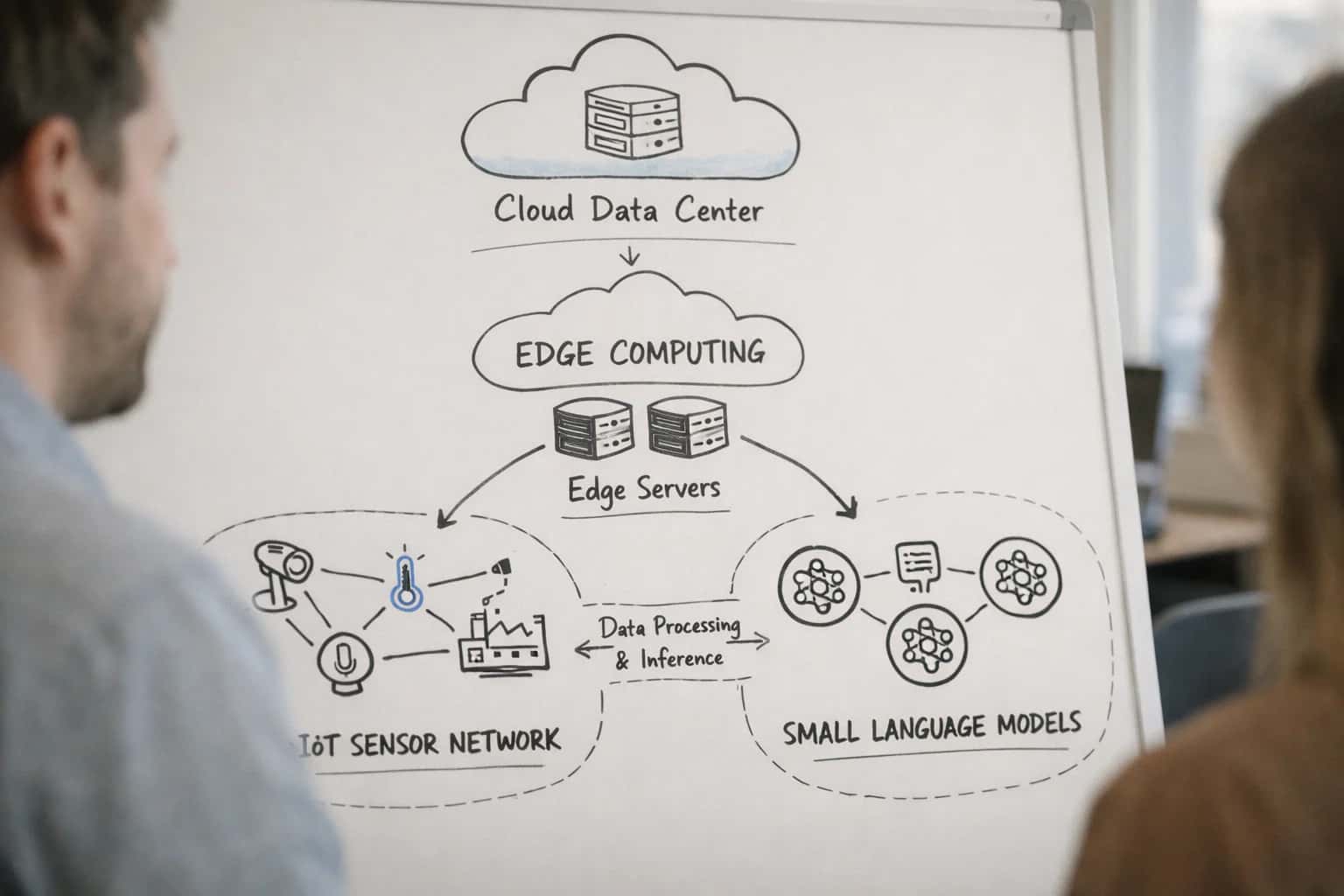
EDGE DEVICE HETEROGENEITY MANAGEMENT
What is Federated Hardware Abstraction Layer (HAL)?
A software interface standardizing interactions with diverse edge hardware in federated learning systems.
The HAL manages operations like tensor computations and memory allocation by delegating to optimized backends like CUDA for NVIDIA GPUs or the Neural Networks API for Android NPUs. This allows dynamic batching and memory-constrained optimization to be implemented portably. By insulating the learning algorithm from hardware variability, the HAL enables elastic federated learning and supports techniques like federated quantization-aware training (FQAT), ensuring models can be efficiently trained and deployed across the entire capability spectrum of the federated network.
FEDERATED HARDWARE ABSTRACTION LAYER
Core Functions of a Federated HAL
A Federated Hardware Abstraction Layer (HAL) is a critical software interface that standardizes interactions between a federated learning framework and the diverse, heterogeneous hardware found across edge devices. Its primary functions ensure efficient, reliable, and scalable decentralized training.
01
Unified Hardware Interface
The HAL provides a single, consistent API for the federated learning orchestrator to interact with, regardless of the underlying client hardware. This abstracts away the complexities of specific accelerators (e.g., NPUs, GPUs, DSPs) and system libraries (e.g., CUDA, OpenCL, ARM Compute Library).
- Example: A training task is dispatched as a generic compute graph. The HAL translates this graph into optimized kernels for an iPhone's Neural Engine, an Android phone's Qualcomm Hexagon DSP, and a Raspberry Pi's CPU, without requiring separate device-specific code paths in the main framework.
02
Capability Discovery & Profiling
The HAL dynamically profiles each client device to build a detailed capability registry. This includes measuring:
- Compute Performance: FLOPs, core count, accelerator availability.
- Memory Constraints: Available RAM, persistent storage.
- Power & Thermal State: Battery level, thermal headroom.
- Network Interface: Bandwidth, latency, cost.
This profile enables resource-aware scheduling, allowing the server to match training tasks (model size, batch size, local epochs) to devices that can complete them efficiently without crashing or excessive delay.
03
Adaptive Model Transformation
To handle hardware heterogeneity, the HAL performs on-the-fly model transformations tailored to each device's profile. Key techniques include:
- Dynamic Quantization: Converting a global FP32 model to INT8 for efficient inference and training on devices with quantized math acceleration.
- Selective Pruning: Applying capability-based pruning to create a smaller, sparser sub-model for memory-constrained clients.
- Graph Optimization: Fusing operations and selecting optimal kernel implementations for the target hardware. This ensures a Raspberry Pi and a data center GPU can both contribute to training the same logical model, despite vast differences in capability.
04
Execution & Resource Management
The HAL manages the full lifecycle of the local training task on the device, acting as an intelligent runtime. Core responsibilities are:
- Dynamic Batching: Automatically adjusting the local batch size based on available memory to prevent out-of-memory (OOM) errors.
- Checkpointing & Recovery: Saving intermediate state to allow training to resume after an interruption (e.g., app backgrounding).
- Thermal-Throttling Management: Proactively reducing computational intensity or pausing training when device temperature rises.
- Power-Aware Scheduling: Deferring or scaling down computation based on battery status and power source. This maximizes participation from devices with intermittent connectivity and variable resource availability.
05
Standardized Update Packaging
After local training, the HAL is responsible for preparing the model update (e.g., gradients, weight deltas) for transmission. This involves:
- Lossless Compression: Applying algorithms like gzip or Brotli to reduce payload size.
- Structured Serialization: Converting the update into a standard, framework-agnostic format (e.g., Protocol Buffers, FlatBuffers).
- Metadata Attachment: Appending the device's capability profile and training context (e.g., local data sample count) to the update. This standardized package enables the server's secure aggregation protocol to efficiently combine updates from thousands of different hardware platforms.
06
Integration with System Orchestrators
The HAL does not operate in isolation; it provides hooks for higher-level federated learning orchestrators (e.g., Flower, NVIDIA FLARE, FedML). It exposes real-time telemetry on device status, training progress, and resource utilization.
This allows the orchestrator to implement advanced strategies like:
- Stratified Client Sampling: Ensuring a representative mix of device tiers is selected for each training round.
- Asynchronous Federated Updates: Aggregating updates from slower devices as they arrive, rather than waiting for a synchronized round.
- Elastic Federated Learning: Dynamically scaling the global model complexity up or down based on the collective resources of the available client pool.
SYSTEM ARCHITECTURE
How a Federated HAL Works in Practice
A Federated Hardware Abstraction Layer (HAL) operationalizes the theoretical abstraction by managing the lifecycle of a training task across a heterogeneous device fleet.
In practice, a Federated HAL functions as a distributed runtime. During a training round, the server's orchestrator queries the federated device registry and uses client capability profiling to select suitable devices. It then packages the global model and training task, which the HAL's client-side agent receives. This agent interfaces directly with the device's local hardware—CPU, GPU, or NPU—via standardized calls, insulating the framework from driver-level specifics. The agent also consults an on-device resource monitor to enforce constraints like memory-constrained optimization or dynamic batching, ensuring the task completes without crashing the device.
Post-training, the HAL handles the secure packaging and transmission of the model update. It implements connectivity-aware compression if the network is poor and may cache updates via a federated intermittent connectivity protocol. Back on the server, the HAL's aggregation component normalizes the heterogeneous updates—which may come from devices that performed variable-length training rounds or used different precision—before secure averaging. This end-to-end management by the HAL enables elastic federated learning, where the system dynamically adapts to the ever-changing pool of available edge resources.
ARCHITECTURAL COMPARISON
Federated HAL vs. Traditional HAL
A comparison of the core architectural principles and operational characteristics of a Federated Hardware Abstraction Layer versus a conventional HAL.
| Architectural Feature | Traditional Hardware Abstraction Layer (HAL) | Federated Hardware Abstraction Layer (HAL) |
|---|---|---|
Primary Design Goal | Provide a stable, uniform API for a single operating system to control local hardware components. | Provide a uniform API for a federated learning framework to deploy training tasks across a massively heterogeneous, geographically dispersed fleet of edge devices. |
Scope of Abstraction | Local device hardware (e.g., CPU, GPU, sensors on one machine). | Cross-device hardware heterogeneity (e.g., CPUs, GPUs, NPUs, TPUs across millions of different devices). |
Central Orchestrator | The local operating system kernel or driver framework. | The federated learning server or orchestrator, which manages the global training lifecycle. |
Key Managed Resource | Hardware register access, interrupts, memory-mapped I/O. | Compute capability (FLOPS), memory budget, thermal envelope, battery state, and network bandwidth. |
Client Autonomy | None. Hardware is controlled directly by the local OS. | High. Clients self-report capabilities and can adapt training (e.g., dynamic batching) based on real-time resource monitors. |
Update Synchronization | Driver updates are monolithic and pushed to the device. | Model updates are aggregated from clients; the HAL itself may receive capability-aware model partitions or pruned architectures. |
Communication Pattern | In-process or kernel-mode calls; low-latency, high-bandwidth. | Network-based (often intermittent); high-latency, bandwidth-constrained, requiring compression and resume protocols. |
Exemplary Function Call |
|
|
IMPLEMENTATIONS
Frameworks and Platforms Implementing HAL Concepts
A Federated Hardware Abstraction Layer (HAL) is a software interface within a federated learning framework that standardizes interactions with diverse edge hardware. The following platforms and libraries incorporate or enable HAL-like functionality to manage device heterogeneity.
FEDERATED HARDWARE ABSTRACTION LAYER (HAL)
Frequently Asked Questions
A Federated Hardware Abstraction Layer (HAL) is a critical software interface that standardizes interactions between a federated learning framework and the diverse, heterogeneous hardware found on edge devices. This FAQ addresses its core functions, implementation, and role in managing device heterogeneity.
A Federated Hardware Abstraction Layer (HAL) is a software interface within a federated learning framework that provides a uniform API for executing machine learning workloads across diverse and heterogeneous edge hardware, such as CPUs, GPUs, NPUs, and microcontrollers. Its primary function is to abstract away device-specific complexities, allowing the federated learning orchestrator to deploy training tasks without writing custom code for every chipset or accelerator. The HAL sits between the high-level federated learning algorithms and the low-level hardware drivers, translating generic tensor operations (e.g., matrix multiplications, convolutions) into optimized kernel calls for the specific silicon available on each client device. This enables resource-agnostic model deployment, where a single global model update can be efficiently trained on a smartphone's GPU, a Raspberry Pi's CPU, and an IoT sensor's microcontroller in the same federated round.
Enabling Efficiency, Speed & Accuracy
Intelligent Analysis, Decision & Execution
We build AI systems for teams that need search across company data, workflow automation across tools, or AI features inside products and internal software.
Talk to Us
Search across company data
Give teams answers from docs, tickets, runbooks, and product data with sources and permissions.
Useful when people spend too long searching or get different answers from different systems.
Enterprise searchRAGPermissions
Read more
Automate internal workflows
Use AI to route work, draft outputs, trigger actions, and keep approvals and logs in place.
Useful when repetitive work moves across multiple tools and teams.
AI agentsWorkflow automationGovernance
Read more
Add AI to products and internal tools
Build assistants, guided actions, or decision support into the software your team or customers already use.
Useful when AI needs to be part of the product, not a separate tool.
AI integrationDecision supportModel routing
Read more
About the author
Prasad Kumkar
CEO & MD, Inference Systems
Prasad Kumkar is the CEO & MD of Inference Systems and writes about AI systems architecture, LLM infrastructure, model serving, evaluation, and production deployment. Over 5+ years, he has worked across computer vision models, L5 autonomous vehicle systems, and LLM research, with a focus on taking complex AI ideas into real-world engineering systems.
His work and writing cover AI systems, large language models, AI agents, multimodal systems, autonomous systems, inference optimization, RAG, evaluation, and production AI engineering.
LinkedIn
Limited slotsGet a Free AI Consultation
Partnered with leading AI, data, and software stack.





How We Work
Custom AI workflows for your Business
One-fit-all AI don't work for modern businesses. At Inferensys, we aim to understand your business & custom requirements; which we use to define most efficient agentic workflows, the data, and the tools for your business.
01
Review the use case
We understand the task, the users, and where AI can actually help.
Read more02
Pick the right approach
We define what needs search, automation, or product integration.
Read more03
Build the first useful version
We implement the part that proves the value first.
Read more04
Improve from there
We add the checks and visibility needed to keep it useful.
Read moreThe first call is a practical review of your use case and the right next step.
Talk to Us