Gradient quantization is a communication compression technique in federated learning where high-precision gradient values (e.g., 32-bit floating-point numbers) are mapped to a lower-bit representation (e.g., 8-bit integers) before transmission from clients to the server. This process drastically reduces the number of bits required per model update, directly addressing the uplink communication bottleneck that is typical in distributed edge networks. The core trade-off involves managing the introduced quantization noise to ensure the global model still converges effectively.

Glossary
Gradient Quantization
Gradient quantization is a communication compression technique in federated learning where high-precision gradient values are mapped to a lower-bit representation before transmission to reduce bandwidth.
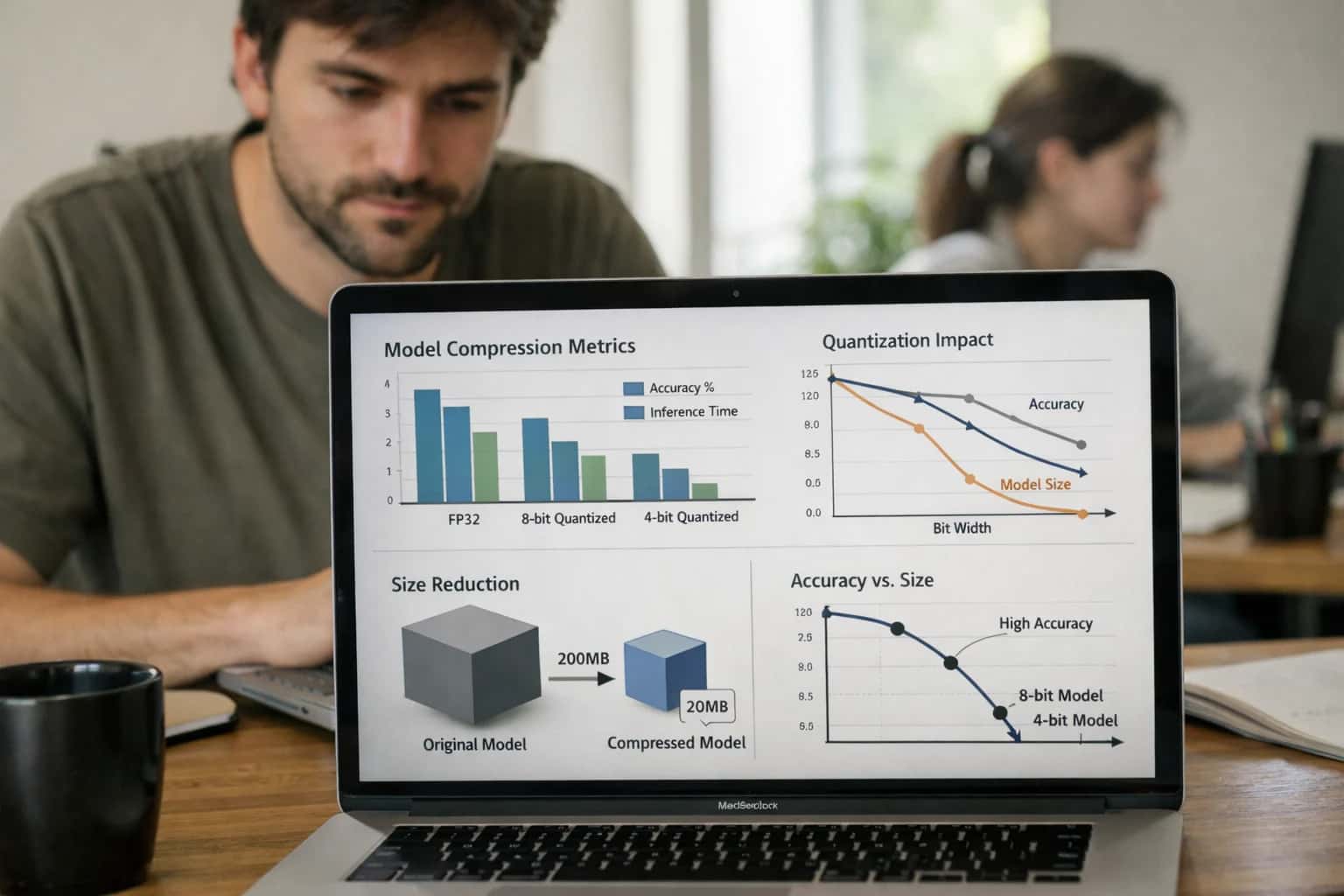
COMMUNICATION-EFFICIENT FEDERATED LEARNING
What is Gradient Quantization?
Gradient quantization is a core technique for reducing the communication bandwidth required in federated learning systems.
Common schemes include uniform quantization, where the range of gradient values is divided into equal intervals, and non-uniform methods that allocate more precision to critical values. It is often combined with techniques like gradient clipping to bound values before quantization and error feedback, where compression error is stored locally and added to the next round's gradient. This maintains convergence guarantees despite the lossy compression, making it foundational for communication-efficient federated learning alongside sibling techniques like gradient sparsification and SignSGD.
COMMUNICATION-EFFICIENT FEDERATED LEARNING
Key Characteristics of Gradient Quantization
Gradient quantization is a core compression technique that reduces the bit-width of transmitted updates. Its design involves trade-offs between communication savings, computational overhead, and model convergence.
01
Bit-Width Reduction
The fundamental operation of gradient quantization is mapping high-precision 32-bit floating-point values to a lower-bit representation, such as 8-bit integers or even 1-bit signs. This directly reduces the number of bits required per parameter update. Common schemes include:
- Uniform Quantization: Divides the value range into equal intervals.
- Non-Uniform Quantization: Uses intervals of varying sizes, often based on value distribution (e.g., log-scale).
- Stochastic Quantization: Randomly rounds values to neighboring quantization levels, which can be unbiased and improve convergence. The choice of bit-width (e.g., 4-bit, 8-bit) creates a direct trade-off: lower bits mean higher compression but introduce more quantization noise.
02
Quantization-Aware Training
To mitigate the distortion caused by low-precision gradients, algorithms often incorporate quantization directly into the training loop. This differs from post-training quantization. Key mechanisms include:
- Error Feedback: The local compression error (difference between original and quantized gradient) is stored in a residual buffer and added to the next round's gradient before quantization. This preserves the expected value of the transmitted update, maintaining convergence guarantees.
- Gradient Clipping: Before quantization, gradients are clipped to a fixed range (e.g., [-τ, τ]). This bounds the dynamic range, making quantization more stable and efficient, and is also a prerequisite for differential privacy.
- Adaptive Range Estimation: The clipping threshold τ or quantization range is dynamically adjusted based on observed gradient statistics across rounds.
03
Convergence Under Compression
A primary theoretical concern is whether the quantized federated optimization process still converges to a good model. Analysis shows that with proper techniques, convergence is preserved, albeit often at a slower rate. Critical factors include:
- Unbiased vs. Biased Quantizers: Stochastic quantization can be designed to be unbiased (expected value equals original gradient), leading to standard convergence rates. Biased quantizers (like deterministic rounding) require different analysis.
- Variance Increase: Quantization acts as noise injection, increasing the variance of the aggregated update. Algorithms must compensate, often through techniques like error feedback or adjusting the learning rate.
- Communication-Computation Trade-off: While quantization reduces bits per round, it may require more communication rounds to achieve the same accuracy as full-precision training. The overall communication complexity (total bits transmitted) is the key metric.
04
System-Level Integration
Deploying gradient quantization requires integration with broader federated learning system components. Key integration points are:
- Compatibility with Secure Aggregation: Quantized integer values are well-suited for cryptographic secure aggregation protocols (e.g., using Homomorphic Encryption or Secure Multi-Party Computation), as they operate in a finite integer domain.
- Handling Device Heterogeneity: Quantization reduces the uplink communication payload size, which is critical for clients with limited or expensive bandwidth (e.g., mobile devices, satellites).
- Orchestrator Support: The central server (or federated learning orchestrator) must implement the dequantization step, converting received low-bit integers back into floating-point values for aggregation (e.g., Federated Averaging).
- Combination with Other Techniques: Quantization is frequently combined with gradient sparsification (sending only a subset of values) for multiplicative compression gains.
05
Extreme 1-Bit & Ternary Methods
The most aggressive forms of quantization reduce each gradient component to just one or two bits, representing an extreme point in the efficiency-accuracy trade-off.
- SignSGD: Clients transmit only the sign (+1 or -1) of each gradient. The server aggregates updates via a majority vote. Communication cost is 1 bit per parameter.
- Sparse Ternary Compression (STC): Combines sparsification with ternary quantization. Gradients are quantized to three levels {−α, 0, +α}, and only the non-zero values (and their indices) are transmitted.
- Benefits: These methods enable massive compression, making federated learning feasible over very low-bandwidth links. They can also provide inherent robustness to outliers.
- Challenges: They introduce significant bias and noise, requiring careful tuning and often more aggregation rounds to converge.
06
Hardware & Numerical Efficiency
Beyond communication savings, quantization offers computational benefits on both clients and server.
- Faster Client Computation: Training with lower precision (e.g., 8-bit) can leverage optimized integer arithmetic units on modern CPUs, GPUs, and Neural Processing Units (NPUs), speeding up local Stochastic Gradient Descent.
- Reduced Server Memory & Bandwidth: The server receives and must buffer smaller updates, reducing memory pressure during aggregation.
- Standardized Formats: Using integer types (int8, int32) aligns with efficient network serialization protocols (like Protocol Buffers) and avoids the complexity of sending raw float arrays.
- Energy Savings: Transmitting fewer bits directly reduces the radio energy consumption on battery-constrained edge devices, a critical factor for IoT and mobile deployments.
COMPARISON
Gradient Quantization vs. Other Compression Techniques
A technical comparison of gradient quantization against other primary methods for reducing communication bandwidth in federated learning systems.
| Feature / Metric | Gradient Quantization | Gradient Sparsification | Low-Rank Approximation |
|---|---|---|---|
Core Mechanism | Reduces bit-depth of each value (e.g., 32-bit float → 8-bit int) | Transmits only a subset of values (e.g., top-k by magnitude) | Approximates update as product of two low-rank matrices |
Compression Target | Precision of individual gradient elements | Cardinality (number) of non-zero gradient elements | Intrinsic dimensionality of the update matrix |
Typinal Bit Reduction | 2x to 8x per parameter | 10x to 100x (sparsity-dependent) | 10x to 50x (rank-dependent) |
Preserves Convergence Guarantees | |||
Requires Error Feedback | |||
Adds Computational Overhead | < 1% | ~1-5% for top-k selection | ~5-15% for matrix factorization |
Compatible with Secure Aggregation | |||
Optimal Use Case | Bandwidth-limited, compute-rich clients | Extremely sparse gradients (e.g., NLP models) | Updates with inherent low-rank structure (e.g., later DNN layers) |
GRADIENT QUANTIZATION
Frequently Asked Questions
Gradient quantization is a core technique for reducing the communication overhead in federated learning. These questions address its mechanics, trade-offs, and implementation.
Gradient quantization is a communication compression technique in federated learning where high-precision gradient values (e.g., 32-bit floating-point numbers) are mapped to a lower-bit representation (e.g., 8-bit integers) before transmission from clients to the server. The process typically involves three steps: first, the local client computes a gradient update via Stochastic Gradient Descent (SGD); second, this gradient is clipped to a fixed range to control its dynamic range; third, the clipped values are uniformly or non-uniformly quantized, often using a deterministic or stochastic rounding function to the nearest discrete level in the low-bit representation. The server receives these quantized gradients, de-quantizes them, and aggregates them to update the global model. This reduces the uplink communication payload by a factor of 4x (32-bit to 8-bit) or more, directly lowering bandwidth consumption and accelerating training rounds.
Enabling Efficiency, Speed & Accuracy
Intelligent Analysis, Decision & Execution
We build AI systems for teams that need search across company data, workflow automation across tools, or AI features inside products and internal software.
Talk to Us
Search across company data
Give teams answers from docs, tickets, runbooks, and product data with sources and permissions.
Useful when people spend too long searching or get different answers from different systems.
Enterprise searchRAGPermissions
Read more
Automate internal workflows
Use AI to route work, draft outputs, trigger actions, and keep approvals and logs in place.
Useful when repetitive work moves across multiple tools and teams.
AI agentsWorkflow automationGovernance
Read more
Add AI to products and internal tools
Build assistants, guided actions, or decision support into the software your team or customers already use.
Useful when AI needs to be part of the product, not a separate tool.
AI integrationDecision supportModel routing
Read more
About the author
Prasad Kumkar
CEO & MD, Inference Systems
Prasad Kumkar is the CEO & MD of Inference Systems and writes about AI systems architecture, LLM infrastructure, model serving, evaluation, and production deployment. Over 5+ years, he has worked across computer vision models, L5 autonomous vehicle systems, and LLM research, with a focus on taking complex AI ideas into real-world engineering systems.
His work and writing cover AI systems, large language models, AI agents, multimodal systems, autonomous systems, inference optimization, RAG, evaluation, and production AI engineering.
LinkedIn
Limited slotsGet a Free AI Consultation
Partnered with leading AI, data, and software stack.





How We Work
Custom AI workflows for your Business
One-fit-all AI don't work for modern businesses. At Inferensys, we aim to understand your business & custom requirements; which we use to define most efficient agentic workflows, the data, and the tools for your business.
01
Review the use case
We understand the task, the users, and where AI can actually help.
Read more02
Pick the right approach
We define what needs search, automation, or product integration.
Read more03
Build the first useful version
We implement the part that proves the value first.
Read more04
Improve from there
We add the checks and visibility needed to keep it useful.
Read moreThe first call is a practical review of your use case and the right next step.
Talk to Us