Decentralized federated learning (DFL) is a peer-to-peer machine learning paradigm where distributed clients (e.g., edge devices) train a shared model by directly exchanging and averaging parameter updates with a subset of neighboring peers, typically using gossip protocols or consensus algorithms. This architecture removes the single point of failure and communication bottleneck of a central server, creating a more resilient and scalable network for collaborative learning on private, decentralized data.

Glossary
Decentralized Federated Learning
Decentralized Federated Learning is a peer-to-peer machine learning architecture where edge devices collaboratively train a model by directly exchanging updates with neighbors via gossip protocols, eliminating the central aggregation server.
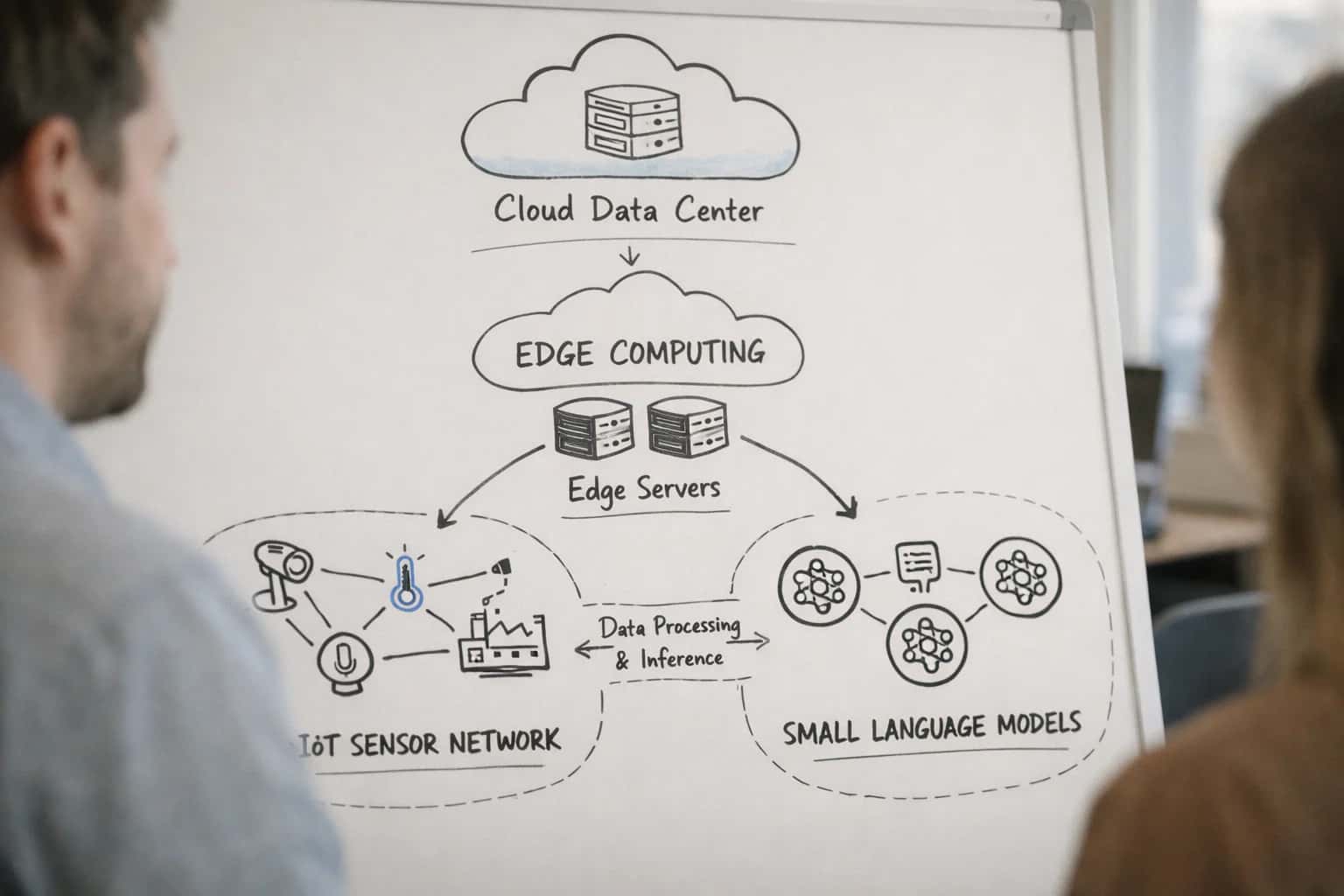
COMMUNICATION-EFFICIENT FEDERATED LEARNING
What is Decentralized Federated Learning?
Decentralized federated learning is a peer-to-peer architecture where clients collaborate by directly exchanging model updates with their neighbors, eliminating the central aggregation server.
The system operates through iterative local training and peer-to-peer communication rounds. Each client performs Stochastic Gradient Descent on its local dataset, then transmits its updated model parameters to randomly selected neighbors. Through repeated averaging exchanges, knowledge diffuses across the network, converging towards a consensus model. This approach inherently reduces reliance on any single infrastructure component and can lower communication latency, though it introduces challenges in managing client drift and ensuring convergence across heterogeneous data and network topologies.
ARCHITECTURAL PARADIGM
Key Characteristics of Decentralized Federated Learning
Decentralized Federated Learning (DFL) replaces the central server with a peer-to-peer network where clients collaborate directly. This architecture fundamentally alters system properties, resilience, and communication patterns compared to its centralized counterpart.
01
Peer-to-Peer Gossip Protocols
The core communication mechanism in DFL is the gossip protocol (or epidemic protocol). Instead of sending updates to a server, each client (node) periodically selects a random subset of neighboring peers and exchanges model parameters. Through repeated pairwise averaging, knowledge diffuses across the entire network until consensus on a global model is asymptotically achieved. This eliminates the single point of failure and communication bottleneck of a central aggregator.
- Example: A node averages its model weights with a peer's weights, then both proceed to gossip with other nodes.
- Key Property: Eventual consistency is guaranteed under mild connectivity assumptions, but convergence speed depends on network topology.
02
Elimination of Central Server
DFL architectures completely remove the central parameter server. This has profound implications:
- Resilience & Fault Tolerance: The system has no single point of failure. The failure of any individual node only marginally slows convergence.
- Data Sovereignty & Trust: Clients never entrust their updates to a third-party server, enhancing perceived privacy and aligning with sovereign AI principles.
- Load Distribution: The computational and communication burden of aggregation is distributed across all participating nodes, preventing server-side bottlenecks.
Trade-off: This comes at the cost of more complex coordination, potentially slower convergence due to multi-hop communication, and the need for robust peer discovery mechanisms.
03
Network Topology Dependence
System performance is intrinsically linked to the underlying communication graph connecting clients. Key topologies include:
- Fully Connected: Impractical at scale but offers fastest convergence.
- Ring / Chain: Simple but slow diffusion; a single break disrupts flow.
- Random Graph / Erdős–Rényi: Common in theoretical analysis; each node connects to others with probability p.
- Geographic / Proximity-Based: Nodes communicate with physically nearby peers (e.g., other phones in a Bluetooth mesh), minimizing latency and wide-area bandwidth use.
Convergence rate is directly affected by the spectral gap of the network's mixing matrix. A larger gap (better connectivity) leads to faster consensus. Topology must be managed to balance convergence speed with communication cost and physical constraints.
04
Asynchronous & Uncoordinated Execution
DFL naturally supports asynchronous operation. Clients do not need to be synchronized in training rounds. They can:
- Perform local training at their own pace (e.g., when charging, on Wi-Fi).
- Initiate gossip exchanges with available neighbors independently.
This is crucial for real-world edge environments with extreme heterogeneity in device availability, compute power, and energy. It avoids the straggler problem prevalent in synchronized centralized FL. However, it introduces model staleness, where a node may receive an update from a peer that is several local iterations behind. Algorithms must be robust to this asynchronous, potentially stale, information flow.
05
Enhanced Privacy & Security Profile
While DFL does not provide cryptographic privacy by itself, its architecture alters the threat model:
- Privacy: Updates are only exposed to a small, randomly changing set of direct peers rather than a central entity. This limits the attack surface for model inversion or membership inference attacks.
- Security: It is inherently resistant to server-targeted attacks (e.g., DDoS on the aggregator). However, it introduces new challenges like Byzantine resilience in a peer-to-peer setting, where malicious nodes can spread corrupted models to their neighbors. Gossip protocols must be designed with verification mechanisms (e.g., reputation systems, proof-of-work) to tolerate a fraction of Byzantine peers.
DFL is often combined with secure multi-party computation (MPC) or differential privacy for stronger, formal guarantees.
06
Convergence to Consensus
The learning objective shifts from optimizing a global loss on a server to achieving consensus on model parameters across the network. The global model is not stored anywhere but is emergent. The convergence guarantee is typically of the form:
lim_(k→∞) ‖w_i^k - w̄^k‖ → 0 for all nodes i,
where w_i^k is the model at node i and w̄^k is the average model across the network at iteration k.
Challenges: Data heterogeneity (non-IID) causes client drift locally, which gossip must correct. The consensus distance (how far nodes are from agreement) is a key metric. Algorithms like Decentralized Parallel SGD (D-PSGD) prove convergence rates that depend on network connectivity and data variance. Final model quality may differ from centralized FL due to the consensus-based averaging process.
COMMUNICATION-EFFICIENT FEDERATED LEARNING
How Decentralized Federated Learning Works: The Gossip Protocol
Decentralized federated learning eliminates the central server by enabling clients to directly exchange model updates with their neighbors.
A gossip protocol is a decentralized, peer-to-peer communication scheme where each participating node (client or edge server) periodically exchanges and averages its model parameters with a randomly selected subset of its peers. This process of repeated local averaging allows knowledge—in the form of model updates—to propagate diffusively across the entire network. Over successive communication rounds, this consensus algorithm ensures all nodes converge towards a unified global model without any central coordination point, fundamentally altering the system's topology and fault tolerance.
The protocol operates in synchronized rounds: each node trains locally on its private data, then initiates a gossip step by sending its updated model to k randomly chosen neighbors while simultaneously receiving their models. A critical mechanism is model averaging, where a node computes a weighted average of its own parameters and those received. This design inherently mitigates single points of failure and reduces communication bottlenecks, as traffic is distributed across the network's edges rather than funneled through a central aggregator, though it may increase the total number of messages required for convergence.
ARCHITECTURE COMPARISON
Decentralized vs. Centralized Federated Learning
A technical comparison of the two primary architectural paradigms for federated learning, focusing on communication patterns, scalability, and system resilience.
| Architectural Feature | Centralized Federated Learning | Decentralized Federated Learning |
|---|---|---|
Coordination Topology | Star topology with a central parameter server | Peer-to-peer mesh or ring topology |
Aggregation Point | Single central server | Distributed across participating client nodes |
Primary Communication Pattern | Client-server (many-to-one, one-to-many) | Gossip or consensus protocol (many-to-many) |
Critical Single Point of Failure | Central aggregation server | None (inherently resilient) |
Scalability Bottleneck | Server compute/bandwidth for aggregation | Network diameter & peer connection management |
Convergence Mechanism | Synchronous or asynchronous averaging by server | Iterative local averaging with neighbors |
Typical Latency per Round | Bounded by slowest client in synchronous mode | Determined by local peer communication latency |
Communication Overhead per Node | High (full model upload/download to/from server) | Lower (exchanges only with a subset of neighbors) |
Privacy Threat Surface | Server sees all individual updates (requires trust) | Updates only shared with direct peers; no global view |
System Heterogeneity Tolerance | Low (stragglers delay entire round) | High (local progress continues despite slow nodes) |
Join/Leave (Churn) Handling | Complex server-side cohort management required | Native resilience via dynamic peer discovery |
Primary Use Case | Controlled environments with a trusted coordinator (e.g., cross-silo FL) | Ad-hoc, massive-scale networks (e.g., mobile/IoT swarms) |
DECENTRALIZED FEDERATED LEARNING
Applications and Use Cases
Decentralized federated learning enables collaborative model training across distributed devices without a central server. Its peer-to-peer architecture is uniquely suited for scenarios demanding resilience, low-latency, and absolute privacy.
01
Healthcare & Medical Diagnostics
Enables hospitals and research institutions to collaboratively train diagnostic models (e.g., for medical imaging) without sharing sensitive patient data. Peer-to-peer gossip protocols allow institutions within a trusted network (like a hospital consortium) to improve a shared model while keeping all Protected Health Information (PHI) on-premises. This directly addresses compliance with regulations like HIPAA and GDPR.
- Example: Multiple clinics improving a skin cancer detection model by sharing only model updates with neighboring partner institutions.
- Key Benefit: Eliminates the single point of failure and data concentration risk of a central aggregation server.
02
Autonomous Vehicle Fleets
Allows vehicles from different manufacturers or fleets to learn from real-world driving experiences without centralizing data. Each vehicle trains a local model on sensor data (camera, LiDAR) and exchanges parameters directly with nearby vehicles or roadside units via vehicle-to-everything (V2X) communication.
- Enables: Collective improvement of perception models for rare edge cases (e.g., extreme weather, unusual obstacles).
- Critical Advantage: Operates in environments with intermittent or high-latency cloud connectivity, ensuring continuous learning. Reduces reliance on a central data center vulnerable to outages.
03
Industrial IoT & Smart Manufacturing
Facilitates predictive maintenance and quality control across factories owned by the same corporation but in different geographic or regulatory zones. Machines on the factory floor (sensors, robotic arms) collaborate to train models that predict equipment failure or detect product defects.
- Use Case: A multinational manufacturer training a vibration analysis model for pumps using data from plants in the EU, US, and Asia, without transferring sensitive operational data across borders.
- System Benefit: Inherent resilience; the failure of one factory's local server does not halt the global learning process, as other peers continue to exchange updates.
04
Mobile Keyboard & Next-Word Prediction
Improves language models for text prediction directly on users' smartphones. Phones train locally on typing data and share updates in a peer-to-peer mesh (e.g., via Bluetooth or local Wi-Fi), eventually propagating improvements across the network.
- Privacy Guarantee: Keeps personal typing patterns and vocabulary entirely on-device.
- Efficiency: Dramatically reduces the bandwidth and cloud compute costs associated with centralizing anonymized typing snippets from millions of users. Enables context-aware personalization (e.g., local slang, specialized terminology) without data leaving the device.
05
Financial Fraud Detection Networks
Enables banks and financial institutions to collaboratively build more robust fraud detection models without exposing proprietary transaction data or customer information. Institutions in a consortium can directly share model updates reflecting emerging fraud patterns.
- Addresses a Key Constraint: Financial data is highly sensitive and competitively advantageous; decentralized FL allows for collaboration while preserving data sovereignty.
- Resilience to Attack: The absence of a central aggregator removes a high-value target for adversaries attempting to poison the global model or steal aggregated insights.
06
Edge AI for Smart Cities
Coordinates learning across distributed edge devices like traffic cameras, environmental sensors, and smart meters. Devices can collaboratively optimize models for traffic flow prediction, air quality monitoring, or energy load forecasting through local communication.
- Example: Traffic cameras at intersections sharing updates to a shared model that predicts congestion, enabling real-time, low-latency optimization of traffic light timing without sending video to a city data center.
- Architectural Fit: Aligns with the physical and network topology of smart city infrastructure, where devices are geographically distributed and connected via mesh networks.
DECENTRALIZED FEDERATED LEARNING
Frequently Asked Questions
Decentralized federated learning (DFL) replaces the central server with a peer-to-peer network, enabling direct model exchange between clients. This FAQ addresses its core mechanisms, trade-offs, and practical applications.
Decentralized federated learning (DFL) is a peer-to-peer machine learning paradigm where client devices (nodes) collaboratively train a model by directly exchanging and averaging parameter updates with their network neighbors, eliminating the need for a central aggregation server. It operates via gossip protocols: each node trains on its local data, then communicates its model update to a randomly selected subset of peers. Through successive rounds of local training and neighbor averaging, knowledge diffuses across the entire network, converging towards a consensus model. This architecture fundamentally shifts the communication topology from a star (client-server) to a graph (peer-to-peer), enhancing scalability and resilience against single-point failures.
Enabling Efficiency, Speed & Accuracy
Intelligent Analysis, Decision & Execution
We build AI systems for teams that need search across company data, workflow automation across tools, or AI features inside products and internal software.
Talk to Us
Search across company data
Give teams answers from docs, tickets, runbooks, and product data with sources and permissions.
Useful when people spend too long searching or get different answers from different systems.
Enterprise searchRAGPermissions
Read more
Automate internal workflows
Use AI to route work, draft outputs, trigger actions, and keep approvals and logs in place.
Useful when repetitive work moves across multiple tools and teams.
AI agentsWorkflow automationGovernance
Read more
Add AI to products and internal tools
Build assistants, guided actions, or decision support into the software your team or customers already use.
Useful when AI needs to be part of the product, not a separate tool.
AI integrationDecision supportModel routing
Read more
About the author
Prasad Kumkar
CEO & MD, Inference Systems
Prasad Kumkar is the CEO & MD of Inference Systems and writes about AI systems architecture, LLM infrastructure, model serving, evaluation, and production deployment. Over 5+ years, he has worked across computer vision models, L5 autonomous vehicle systems, and LLM research, with a focus on taking complex AI ideas into real-world engineering systems.
His work and writing cover AI systems, large language models, AI agents, multimodal systems, autonomous systems, inference optimization, RAG, evaluation, and production AI engineering.
LinkedIn
Limited slotsGet a Free AI Consultation
Partnered with leading AI, data, and software stack.





How We Work
Custom AI workflows for your Business
One-fit-all AI don't work for modern businesses. At Inferensys, we aim to understand your business & custom requirements; which we use to define most efficient agentic workflows, the data, and the tools for your business.
01
Review the use case
We understand the task, the users, and where AI can actually help.
Read more02
Pick the right approach
We define what needs search, automation, or product integration.
Read more03
Build the first useful version
We implement the part that proves the value first.
Read more04
Improve from there
We add the checks and visibility needed to keep it useful.
Read moreThe first call is a practical review of your use case and the right next step.
Talk to Us