A rollout strategy is a predefined, systematic plan for releasing a new version of software or an AI model into a production environment. It specifies the deployment pattern—such as canary, blue-green, or progressive rollout—along with the traffic allocation increments, the evaluation criteria (e.g., error rates, latency), and the rollback procedures to be executed if failures are detected. The core objective is to minimize the blast radius of potential issues by exposing changes gradually to a controlled subset of users or infrastructure.

Glossary
Rollout Strategy
A rollout strategy is a structured plan for releasing new software or AI models, detailing deployment patterns, traffic allocation, evaluation criteria, and rollback procedures.
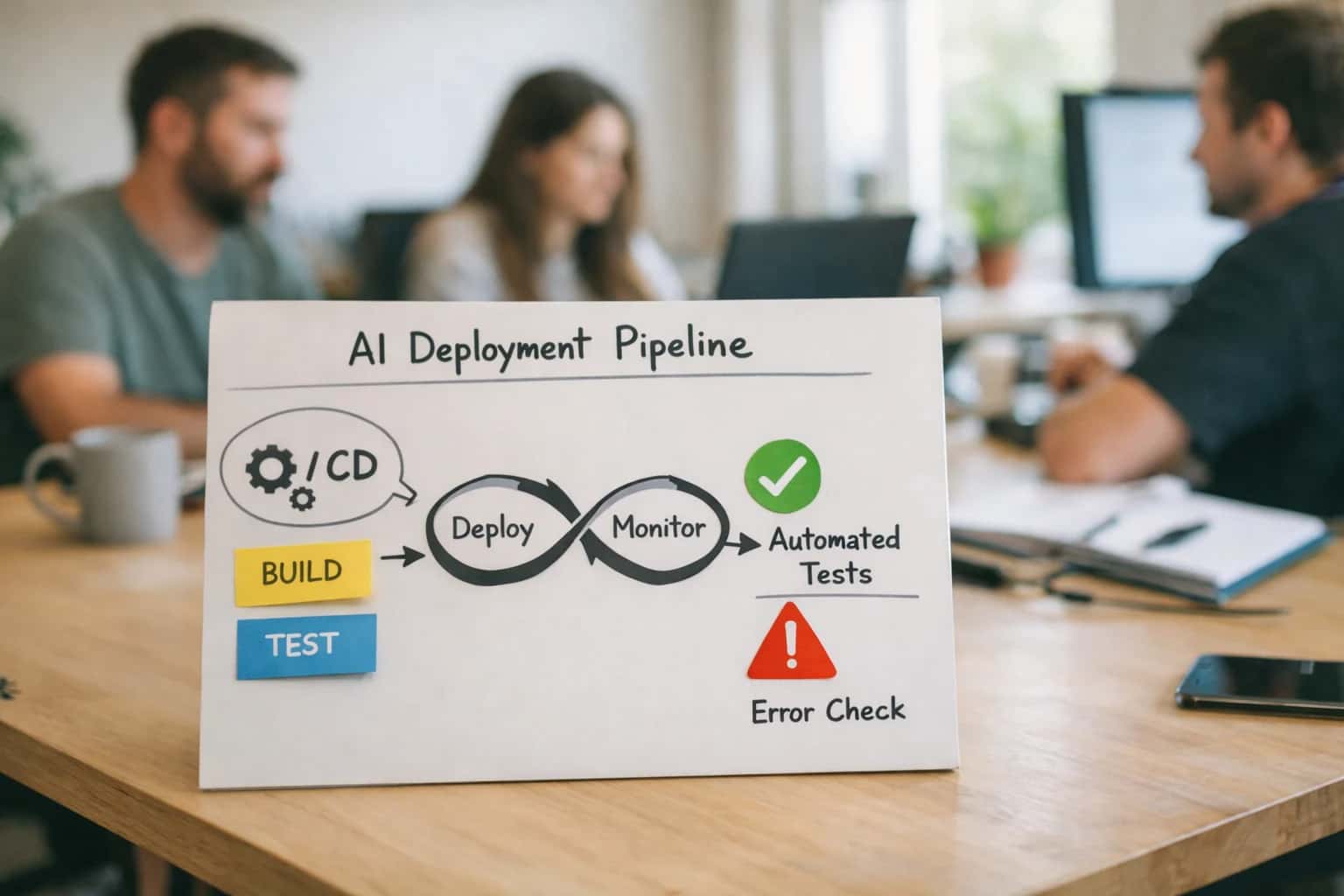
PRODUCTION CANARY ANALYSIS
What is a Rollout Strategy?
A rollout strategy is a systematic plan for deploying new software or AI models into production, designed to mitigate risk and validate performance through controlled, incremental exposure to live traffic.
This strategy is integral to Evaluation-Driven Development and MLOps, providing a framework for Automated Canary Analysis (ACA) and statistical validation against a stable baseline. By defining clear Service Level Objectives (SLOs) and canary metrics, it transforms deployment from a high-risk event into a continuous, data-driven evaluation process, enabling engineering teams to make promotion decisions based on quantitative evidence rather than intuition.
PRODUCTION CANARY ANALYSIS
Core Components of a Rollout Strategy
A rollout strategy is a systematic plan for releasing new software or AI models. Its core components define the deployment pattern, evaluation criteria, and safety mechanisms to ensure a controlled, low-risk release.
01
Deployment Pattern
The deployment pattern defines the technical mechanism for releasing the new version. Common patterns include:
- Canary Deployment: Releases to a small, controlled subset of live traffic first.
- Blue-Green Deployment: Maintains two identical environments (blue and green) for instantaneous, zero-downtime switching.
- Progressive Rollout: Gradually increases the percentage of traffic to the new version in sequential stages.
- Shadow Deployment: Duplicates live traffic to the new version for evaluation without affecting user responses. The pattern directly controls the blast radius of a potential failure.
02
Traffic Allocation & Routing
This component specifies how user requests are directed between the old (control) and new (canary) versions. It involves:
- Traffic Splitting: Using service mesh rules (e.g., Istio VirtualService) or load balancer configurations to route a precise percentage of requests.
- User Segmentation: Defining the subset of users for the initial release, which can be random, based on geography, or other attributes.
- Sticky Sessions: Ensuring a user's session remains on the same version to provide a consistent experience during the evaluation phase.
03
Evaluation Criteria & Metrics
Defines the quantitative and qualitative measures used to judge the success of the new version. This includes:
- Canary Metrics: Technical health signals like error rate, latency (p95/p99), and throughput.
- Business KPIs: User-centric metrics such as conversion rate, engagement, or task success rate.
- Service Level Indicators (SLIs): Specific measures of service performance used to verify Service Level Objective (SLO) compliance.
- Statistical Significance: Determining if observed differences in A/B/n testing are real and not due to random chance.
04
Automated Analysis & Verdict
The system that automatically compares the new version's performance against the baseline and makes a promotion decision. Key elements are:
- Automated Canary Analysis (ACA): Tools like Kayenta that perform statistical testing on metric streams.
- Deployment Verdict: The final automated decision to promote the canary, rollback, or pause for manual review.
- Integration with Controllers: Platforms like Argo Rollouts or Flagger that execute the analysis and manage the deployment lifecycle based on the verdict.
05
Rollback & Failure Procedures
Predefined safety mechanisms to revert the release if the new version fails. This includes:
- Automated Rollback: Triggered when key metric thresholds (e.g., error budget consumption) are breached.
- Manual Override: The ability for an operator to manually initiate a rollback.
- Rollback Speed: The time required to restore the previous stable version, which is minimized in patterns like blue-green deployments.
- Post-Mortem Triggers: Defining which failures necessitate a full incident analysis.
06
Observability & Monitoring
The instrumentation required to observe the rollout in real-time. This encompasses:
- Canary Analysis Dashboard: A unified view showing metric comparisons, traffic split, and the deployment verdict.
- Golden Signals: Monitoring latency, traffic, errors, and saturation for both control and canary.
- Real User Monitoring (RUM): Capturing the actual end-user experience.
- Synthetic Monitoring: Using scripted probes to test critical user journeys from outside the production network.
STRATEGY COMPARISON
Common Deployment Patterns
A comparison of core strategies for releasing new AI models and software versions, highlighting their primary mechanisms, risk profiles, and operational overhead.
| Pattern | Mechanism | Primary Use Case | Blast Radius | Rollback Speed | Infrastructure Overhead |
|---|---|---|---|---|---|
Canary Deployment | Incremental traffic shift to a new version | Safely validating new models with live user data | Low (Controlled user subset) | Fast (Traffic re-routing) | Medium (Requires traffic splitting) |
Blue-Green Deployment | Instant switch between two identical environments | Zero-downtime releases and instant rollbacks | High (Full user base post-switch) | Instant (Switch back to old env) | High (Duplicated full environment) |
Shadow Deployment (Traffic Mirroring) | Duplicate traffic to new version without affecting response | Performance testing and validation without user impact | None (Passive observation only) | Not Applicable | Medium (Duplicate compute, no routing logic) |
A/B/n Testing | Split traffic to compare variants statistically | Optimizing user-facing metrics (e.g., conversion, engagement) | Controlled (Per variant allocation) | Fast (Traffic re-routing) | Medium (Requires experiment framework) |
Feature Flags | Conditional code execution via runtime configuration | Granular, user-level control of functionality | Configurable (User segment to global) | Instant (Toggle disable) | Low (Configuration management) |
Progressive Rollout | Sequential increase in traffic percentage | Cautious, staged release with validation at each step | Gradually increases | Fast (Halt progression, revert %) | Medium (Orchestration of stages) |
Dark Launch | Activate backend logic for internal/users invisibly | Load testing and integration validation in production | Low (Internal or invisible) | Fast (Toggle disable) | Low to Medium (Backend toggles) |
PRODUCTION CANARY ANALYSIS
How a Rollout Strategy Works
A rollout strategy is a systematic, phased plan for releasing new software or AI models into production, designed to minimize risk and validate performance before a full launch.
A rollout strategy is a predefined, systematic plan for releasing a new software version or AI model into a live production environment. It specifies the deployment pattern (e.g., canary, blue-green), the incremental traffic allocation schedule, the quantitative evaluation criteria for success, and the precise rollback procedures to be executed if failures are detected. The core objective is to mitigate risk by exposing changes to a controlled subset of users and infrastructure first.
Execution involves traffic splitting to route a small percentage of live requests to the new version while monitoring canary metrics like error rates and latency. Automated analysis against a service level objective (SLO) determines a deployment verdict to promote or rollback. This process, central to Evaluation-Driven Development, ensures engineering rigor by quantitatively benchmarking model outputs on real data before full release, directly supporting production canary analysis.
EVALUATION-DRIVEN DEVELOPMENT
Special Considerations for AI/ML Rollouts
Deploying AI models introduces unique risks beyond traditional software, requiring specialized strategies to manage non-deterministic outputs, data drift, and complex performance metrics.
01
Non-Deterministic Outputs & Hallucination Risk
Unlike deterministic code, generative AI models can produce stochastic outputs and factual hallucinations. Rollout strategies must include:
- Real-time monitoring for coherence and factual accuracy against a trusted knowledge base.
- Automated canary analysis that evaluates semantic correctness, not just system uptime.
- Shadow deployments to log and compare model outputs (e.g., summary quality, answer relevance) without user impact before deciding to promote.
02
Data & Concept Drift Detection
Model performance degrades as live input data (data drift) or user intent (concept drift) evolves. A robust rollout must integrate:
- Statistical tests (e.g., Kolmogorov-Smirnov, PSI) on feature distributions between training and inference data.
- Performance metric triggers (e.g., sudden drop in precision/recall) as part of the canary health check.
- Automated rollback protocols activated when drift exceeds thresholds, reverting to a stable model version while drift is investigated.
03
Multi-Dimensional Performance Evaluation
AI service health extends beyond latency and errors to domain-specific quality metrics. A rollout strategy defines Service Level Objectives (SLOs) for:
- Inference Quality: Task-specific accuracy, F1 score, ROUGE-L for summarization, or BERTScore for semantic similarity.
- Business KPIs: Conversion rate, user satisfaction scores, or support ticket deflection.
- Resource Efficiency: Tokens-per-second, GPU memory utilization, and cost-per-inference. Canary analysis must weigh all dimensions before a promotion verdict.
04
Stateful Context & Session Management
Many AI applications (e.g., chat agents, multi-step reasoning) are stateful, maintaining context across requests. Rollouts must handle:
- Session affinity to ensure a user's conversation stays with the same model version throughout a canary test, preventing inconsistent behavior.
- State migration and compatibility between model versions if session data structures change.
- Graceful degradation plans for long-running agentic workflows during a rollback.
05
The Champion-Challenger Framework
This is the predominant pattern for model deployment. A stable champion model serves all live traffic while one or more challenger models are evaluated.
- Traffic splitting routes a small percentage (e.g., 5%) of requests to the challenger.
- Automated analysis compares the challenger's metrics (latency, business KPIs, quality scores) against the champion's baseline.
- Promotion occurs only if the challenger demonstrates statistically significant improvement or equivalence across all critical SLOs, otherwise it is rejected.
06
Infrastructure for Rapid Rollback
The ability to revert a faulty model within seconds is critical. This requires:
- Immutable model artifacts with unique version tags stored in a model registry.
- Traffic routing orchestration via service meshes (e.g., Istio VirtualServices) or Kubernetes operators (e.g., Argo Rollouts, Flagger) for instant switchover.
- Pre-warmed infrastructure keeping the previous champion model loaded and ready to serve, avoiding cold-start latency during a rollback emergency.
ROLLOUT STRATEGY
Frequently Asked Questions
A rollout strategy is a systematic plan for releasing new software or AI models into production. It defines the deployment pattern, traffic allocation, evaluation criteria, and rollback procedures to ensure stability and measure impact.
A rollout strategy is a predefined, systematic plan for releasing a new software version or AI model into a live production environment. It specifies the deployment pattern (e.g., canary, blue-green), the incremental steps for allocating traffic, the quantitative metrics for evaluation, and the conditions for rollback. For AI systems, this is critical because model behavior can be non-deterministic and sensitive to real-world data distributions unseen during training. A rigorous strategy mitigates risk by limiting the blast radius of a potential failure, provides a framework for A/B/n testing to measure performance lift, and ensures releases are data-driven decisions based on Service Level Indicators (SLIs) rather than intuition.
Enabling Efficiency, Speed & Accuracy
Intelligent Analysis, Decision & Execution
We build AI systems for teams that need search across company data, workflow automation across tools, or AI features inside products and internal software.
Talk to Us
Search across company data
Give teams answers from docs, tickets, runbooks, and product data with sources and permissions.
Useful when people spend too long searching or get different answers from different systems.
Enterprise searchRAGPermissions
Read more
Automate internal workflows
Use AI to route work, draft outputs, trigger actions, and keep approvals and logs in place.
Useful when repetitive work moves across multiple tools and teams.
AI agentsWorkflow automationGovernance
Read more
Add AI to products and internal tools
Build assistants, guided actions, or decision support into the software your team or customers already use.
Useful when AI needs to be part of the product, not a separate tool.
AI integrationDecision supportModel routing
Read more
About the author
Prasad Kumkar
CEO & MD, Inference Systems
Prasad Kumkar is the CEO & MD of Inference Systems and writes about AI systems architecture, LLM infrastructure, model serving, evaluation, and production deployment. Over 5+ years, he has worked across computer vision models, L5 autonomous vehicle systems, and LLM research, with a focus on taking complex AI ideas into real-world engineering systems.
His work and writing cover AI systems, large language models, AI agents, multimodal systems, autonomous systems, inference optimization, RAG, evaluation, and production AI engineering.
LinkedIn
Limited slotsGet a Free AI Consultation
Partnered with leading AI, data, and software stack.





How We Work
Custom AI workflows for your Business
One-fit-all AI don't work for modern businesses. At Inferensys, we aim to understand your business & custom requirements; which we use to define most efficient agentic workflows, the data, and the tools for your business.
01
Review the use case
We understand the task, the users, and where AI can actually help.
Read more02
Pick the right approach
We define what needs search, automation, or product integration.
Read more03
Build the first useful version
We implement the part that proves the value first.
Read more04
Improve from there
We add the checks and visibility needed to keep it useful.
Read moreThe first call is a practical review of your use case and the right next step.
Talk to Us