A champion-challenger model is a deployment pattern where a currently serving, stable production model (the champion) is compared against one or more candidate models (challengers) using a controlled portion of live traffic to determine if a new model should be promoted. This framework is a core component of evaluation-driven development, enabling rigorous, quantitative benchmarking of model performance in a real-world environment before a full-scale release. It systematically mitigates risk by limiting the blast radius of a potential failure.

Glossary
Champion-Challenger Model
A champion-challenger model is a deployment pattern where a stable production model (the champion) is compared against one or more candidate models (challengers) using live traffic to determine if a new model should be promoted.
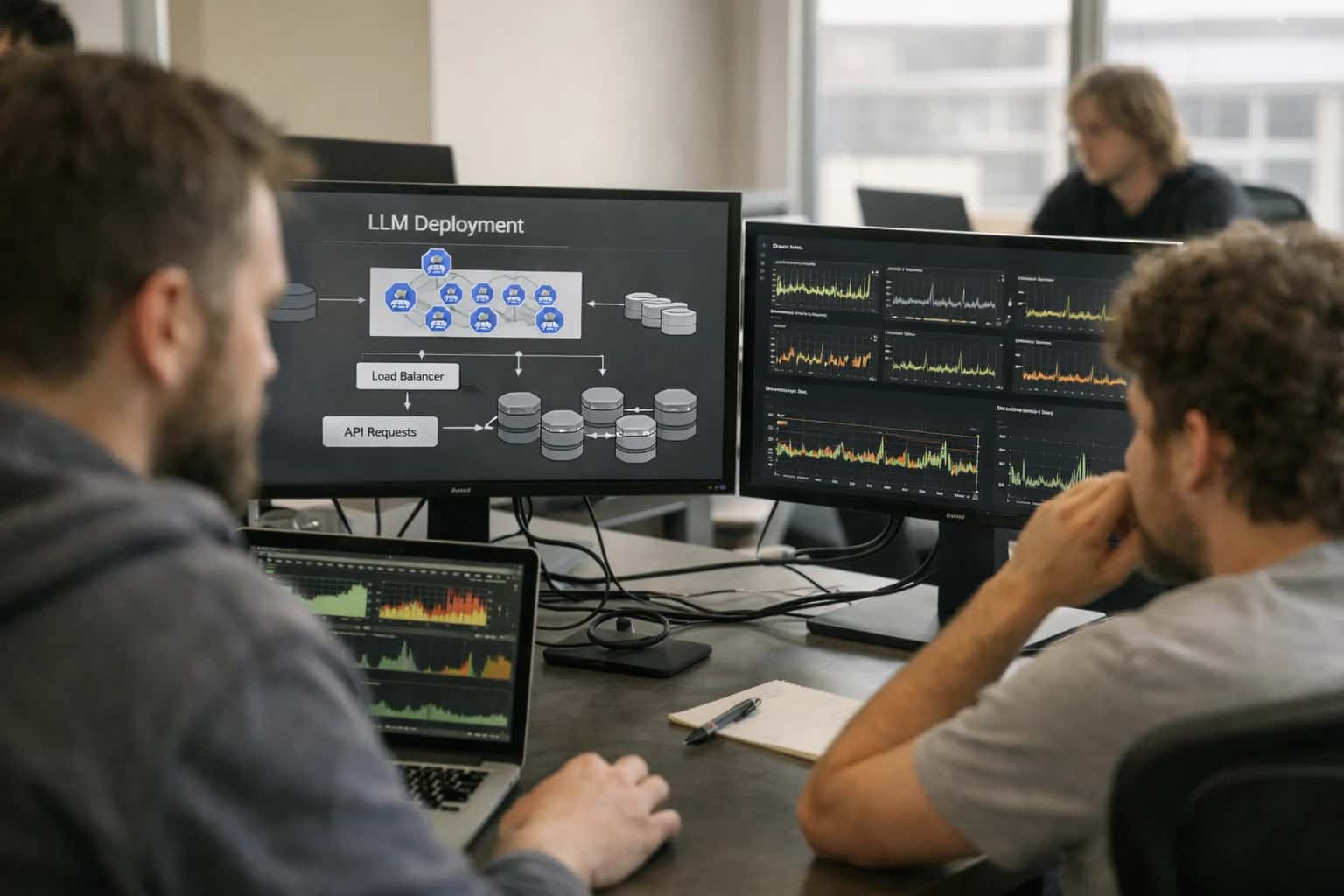
PRODUCTION CANARY ANALYSIS
What is a Champion-Challenger Model?
A deployment and evaluation framework for AI systems that facilitates controlled, data-driven model upgrades.
The process involves traffic splitting to route a small percentage of user requests to the challenger model(s) while the champion handles the majority. Key canary metrics—such as latency, error rates, and business KPIs—are collected and analyzed, often using automated canary analysis (ACA) tools, to generate a deployment verdict. This methodology provides empirical evidence for model promotion, ensuring updates are driven by performance data rather than intuition, and is fundamental to robust MLOps practices.
CHAMPION-CHALLENGER MODEL
Key Components of the Pattern
The Champion-Challenger model is a systematic framework for model deployment and validation. It relies on several core components to function effectively, ensuring controlled, data-driven decisions about which model serves in production.
01
The Champion
The Champion is the currently deployed, stable production model that serves all or the majority of live traffic. It represents the known baseline of performance and business value. Its primary role is to provide a reliable control group against which new candidates are measured. The champion's outputs, latency, and business metrics (e.g., conversion rate, user engagement) establish the standard that any challenger must meet or exceed to be considered for promotion.
02
The Challenger(s)
A Challenger is a new candidate model version being evaluated for potential promotion to champion status. Challengers can include models with:
- New architectures or algorithms
- Updated training data or fine-tuning
- Different hyperparameter configurations
- Optimizations for cost or latency Multiple challengers can be tested concurrently in an A/B/n testing framework. They receive a controlled, statistically significant portion of live traffic, and their performance is rigorously compared to the champion's across predefined metrics.
03
Traffic Routing & Splitting
This is the infrastructure layer that dynamically directs user requests between the champion and challenger models. It is typically implemented using:
- Service Meshes (e.g., Istio
VirtualService) - API Gateways or specialized controllers (e.g., Argo Rollouts, Flagger)
- Feature Flag systems Traffic splitting is controlled, often starting with a small percentage (e.g., 1-5%) routed to the challenger. This limits the blast radius of any potential failure. The split can be increased progressively based on the success criteria being met.
04
Evaluation Metrics & Success Criteria
The decision to promote a challenger is based on quantitative evaluation against the champion. Metrics are defined in two key categories:
- Operational Metrics (SLOs/SLIs): Latency (p50, p99), error rate, throughput, and resource utilization (saturation). These ensure system health.
- Business & Quality Metrics: Task-specific accuracy, precision/recall, revenue per user, click-through rate, or custom Key Performance Indicators (KPIs). For generative models, this includes hallucination detection scores or instruction following accuracy. Success criteria are predefined thresholds (e.g., "challenger latency must be ≤ champion's, and accuracy must be statistically significantly higher").
05
Automated Canary Analysis (ACA)
Automated Canary Analysis (ACA) is the engine that performs real-time statistical comparison of metrics between the champion (control) and challenger (canary) deployments. Tools like Kayenta or integrated analysis in Argo Rollouts continuously monitor the defined canary metrics. They use statistical tests to determine if observed differences are significant and not due to random chance. The ACA system produces a deployment verdict—promote, continue testing, or rollback—based on breaching success or failure thresholds, enabling objective, automated decision-making.
06
Observability & Telemetry
Comprehensive observability is the foundation for reliable champion-challenger comparisons. This involves instrumenting both models to emit:
- Golden Signals: Latency, traffic, errors, saturation.
- Prediction Logs: Inputs, outputs, and model confidence scores for offline analysis.
- Business Events: User actions triggered by model outputs. Data is collected via Real User Monitoring (RUM) and synthetic monitoring, and visualized on a canary analysis dashboard. This telemetry allows for detecting model drift, performance regressions, and unexpected behaviors in the challenger before a full rollout.
PRODUCTION CANARY ANALYSIS
How the Champion-Challenger Model Works
A systematic framework for evaluating new machine learning models against the current production standard using live traffic.
The champion-challenger model is a deployment pattern where a currently serving, stable production model (the champion) is compared against one or more candidate models (challengers) using a controlled percentage of live traffic to determine if a new model should be promoted. This pattern is a cornerstone of evaluation-driven development, enabling rigorous, quantitative benchmarking of model performance in a real-world environment before a full rollout. It directly supports production canary analysis by providing the structural framework for phased testing.
The process involves traffic splitting to route a small portion of user requests to the challenger model(s) while the champion handles the majority. Key canary metrics—such as latency, error rates, and business KPIs—are collected for both. An automated canary analysis (ACA) system then performs a statistical comparison. Based on predefined success criteria, a deployment verdict is rendered to either promote the challenger to champion status or initiate an automated rollback. This methodically limits the blast radius of any potential failure.
CHAMPION-CHALLENGER MODEL
Common Use Cases and Examples
The champion-challenger model is a foundational pattern for controlled experimentation and risk mitigation in production AI systems. Below are its primary applications across different domains.
01
Model Performance Validation
This is the core use case. A new challenger model (e.g., with updated architecture or fresh training data) is deployed to receive a small percentage of live traffic. Its performance is compared against the stable champion model using a predefined suite of canary metrics. These metrics typically include:
- Inference Latency (p50, p95, p99)
- Prediction Accuracy/Precision/Recall
- Business KPIs (e.g., click-through rate, conversion rate)
- Error Rates (5xx, 4xx, model-specific failures) The challenger is only promoted to champion status if it demonstrates statistically significant improvement or equivalence across these metrics, providing empirical validation before a full rollout.
02
Algorithmic Trading & Quantitative Finance
In high-frequency trading, firms deploy multiple challenger strategies (predictive models) against the live champion strategy. Each challenger might use a different ML approach (e.g., deep reinforcement learning vs. gradient boosting). They are evaluated on:
- Sharpe Ratio (risk-adjusted returns)
- Maximum Drawdown (peak-to-trough decline)
- Win Rate and Profit/Loss Traffic (order flow) is split, often using a multi-armed bandit approach to dynamically allocate more capital to the best-performing model while continuously exploring others. This allows for continuous strategy optimization in a live market with controlled financial risk.
03
Recommendation & Ranking Systems
E-commerce platforms and content services (Netflix, Amazon) constantly test new ranking algorithms. A challenger recommendation model might incorporate new user embeddings or a novel neural architecture. It serves recommendations to a small user cohort. Success is measured not just by offline metrics but by live business outcomes:
- User Engagement (watch time, session duration)
- Conversion Rate (add to cart, purchase)
- Downstream Revenue This framework allows for direct A/B/n testing of complex ML systems where offline metrics may not perfectly correlate with user satisfaction and revenue.
04
Credit Scoring & Fraud Detection
In regulated industries like finance, model changes require rigorous validation. A new challenger fraud detection model can be deployed in shadow mode or to a tiny fraction of transactions. It makes predictions in parallel with the champion, but its decisions are not acted upon. Analysts compare:
- False Positive Rate (impact on customer experience)
- False Negative Rate (fraud missed)
- Approval Rate and Loss Rates This allows validation against real-world, evolving fraud patterns without exposing the institution to undue risk, ensuring compliance before a full model switch.
05
LLM-Powered Chat & Search
When updating a large language model powering a chatbot or search engine, a challenger LLM (e.g., a newer foundation model or a differently fine-tuned variant) is evaluated. Beyond standard latency and error rates, evaluation requires specialized metrics:
- Hallucination Rate (via hallucination detection techniques)
- Retrieval-Augmented Generation (RAG) Accuracy (citation precision/recall)
- Instruction Following Accuracy
- User Satisfaction Scores (thumbs up/down, surveys) Traffic splitting allows for comparative analysis of nuanced quality factors that are difficult to assess fully in a staging environment.
06
Infrastructure & Cost Optimization
Challengers can test new inference optimization techniques against the champion. Examples include:
- A challenger using model quantization (FP16 vs. INT8) to reduce GPU memory and cost.
- A challenger served on a different hardware accelerator (inferentia vs. GPU).
- A challenger using an optimized serving runtime (TensorRT vs. ONNX Runtime). The comparison focuses on operational metrics:
- Cost per Inference (cloud compute cost)
- Throughput (requests per second)
- Latency under load
- Model Quality (ensuring optimization doesn't degrade accuracy). This provides a data-driven path to reducing infrastructure spend.
2-4x
Typical Inference Speedup
50-75%
Potential Cost Reduction
DEPLOYMENT STRATEGIES
Comparison with Related Deployment Patterns
A feature-by-feature comparison of the Champion-Challenger model against other common deployment patterns for AI models and software services.
| Feature / Characteristic | Champion-Challenger | Canary Deployment | Shadow Deployment | Blue-Green Deployment |
|---|---|---|---|---|
Primary Objective | Model performance comparison and selection | Risk mitigation and stability validation | Safe behavioral validation and performance testing | Zero-downtime release and instant rollback |
Live Traffic Exposure | Yes, split between models | Yes, to a small subset | No (traffic is mirrored/duplicated) | Yes, to 100% of traffic after cutover |
User Impact from New Version | Direct, for the traffic segment routed to the challenger(s) | Direct, for the canary segment | None (users interact only with the stable version) | Direct, for all users after the traffic switch |
Key Evaluation Method | Statistical A/B/n testing on business and performance metrics | Automated Canary Analysis (ACA) on operational metrics | Offline comparison of outputs/logs against the baseline | Health checks and synthetic monitoring post-cutover |
Parallel Model Execution | Yes, multiple challengers can run concurrently | Typically one new version vs. one old version | Yes, the shadow version runs in parallel | No, only one active environment (blue OR green) serves traffic |
Automatic Promotion Logic | Yes, based on predefined performance thresholds (e.g., higher accuracy) | Yes, based on metric analysis and success criteria | Not applicable (no traffic serving) | Manual or automated based on post-switch health checks |
Infrastructure Cost Overhead | Medium (requires parallel compute for multiple live models) | Low (small, incremental compute for canary) | High (duplicate compute for 100% mirrored traffic) | High (requires two full, identical production environments) |
Typical Use Case | Comparing new machine learning models against an incumbent | Safely rolling out new application features or microservices | Validating a new model's logic or performance under real load | Releasing major application versions with minimal risk |
CHAMPION-CHALLENGER MODEL
Frequently Asked Questions
The champion-challenger model is a core pattern in evaluation-driven development, enabling rigorous, data-backed decisions for model updates in production. These questions address its implementation, benefits, and relationship to other deployment strategies.
The champion-challenger model is a deployment pattern where a stable, currently serving production model (the champion) is systematically compared against one or more candidate models (the challengers) using live traffic to determine if a new model should be promoted. It works by routing a controlled percentage of incoming requests (e.g., 5%) to the challenger model while the champion handles the remainder. Key performance metrics—such as latency, error rates, and business KPIs—are collected for both models. An automated canary analysis (ACA) system then performs a statistical comparison. If the challenger meets or exceeds predefined success criteria without degrading service, it is promoted to become the new champion. This process creates a continuous, data-driven cycle for model improvement and risk mitigation.
Enabling Efficiency, Speed & Accuracy
Intelligent Analysis, Decision & Execution
We build AI systems for teams that need search across company data, workflow automation across tools, or AI features inside products and internal software.
Talk to Us
Search across company data
Give teams answers from docs, tickets, runbooks, and product data with sources and permissions.
Useful when people spend too long searching or get different answers from different systems.
Enterprise searchRAGPermissions
Read more
Automate internal workflows
Use AI to route work, draft outputs, trigger actions, and keep approvals and logs in place.
Useful when repetitive work moves across multiple tools and teams.
AI agentsWorkflow automationGovernance
Read more
Add AI to products and internal tools
Build assistants, guided actions, or decision support into the software your team or customers already use.
Useful when AI needs to be part of the product, not a separate tool.
AI integrationDecision supportModel routing
Read more
About the author
Prasad Kumkar
CEO & MD, Inference Systems
Prasad Kumkar is the CEO & MD of Inference Systems and writes about AI systems architecture, LLM infrastructure, model serving, evaluation, and production deployment. Over 5+ years, he has worked across computer vision models, L5 autonomous vehicle systems, and LLM research, with a focus on taking complex AI ideas into real-world engineering systems.
His work and writing cover AI systems, large language models, AI agents, multimodal systems, autonomous systems, inference optimization, RAG, evaluation, and production AI engineering.
LinkedIn
Limited slotsGet a Free AI Consultation
Partnered with leading AI, data, and software stack.





How We Work
Custom AI workflows for your Business
One-fit-all AI don't work for modern businesses. At Inferensys, we aim to understand your business & custom requirements; which we use to define most efficient agentic workflows, the data, and the tools for your business.
01
Review the use case
We understand the task, the users, and where AI can actually help.
Read more02
Pick the right approach
We define what needs search, automation, or product integration.
Read more03
Build the first useful version
We implement the part that proves the value first.
Read more04
Improve from there
We add the checks and visibility needed to keep it useful.
Read moreThe first call is a practical review of your use case and the right next step.
Talk to Us