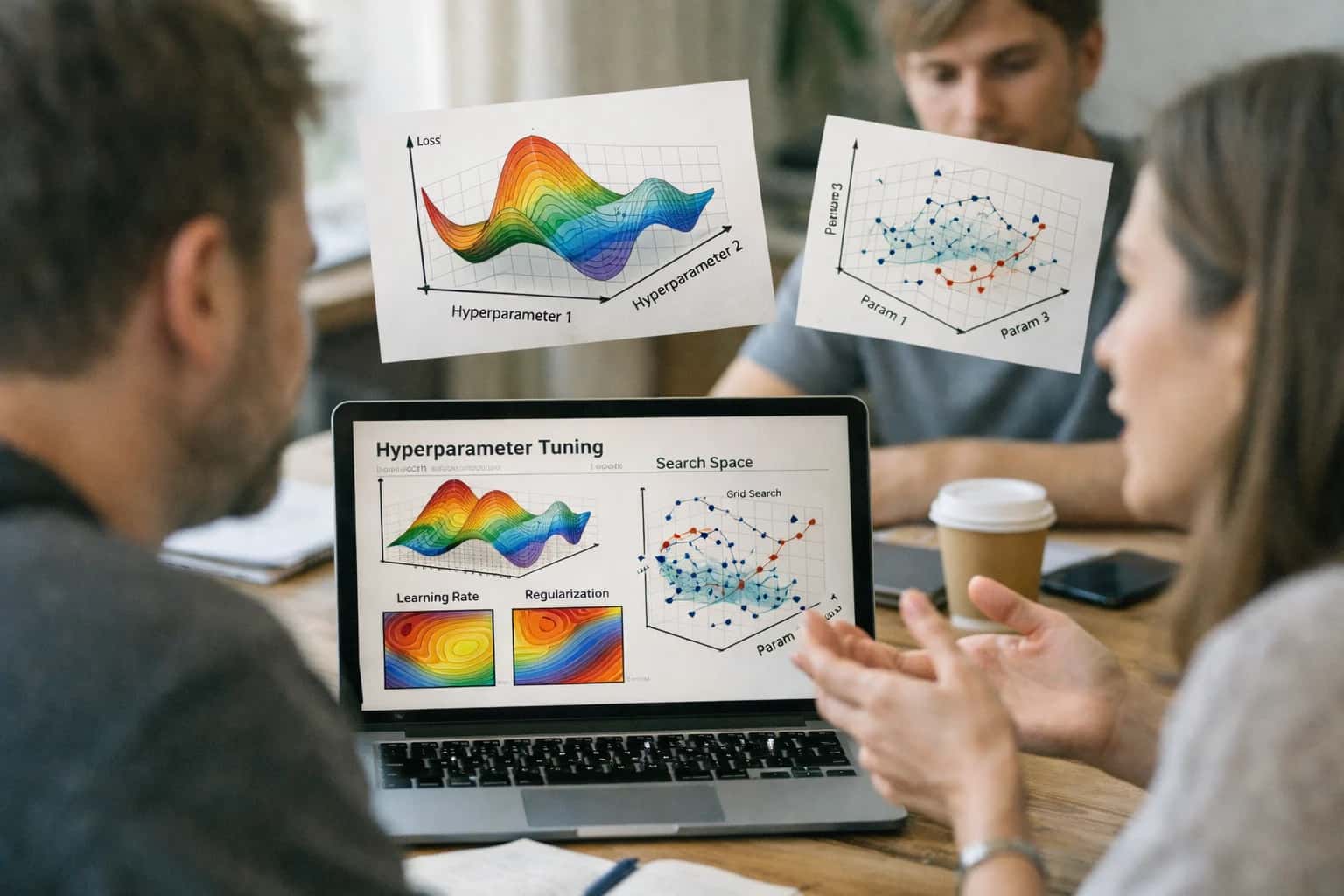
Ray Tune is a scalable hyperparameter tuning library built on the Ray distributed computing framework. It automates the search for optimal model configurations by launching parallel training runs across a cluster or a single machine. It supports a wide array of search algorithms, including grid search, random search, and advanced methods like Bayesian Optimization and Population-Based Training. Its core function is to manage the lifecycle of these distributed trials, handling scheduling, fault tolerance, and result aggregation.

Glossary
Ray Tune
Ray Tune is a scalable Python library for distributed hyperparameter tuning and experiment execution, built on Ray for cluster-scale machine learning.
EXPERIMENT TRACKING
What is Ray Tune?
Ray Tune is a Python library for scalable hyperparameter tuning and distributed experiment execution.
The library integrates seamlessly with major machine learning frameworks like PyTorch, TensorFlow, and JAX. Key features include early stopping and hyperparameter pruning to cut resource waste, and native support for experiment tracking tools like MLflow and Weights & Biases. By abstracting distributed execution, Ray Tune allows researchers to scale hyperparameter sweeps from a laptop to a large cluster without modifying their training code, making it a foundational tool for evaluation-driven development.
SCALABLE HYPERPARAMETER TUNING
Key Features of Ray Tune
Ray Tune is a Python library for scalable hyperparameter tuning and experiment execution, built on the Ray distributed computing framework. It abstracts the complexity of distributed training to enable efficient exploration of model configurations across clusters.
01
Distributed Trial Execution
Ray Tune leverages the Ray runtime to distribute individual training runs, called trials, across a cluster of machines or a single multi-core machine. It abstracts away the complexities of parallelization, allowing you to scale from a laptop to a large cluster without changing your training code. Trials are scheduled on available Ray actors, enabling efficient resource utilization and massive parallelization of hyperparameter searches.
02
State-of-the-Art Search Algorithms
The library provides a wide array of hyperparameter optimization (HPO) algorithms out of the box, moving beyond simple grid and random search. Key integrated algorithms include:
- Population-Based Training (PBT): Asynchronously trains and mutates a population of models, effectively optimizing both weights and hyperparameters simultaneously.
- HyperBand / ASHA: Successive Halving algorithms that aggressively prune underperforming trials early, dramatically improving search efficiency.
- Bayesian Optimization (via BOHB): Combines Bayesian optimization with HyperBand for sample-efficient search.
- Optuna & Nevergrad Integrations: Allows you to use these external optimization libraries as schedulers within Ray Tune's execution framework.
03
Fault Tolerance and Checkpointing
Ray Tune provides robust fault tolerance for long-running, expensive experiments. Its core mechanism is automated checkpointing. You can configure your training function to save its state periodically. If a trial fails or is paused for pruning, Ray Tune can restore it from the last checkpoint on an available node, preventing lost work. This is critical for reliability when using spot instances in the cloud or running on preemptible hardware, ensuring computational resources are not wasted.
04
Framework Agnosticism
Ray Tune is designed to work with any machine learning framework. It provides simple integrations and callbacks for popular libraries without locking you in. You can tune models built with:
- PyTorch (via
torch) - TensorFlow/Keras (via
tf.keras) - XGBoost, LightGBM, Scikit-learn
- JAX (via libraries like Flax) The tuning logic is separate from the training code; you simply wrap your existing training loop, making it highly adaptable to existing codebases.
05
Advanced Schedulers for Resource Management
Beyond search algorithms, Ray Tune uses schedulers to control trial execution dynamics. Schedulers manage when to stop, pause, or modify trials, enabling sophisticated resource allocation strategies. Examples include:
- Async HyperBand (ASHA) Scheduler: For early stopping.
- Population Based Training (PBT) Scheduler: For evolutionary optimization.
- Median Stopping Rule: Stops trials performing worse than the median of other running trials.
- FIFO Scheduler: The default, which runs trials in a first-in, first-out manner. Schedulers work in tandem with search algorithms to maximize result quality per unit of compute time.
06
Comprehensive Experiment Analysis
Ray Tune includes utilities for analyzing tuning results post-hoc. After a tuning run, you can easily:
- Retrieve the best trial and its configuration.
- Export results to pandas DataFrames for custom analysis.
- Generate visualizations like parallel coordinates plots to understand the relationship between hyperparameters and performance metrics.
- Leverage TensorBoard or MLflow integrations automatically for real-time tracking. This tight feedback loop is essential for experiment tracking and deriving insights to guide the next round of model development.
SCALABLE HYPERPARAMETER TUNING
How Ray Tune Works
Ray Tune is a distributed hyperparameter tuning library built on the Ray runtime, designed to scale experiment execution across clusters and support advanced optimization algorithms.
Ray Tune orchestrates hyperparameter tuning by defining a search space and launching multiple parallel training runs, called trials, each testing a different configuration. It integrates with a scheduler for early stopping and a search algorithm (like Bayesian Optimization or Population-Based Training) to intelligently explore the parameter space. Trials are executed as Ray tasks, allowing them to be distributed across a cluster's CPUs or GPUs, with results and model checkpoints logged centrally.
The library abstracts the complexity of distributed computing, providing a unified API to run trials using any major ML framework (PyTorch, TensorFlow, JAX). It manages resource allocation, fault tolerance, and result aggregation. Key features include pruning to halt unpromising trials, checkpointing for resuming experiments, and integration with experiment trackers like MLflow and Weights & Biases for comprehensive run comparison and reproducibility.
FEATURE COMPARISON
Ray Tune Search Algorithms
A comparison of the primary hyperparameter optimization algorithms available in Ray Tune, detailing their search methodology, parallelization support, and typical use cases.
| Algorithm / Feature | Random Search | Bayesian Optimization (Ax, BayesOpt) | Population-Based Training (PBT) | HyperBand / ASHA |
|---|---|---|---|---|
Core Search Methodology | Random sampling from defined distributions | Probabilistic model (surrogate) guiding sequential search | Evolutionary algorithm mutating and exploiting top performers | Successive Halving: early termination of low-performing trials |
Parallelization Efficiency | ||||
Supports Early Stopping/Pruning | ||||
Handles Conditional Search Spaces | ||||
Optimal For | Initial broad exploration, simple baselines | Complex, expensive-to-evaluate functions with < 20-30 parameters | Dynamic hyperparameters (e.g., LR schedules), noisy training landscapes | Large-scale parallel tuning with many configurations, resource-constrained |
Primary Library/Integration | Built-in (Tune) | Ax, Scikit-Optimize, BayesOpt | Built-in (Tune) | Built-in (Tune) |
Typical Trial Count Recommendation | 10s - 1000s | 10s - 100s | 10s - 100s | 100s - 1000s |
Key Advantage | Embarrassingly parallel, unbiased exploration | Sample-efficient, finds optima with fewer evaluations | Automatically discovers schedules, adapts during training | Dramatically reduces total compute by aggressive early stopping |
SCALABLE HYPERPARAMETER TUNING
Common Use Cases for Ray Tune
Ray Tune is a distributed hyperparameter tuning library built on Ray. Its primary use cases extend beyond simple grid search to support scalable, state-of-the-art optimization for complex machine learning workflows.
05
Large Language Model (LLM) Fine-Tuning Optimization
Fine-tuning LLMs requires careful tuning of parameters specific to the adaptation process. Ray Tine manages the costly process of evaluating multiple fine-tuning configurations in parallel.
- Critical Parameters: Optimizes low-rank adaptation (LoRA) ranks, alpha scaling, learning rate schedules, and prompt tuning vectors.
- Checkpoint Management: Efficiently handles the large model checkpoints (multi-GB) generated during each trial, supporting cloud storage backends.
- Scheduler Pruning: Uses ASHA or Median Stopping Rule to automatically halt trials that are underperforming early in the fine-tuning process, providing massive compute savings.
06
Multi-Objective and Constrained Optimization
Beyond maximizing a single metric, Ray Tine supports multi-objective optimization (e.g., balancing accuracy vs. model size, latency vs. F1 score) and constrained optimization (e.g., maximize accuracy subject to inference time < 100ms).
- Pareto Front Identification: Uses algorithms like NSGA-II to find a set of non-dominated optimal solutions (Pareto optimal).
- Constraint Handling: Allows the objective function to return metrics and constraints, guiding the search to feasible regions of the hyperparameter space.
- Business Metric Integration: Enables direct optimization of complex, derived business KPIs that are functions of standard model metrics.
RAY TUNE
Frequently Asked Questions
Ray Tune is a core library for scalable hyperparameter tuning and distributed experiment execution. These questions address its core mechanisms, use cases, and integration within the machine learning lifecycle.
Ray Tune is a scalable hyperparameter tuning and experiment execution library built on the Ray distributed computing framework. It works by abstracting the training loop of a machine learning model into a tunable function. Users define a search space for their hyperparameters, and Ray Tune's schedulers (like ASHA or HyperBand) and search algorithms (like Bayesian Optimization or random search) automatically launch and manage many parallel training trials across a cluster. It handles resource allocation, result aggregation, and early termination of underperforming runs, efficiently navigating the hyperparameter landscape to find optimal configurations.
Enabling Efficiency, Speed & Accuracy
Intelligent Analysis, Decision & Execution
We build AI systems for teams that need search across company data, workflow automation across tools, or AI features inside products and internal software.
Talk to Us
Search across company data
Give teams answers from docs, tickets, runbooks, and product data with sources and permissions.
Useful when people spend too long searching or get different answers from different systems.
Enterprise searchRAGPermissions
Read more
Automate internal workflows
Use AI to route work, draft outputs, trigger actions, and keep approvals and logs in place.
Useful when repetitive work moves across multiple tools and teams.
AI agentsWorkflow automationGovernance
Read more
Add AI to products and internal tools
Build assistants, guided actions, or decision support into the software your team or customers already use.
Useful when AI needs to be part of the product, not a separate tool.
AI integrationDecision supportModel routing
Read more
About the author
Prasad Kumkar
CEO & MD, Inference Systems
Prasad Kumkar is the CEO & MD of Inference Systems and writes about AI systems architecture, LLM infrastructure, model serving, evaluation, and production deployment. Over 5+ years, he has worked across computer vision models, L5 autonomous vehicle systems, and LLM research, with a focus on taking complex AI ideas into real-world engineering systems.
His work and writing cover AI systems, large language models, AI agents, multimodal systems, autonomous systems, inference optimization, RAG, evaluation, and production AI engineering.
LinkedIn
Limited slotsGet a Free AI Consultation
Partnered with leading AI, data, and software stack.





How We Work
Custom AI workflows for your Business
One-fit-all AI don't work for modern businesses. At Inferensys, we aim to understand your business & custom requirements; which we use to define most efficient agentic workflows, the data, and the tools for your business.
01
Review the use case
We understand the task, the users, and where AI can actually help.
Read more02
Pick the right approach
We define what needs search, automation, or product integration.
Read more03
Build the first useful version
We implement the part that proves the value first.
Read more04
Improve from there
We add the checks and visibility needed to keep it useful.
Read moreThe first call is a practical review of your use case and the right next step.
Talk to Us