Detection delay is the critical latency metric for evaluating drift detection algorithms, measured from the moment a data distribution or concept begins to change until an alert is triggered. A shorter delay enables faster model remediation, such as retraining, minimizing performance degradation. This lag is influenced by algorithm sensitivity, the drift severity, and whether the change is sudden or gradual. In online drift detection, minimizing this delay is paramount for maintaining real-time system health.

Glossary
Detection Delay
Detection delay is the elapsed time between the actual onset of a statistical drift event in a machine learning system and its identification by a monitoring algorithm.
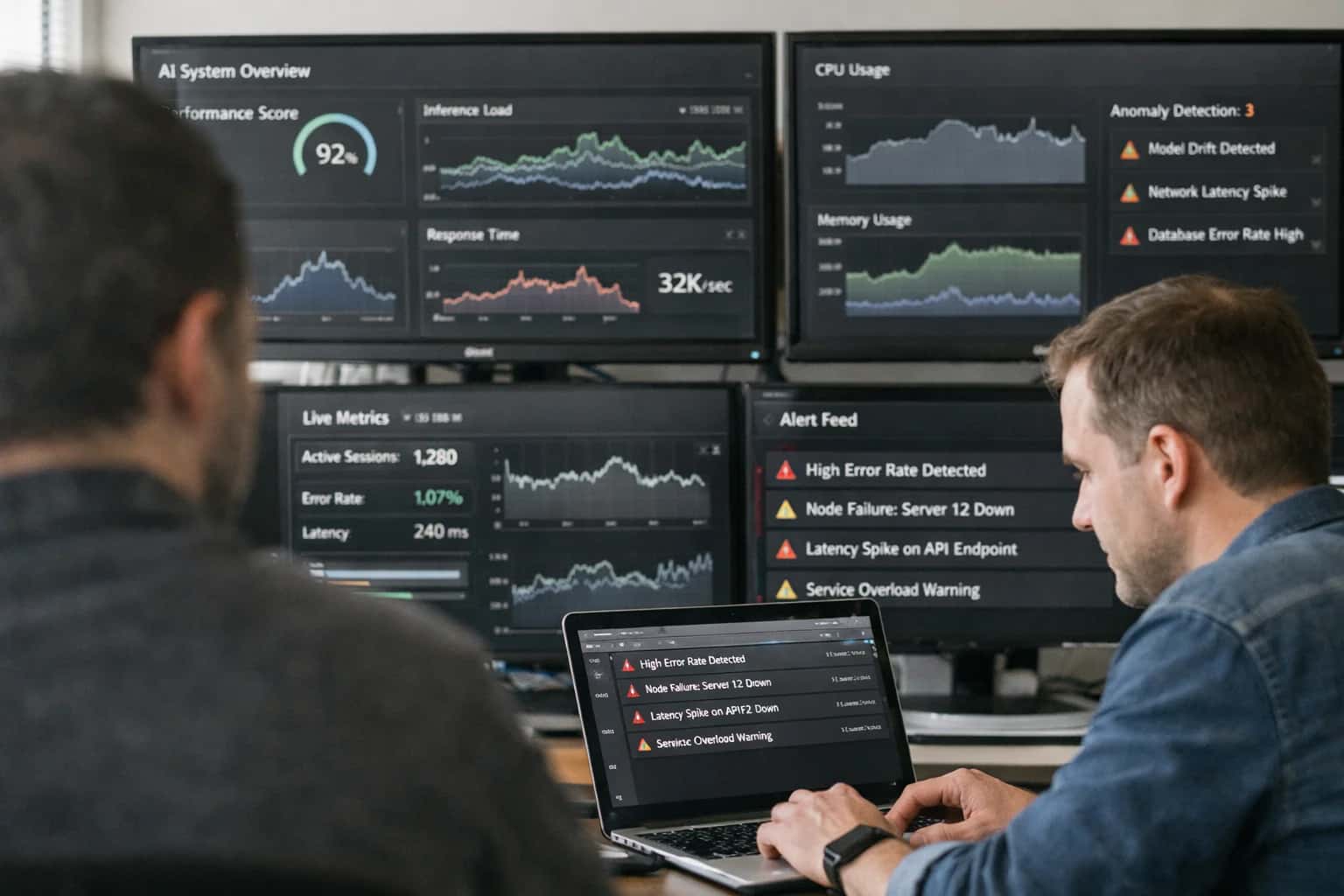
DRIFT DETECTION SYSTEMS
What is Detection Delay?
Detection delay is the elapsed time between the actual onset of a statistical drift event in a machine learning system and its identification by a monitoring algorithm.
Excessive detection delay directly impacts business metrics by allowing a degraded model to make erroneous predictions. False Positive Rate (FPR) and detection delay often trade off; a highly sensitive detector may alert quickly but generate noise. Effective MLOps practice involves tuning detection thresholds and using techniques like adaptive windowing (ADWIN) to balance timely alerts with operational stability, ensuring the drift alerting pipeline provides actionable intelligence for root cause analysis (RCA).
DRIFT DETECTION SYSTEMS
Key Factors Influencing Detection Delay
Detection delay is a critical performance metric for drift detection systems. The time lag between a drift event's onset and its identification is influenced by several interdependent algorithmic and operational factors.
01
Algorithm Sensitivity & Thresholds
The statistical sensitivity of a detection algorithm and its configured alert thresholds directly control the trade-off between speed and reliability. A low threshold detects subtle changes faster but increases the false positive rate (FPR), creating alert fatigue. Conversely, a high threshold reduces noise but introduces significant lag, especially for gradual drift. Optimal tuning requires balancing business risk tolerance with operational overhead.
02
Drift Type & Velocity
The inherent characteristics of the drift event itself are primary determinants.
- Sudden (Abrupt) Drift: Caused by discrete events (e.g., a policy change, data source switch). Easier and faster to detect, often resulting in shorter delays.
- Gradual Drift: A slow, incremental change over time. Algorithms must distinguish the signal from natural variance, leading to inherently longer detection delays.
- Recurring Drift: Periodic or seasonal patterns can confuse detectors, increasing delay unless the system is specifically designed to recognize and adapt to cyclic behavior.
03
Monitoring Granularity & Window Size
The temporal resolution of monitoring and the data window used for analysis create fundamental constraints.
- Online vs. Batch Detection: Online drift detection on streaming data can minimize delay but requires efficient incremental algorithms. Batch detection on accumulated data introduces inherent latency equal to the batch interval.
- Sliding Window Size: A smaller window reacts faster to change but is more volatile. A larger window provides stability but smooths out early signals of drift, increasing delay. Adaptive windowing algorithms like ADWIN attempt to dynamically optimize this trade-off.
04
Data Volume & Signal-to-Noise Ratio
The rate and quality of incoming data directly impact how quickly a statistically significant change can be confirmed.
- Low Data Volume: Sparse data points make it difficult to reliably estimate distributional properties, forcing the system to wait for more evidence and increasing delay.
- High Variance/Noise: Noisy data streams with high inherent variance mask the underlying drift signal. Detectors must aggregate more data to achieve confidence, prolonging the delay. Pre-processing to reduce noise can improve detection speed.
05
Detection Methodology
The underlying statistical or machine learning approach governs fundamental capabilities.
- Unsupervised Methods (e.g., PSI, KL Divergence on features): Detect data drift using only input data. Delay is based on feature distribution change.
- Performance-Based Methods (Monitoring accuracy/F1 score): Detect concept drift but require ground truth labels, which may be delayed in real-world applications. This label latency can become the dominant component of total detection delay.
- Multivariate vs. Univariate: Monitoring all features jointly (Wasserstein Distance) can detect complex interactions faster but is computationally heavier. Univariate monitoring per feature is faster but may miss correlated drift.
06
System & Operational Overhead
Infrastructure and process design introduce practical latency.
- Computational Latency: The time to compute distributional metrics (e.g., on high-dimensional data) or run complex detection algorithms adds to the delay.
- Pipeline Scheduling: Batch jobs run on hourly/daily schedules create fixed, additive delays.
- Alert Aggregation & Debouncing: Operational systems often implement debouncing periods to group provisional alerts, intentionally adding a short delay to prevent spamming. The alerting pipeline itself (message queues, notification systems) adds minor but non-zero overhead.
METHODOLOGY COMPARISON
Detection Delay Across Common Methods
Comparison of detection delay characteristics for prominent statistical and algorithmic drift detection techniques, highlighting trade-offs between sensitivity, computational cost, and implementation complexity.
| Detection Method | Typical Delay for Sudden Drift | Typical Delay for Gradual Drift | Computational Overhead | Primary Use Case |
|---|---|---|---|---|
Statistical Process Control (SPC) / Shewhart Chart | < 1 batch cycle | High (often fails to detect) | Low | Monitoring known performance metrics (e.g., accuracy, F1) for abrupt shifts from a stable mean. |
ADWIN (Adaptive Windowing) | Medium | Medium | Medium | Online detection in data streams where the rate of drift is unknown; adapts window size automatically. |
Page-Hinkley Test (PH Test) | Low | High | Low | Online detection of abrupt changes in the mean of a Gaussian signal; sensitive to sudden drift. |
Population Stability Index (PSI) / Kullback-Leibler Divergence | 1 batch cycle | 1 batch cycle | Medium | Batch-based detection of distributional shift in features or model scores between a reference and current window. |
Ensemble Methods (e.g., DDM, EDDM) | Low-Medium | Low-Medium | High | Online concept drift detection where multiple change detectors are combined for improved robustness and lower false positive rates. |
Unsupervised Clustering Shift (e.g., using Wasserstein Distance) | 1 batch cycle | 1 batch cycle | High | Detecting multivariate data drift without labels by comparing distributions of embeddings or raw features across windows. |
Model Performance Monitoring (Threshold-Based) | 1 evaluation cycle | High | Low | Direct monitoring of business or accuracy metrics; delay is a function of label availability and evaluation frequency. |
DRIFT DETECTION SYSTEMS
Detection Delay
Detection delay is a critical performance metric for drift detection systems, measuring the operational lag between a real-world change and its algorithmic identification.
Detection delay is the elapsed time between the actual onset of a drift event—such as a change in input data distribution or the underlying concept being modeled—and its successful identification by a monitoring system. This lag is a fundamental measure of a detection algorithm's responsiveness and directly impacts the window of degraded model performance before corrective action can be taken. Minimizing delay is essential for maintaining model efficacy and business process integrity in production environments.
The length of detection delay is influenced by the detection algorithm's sensitivity, the chosen statistical test (e.g., Page-Hinkley, ADWIN), and the sampling rate of the monitoring system. Sudden drift is typically detected with less delay than gradual drift. Excessive delay increases operational risk and financial exposure, as models make suboptimal decisions on changed data. Effective MLOps practice involves benchmarking detection delay alongside false positive rates to tune alerting systems for optimal business responsiveness.
DETECTION DELAY
Frequently Asked Questions
Detection delay is a critical performance metric for drift detection systems, quantifying the lag between a real-world change and its algorithmic identification. This FAQ addresses its measurement, impact, and optimization for MLOps practitioners.
Detection delay is the elapsed time between the actual onset of a statistical drift event in a data stream or model environment and the moment a monitoring system correctly identifies and alerts on that change. It is a core metric for evaluating the efficacy and responsiveness of drift detection algorithms. A shorter delay enables faster corrective actions like model retraining, minimizing the period of degraded performance. The delay is influenced by factors including the detection algorithm's sensitivity, the magnitude of the drift, the data arrival rate, and the chosen statistical significance thresholds. In production MLOps, balancing a low detection delay with a manageable false positive rate is a key engineering challenge.
Enabling Efficiency, Speed & Accuracy
Intelligent Analysis, Decision & Execution
We build AI systems for teams that need search across company data, workflow automation across tools, or AI features inside products and internal software.
Talk to Us
Search across company data
Give teams answers from docs, tickets, runbooks, and product data with sources and permissions.
Useful when people spend too long searching or get different answers from different systems.
Enterprise searchRAGPermissions
Read more
Automate internal workflows
Use AI to route work, draft outputs, trigger actions, and keep approvals and logs in place.
Useful when repetitive work moves across multiple tools and teams.
AI agentsWorkflow automationGovernance
Read more
Add AI to products and internal tools
Build assistants, guided actions, or decision support into the software your team or customers already use.
Useful when AI needs to be part of the product, not a separate tool.
AI integrationDecision supportModel routing
Read more
About the author
Prasad Kumkar
CEO & MD, Inference Systems
Prasad Kumkar is the CEO & MD of Inference Systems and writes about AI systems architecture, LLM infrastructure, model serving, evaluation, and production deployment. Over 5+ years, he has worked across computer vision models, L5 autonomous vehicle systems, and LLM research, with a focus on taking complex AI ideas into real-world engineering systems.
His work and writing cover AI systems, large language models, AI agents, multimodal systems, autonomous systems, inference optimization, RAG, evaluation, and production AI engineering.
LinkedIn
Limited slotsGet a Free AI Consultation
Partnered with leading AI, data, and software stack.





How We Work
Custom AI workflows for your Business
One-fit-all AI don't work for modern businesses. At Inferensys, we aim to understand your business & custom requirements; which we use to define most efficient agentic workflows, the data, and the tools for your business.
01
Review the use case
We understand the task, the users, and where AI can actually help.
Read more02
Pick the right approach
We define what needs search, automation, or product integration.
Read more03
Build the first useful version
We implement the part that proves the value first.
Read more04
Improve from there
We add the checks and visibility needed to keep it useful.
Read moreThe first call is a practical review of your use case and the right next step.
Talk to Us