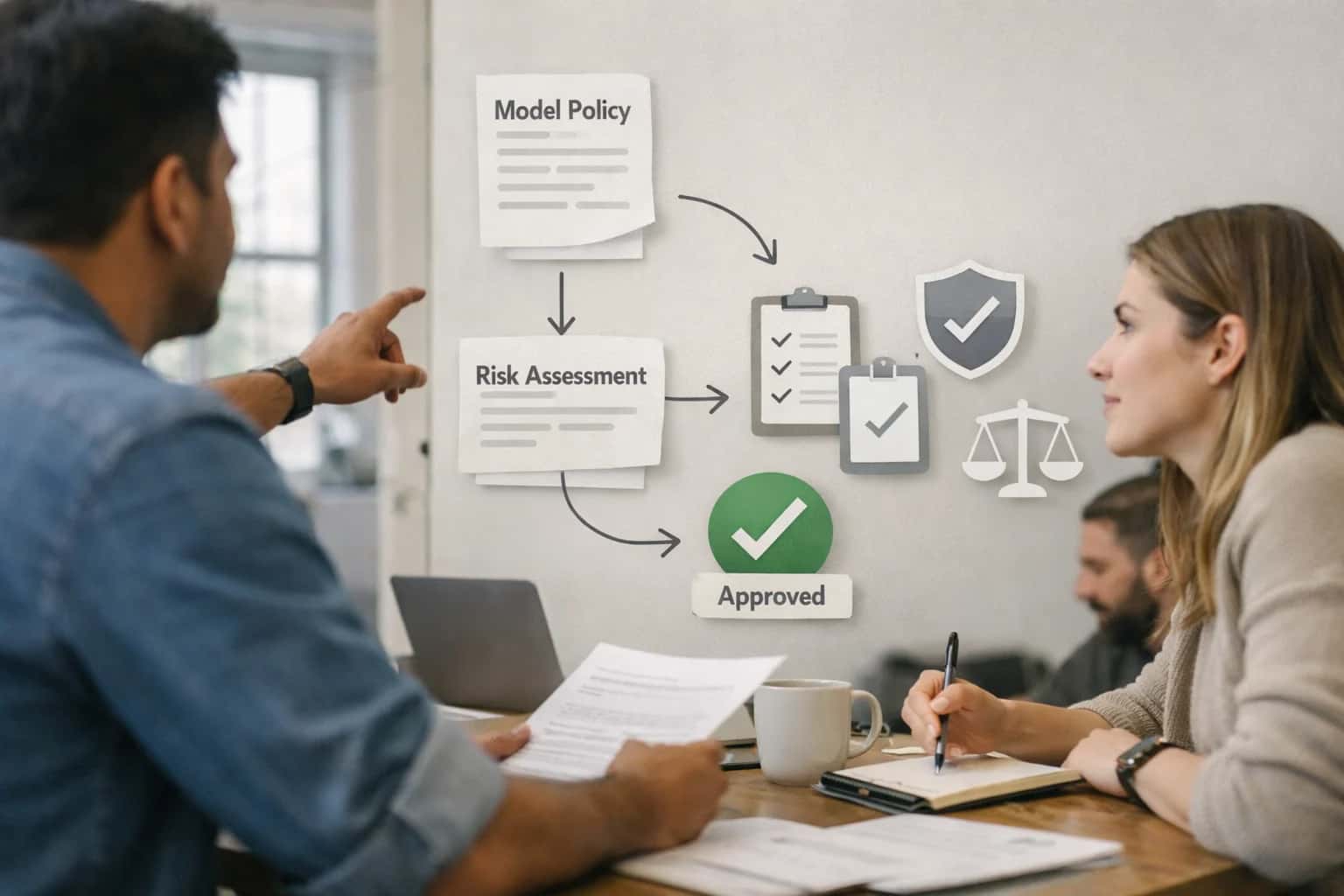
Semantic governance establishes the policies, standards, and processes for creating, validating, versioning, and retiring semantic models. It ensures that core concepts like 'customer' or 'product' are defined consistently across the enterprise, preventing data silos and misinterpretation. This governance is enforced through workflow automation, role-based access control, and change management protocols, making it integral to a semantic data fabric.

Glossary
Semantic Governance
Semantic governance is the framework of policies, standards, and processes for managing the lifecycle of semantic artifacts—like ontologies and taxonomies—to ensure data consistency, quality, and alignment with business goals.
ENTERPRISE KNOWLEDGE GRAPHS
What is Semantic Governance?
Semantic governance is the formal discipline of managing the lifecycle of semantic artifacts—such as ontologies, taxonomies, and mappings—to ensure consistency, quality, and alignment with business objectives within a knowledge graph or semantic data fabric.
Effective semantic governance directly enables semantic interoperability and reliable data products. By maintaining a curated library of shared meanings, it provides the deterministic grounding needed for Retrieval-Augmented Generation (RAG) systems and agentic reasoning. This reduces integration costs and ensures that AI systems operate on a unified, trustworthy representation of enterprise knowledge.
SEMANTIC GOVERNANCE
Core Components of a Semantic Governance Framework
A semantic governance framework establishes the policies, standards, and processes required to manage the lifecycle of semantic artifacts—such as ontologies, taxonomies, and mappings—ensuring consistency, quality, and alignment with business objectives.
01
Ontology & Vocabulary Management
This component governs the formal definition and lifecycle of shared conceptual models. It includes processes for:
- Ontology development and versioning: Systematic creation and evolution of formal OWL or RDFS ontologies.
- Vocabulary and taxonomy stewardship: Management of controlled vocabularies, taxonomies, and SKOS concept schemes.
- Change control and deprecation: Formal review boards and procedures for approving new terms, modifying definitions, and retiring obsolete concepts.
- Cross-domain alignment: Establishing mappings between different domain ontologies to ensure enterprise-wide semantic interoperability.
02
Semantic Mapping Governance
This governs the rules that transform raw data into semantically meaningful knowledge graphs. It focuses on the integrity of R2RML and RML mapping definitions. Key aspects include:
- Mapping specification and validation: Ensuring mapping logic correctly translates source schemas to target ontology terms.
- Lineage tracking: Documenting which source fields and transformations populate each graph predicate, which is critical for data provenance.
- Impact analysis: Understanding how changes to source systems or ontologies affect existing mappings and downstream consumers.
- Mapping registry: A centralized catalog of all active mapping documents, their owners, and their status.
03
Quality & Consistency Rules
This component defines and enforces the integrity constraints that ensure the knowledge graph's factual correctness. It involves:
- SHACL or ShEx validation: Defining shape constraints to enforce data structure, cardinality, and datatype rules.
- Logical consistency checking: Using OWL reasoners to detect contradictory statements (e.g., an instance belonging to two disjoint classes).
- Business rule execution: Applying domain-specific rules (e.g., "a retired employee cannot be an active project lead") via rule engines like SWRL or SPIN.
- Metric definition and monitoring: Establishing KPIs for graph completeness, freshness, and accuracy, feeding into a data observability dashboard.
04
Metadata & Lineage Governance
This manages the descriptive information about semantic assets themselves, creating a metadata graph. It encompasses:
- Provenance tracking: Capturing the origin, authorship, and derivation history of every triple or entity, a core aspect of data provenance.
- Asset cataloging: Registering all ontologies, mappings, and graph datasets in a semantic catalog with rich, searchable metadata.
- Impact and dependency analysis: Using the lineage graph to trace how a change in a source system propagates through mappings to affect downstream reports or AI models.
- Usage analytics: Monitoring query patterns to identify popular vs. unused ontology terms, informing prioritization for stewardship efforts.
05
Access Control & Security Policies
This defines who can create, read, update, or delete semantic content, addressing unique graph-based security challenges. It includes:
- Triple-level and graph-level permissions: Implementing fine-grained access control using standards like W3C's WebID and ACL.
- Inference-aware security: Managing the risk of sensitive information being inferred through logical reasoning, not just explicitly stated.
- Policy definition for virtual graphs: Governing access in a virtual knowledge graph architecture where queries are federated to underlying secured sources.
- Audit logging: Maintaining immutable logs of all changes to ontologies, mappings, and critical instance data for compliance auditing.
06
Stewardship Roles & Processes
This establishes the human organizational structure and workflows required for effective governance. It defines:
- Role definitions: Clear responsibilities for Ontology Engineers, Domain Stewards, Vocabulary Curators, and Data Custodians.
- Review and approval workflows: Formalized processes for submitting change requests, conducting peer reviews, and obtaining approvals.
- Communication and training: Programs to educate data producers and consumers on ontology usage and governance policies.
- Tooling and platform support: Provisioning of dedicated platforms (e.g., ontology editors, workflow managers) to enable stewards to perform their duties efficiently.
OPERATIONAL FRAMEWORK
How Semantic Governance Works in Practice
Semantic governance operationalizes the management of meaning within an enterprise. It translates high-level policies into concrete workflows for creating, validating, and maintaining semantic artifacts like ontologies and taxonomies.
In practice, semantic governance establishes a governance council and defines stewardship roles for domain experts and data architects. This body creates and enforces style guides for ontology development, versioning protocols for controlled vocabularies, and approval workflows for new terms. Core activities include ontology lifecycle management, mapping validation, and change impact analysis to prevent semantic drift across integrated systems.
Execution relies on a semantic governance platform that integrates with the knowledge graph and data fabric. This platform automates policy enforcement, tracks provenance and lineage of semantic assets, and provides quality dashboards. It manages access controls, audits term usage, and facilitates collaborative editing to ensure all semantic models remain consistent, compliant, and aligned with evolving business objectives.
COMPARISON MATRIX
Semantic Governance vs. Related Concepts
This table distinguishes semantic governance from adjacent data management disciplines by comparing their primary focus, core artifacts, and operational scope.
| Feature / Dimension | Semantic Governance | Master Data Management (MDM) | Data Governance | Data Catalog Management |
|---|---|---|---|---|
Primary Objective | Ensure consistency, quality, and lifecycle management of semantic models (ontologies, taxonomies) and their mappings. | Create and maintain a single, authoritative version of core business entities (e.g., Customer, Product). | Ensure overall data availability, usability, integrity, and security across the enterprise. | Enable discovery, understanding, and trust in data assets through centralized metadata inventory. |
Core Artifacts Managed | Ontologies, taxonomies, semantic mappings (R2RML/RML), entity definitions, vocabulary standards. | Golden records, entity hierarchies, cross-system ID mappings, reference data. | Data policies, standards, quality rules, access controls, compliance frameworks. | Technical metadata, business glossaries, data lineage diagrams, user ratings, usage metrics. |
Scope of Control | Governs the meaning, relationships, and logical models of data across systems. | Governs the identity and core attributes of key business entities across systems. | Governs the full data lifecycle, including security, quality, and architecture. | Governs the documentation, discovery, and contextual understanding of data assets. |
Key Processes | Ontology versioning, mapping validation, vocabulary alignment, semantic rule enforcement. | Entity resolution, record survivorship, hierarchy management, reference data distribution. | Policy definition, stewardship assignment, compliance monitoring, issue remediation. | Metadata harvesting, asset classification, lineage tracking, stakeholder collaboration. |
Enabling Technology | Ontology editors (Protégé), mapping engines (RMLMapper), semantic reasoners, SHACL validators. | MDM hubs, identity resolution engines, data quality tools. | Data governance platforms, policy engines, workflow automation. | Data catalogs, automated metadata scanners, business glossary tools. |
Relationship to Knowledge Graph | Directly governs the schema and semantic layer of the knowledge graph; defines its meaning. | Provides cleansed, mastered entity data as a high-quality input to populate the knowledge graph. | Provides the overarching policy framework within which the knowledge graph is developed and used. | Documents the knowledge graph as a core data asset, capturing its lineage and usage. |
Typical Metrics | Ontology coverage, mapping accuracy, vocabulary reuse rate, semantic validation errors. | Golden record completeness, entity duplication rate, cross-system consistency. | Policy compliance rate, data quality score, security incident count. | Asset coverage, search success rate, user engagement, lineage accuracy. |
Primary Stakeholders | Ontology engineers, data architects, semantic modelers. | Data stewards, business process owners, application data managers. | Chief Data Officer, data stewards, compliance officers, security teams. | Data consumers, analysts, scientists, data stewards. |
SEMANTIC GOVERNANCE
Frequently Asked Questions
Semantic governance is the framework of policies, standards, and processes for managing the lifecycle of semantic artifacts—such as ontologies, taxonomies, and mappings—to ensure consistency, quality, and alignment with business goals.
Semantic governance is the systematic management of an organization's semantic assets—including ontologies, taxonomies, controlled vocabularies, and data mappings—throughout their lifecycle. It is critical because it ensures that the meaning of data is consistently defined, understood, and applied across all systems, enabling semantic interoperability and reliable data integration. Without it, enterprises face data silos, inconsistent analytics, and failed AI initiatives due to ambiguous or conflicting definitions of core business concepts like 'customer' or 'revenue'.
Enabling Efficiency, Speed & Accuracy
Intelligent Analysis, Decision & Execution
We build AI systems for teams that need search across company data, workflow automation across tools, or AI features inside products and internal software.
Talk to Us
Search across company data
Give teams answers from docs, tickets, runbooks, and product data with sources and permissions.
Useful when people spend too long searching or get different answers from different systems.
Enterprise searchRAGPermissions
Read more
Automate internal workflows
Use AI to route work, draft outputs, trigger actions, and keep approvals and logs in place.
Useful when repetitive work moves across multiple tools and teams.
AI agentsWorkflow automationGovernance
Read more
Add AI to products and internal tools
Build assistants, guided actions, or decision support into the software your team or customers already use.
Useful when AI needs to be part of the product, not a separate tool.
AI integrationDecision supportModel routing
Read more
About the author
Prasad Kumkar
CEO & MD, Inference Systems
Prasad Kumkar is the CEO & MD of Inference Systems and writes about AI systems architecture, LLM infrastructure, model serving, evaluation, and production deployment. Over 5+ years, he has worked across computer vision models, L5 autonomous vehicle systems, and LLM research, with a focus on taking complex AI ideas into real-world engineering systems.
His work and writing cover AI systems, large language models, AI agents, multimodal systems, autonomous systems, inference optimization, RAG, evaluation, and production AI engineering.
LinkedIn
Limited slotsGet a Free AI Consultation
Partnered with leading AI, data, and software stack.





How We Work
Custom AI workflows for your Business
One-fit-all AI don't work for modern businesses. At Inferensys, we aim to understand your business & custom requirements; which we use to define most efficient agentic workflows, the data, and the tools for your business.
01
Review the use case
We understand the task, the users, and where AI can actually help.
Read more02
Pick the right approach
We define what needs search, automation, or product integration.
Read more03
Build the first useful version
We implement the part that proves the value first.
Read more04
Improve from there
We add the checks and visibility needed to keep it useful.
Read moreThe first call is a practical review of your use case and the right next step.
Talk to Us