Provenance Tracking is the systematic capability to record, store, and query the complete origin, lineage, and transformation history of every fact, entity, and relationship within a knowledge graph. It creates a verifiable audit trail that answers critical questions: where did this data come from, who created or modified it, when did it change, and what processes were applied? This metadata is essential for establishing data trustworthiness, debugging errors, and meeting regulatory compliance requirements like data sovereignty and algorithmic transparency.

Glossary
Provenance Tracking
Provenance tracking is the systematic recording of the origin, lineage, and transformations of each fact or entity within a knowledge graph to create a verifiable audit trail.
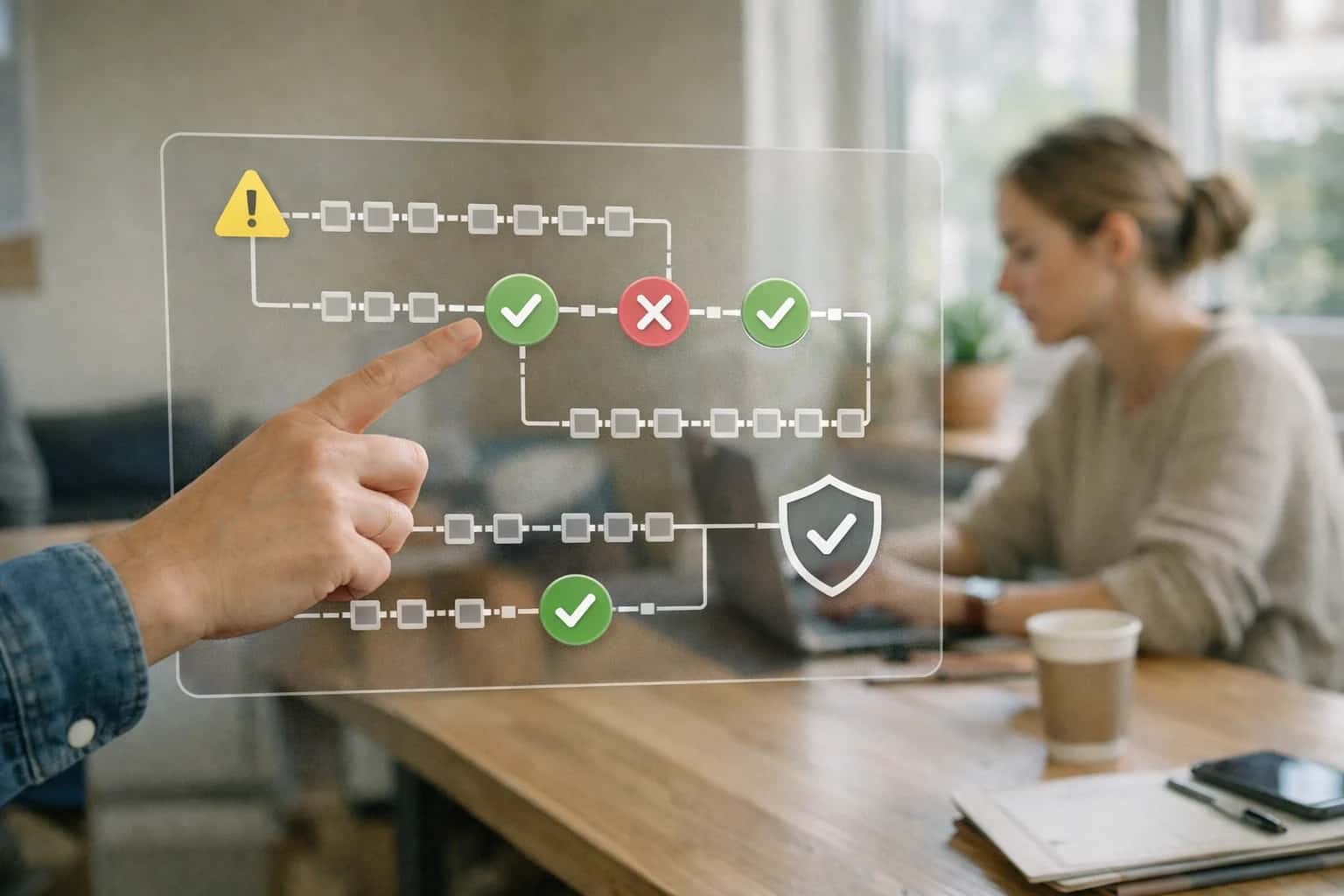
KNOWLEDGE GRAPH QUALITY ASSESSMENT
What is Provenance Tracking?
A core capability for ensuring trust, auditability, and data governance in structured information systems.
In practice, provenance is implemented by attaching provenance metadata—such as source URIs, timestamps, agent identifiers, and derivation methods—directly to graph triples. This enables deterministic grounding for reasoning systems and is a foundational requirement for explainable AI. Within a semantic data fabric, robust provenance tracking allows data stewards to perform impact analysis, validate factual consistency, and ensure reference integrity across the entire enterprise knowledge ecosystem.
KNOWLEDGE GRAPH QUALITY ASSESSMENT
Core Characteristics of Provenance Tracking
Provenance tracking is the systematic capability to record and trace the origin, lineage, and transformations of each fact or entity within a knowledge graph, providing a verifiable audit trail for data governance and quality assurance.
01
Granular Lineage
Provenance tracking captures the complete lineage of each triple (subject-predicate-object) or entity. This includes:
- Source Origin: The exact raw data source (e.g., database record
CRM.Contacts.ID=4521, PDF documentQ3_Report.pdf). - Transformation Steps: Every ETL process, data cleaning rule, or algorithmic enrichment applied.
- Temporal Metadata: Timestamps for creation, modification, and deprecation. This granularity enables precise root-cause analysis when data quality issues, such as a factual inconsistency, are detected.
02
Deterministic Attribution
Every piece of information is irrevocably linked to its origin. This provides deterministic attribution, answering critical questions:
- Who created or modified this fact? (e.g., user
AI_Agent_7, pipelinesemantic_mapper_v2.1) - What was the source system or document?
- When did this occur?
- Why was this fact added or changed? (e.g., triggered by rule
ER-rule-5for entity resolution). This is foundational for algorithmic explainability and audit compliance, moving beyond opaque data silos.
03
Immutable Audit Trail
Provenance records are immutable and append-only, creating a tamper-evident history. This is not a simple version log but a cryptographically verifiable chain of custody. Key implementations include:
- Using content-addressable storage (e.g., hashing) to link facts to their provenance data.
- Storing provenance as metadata within the graph itself, often using standards like W3C PROV-O ontology. This immutability is essential for data governance, regulatory audits, and establishing trust in explainable AI systems built on the knowledge graph.
04
Impact Analysis & Propagation
Provenance enables sophisticated impact analysis. When a source datum is found to be erroneous or updated, the system can trace and flag all downstream derived facts and inferences. This is critical for:
- Corrective Action: Identifying which RAG responses, dashboard metrics, or model predictions are now invalid.
- Proactive Updates: Triggering recomputation of dependent graph embeddings or materialized views.
- Quality Metric Recalculation: Updating scores for entity accuracy and link validity based on source corrections.
05
Integration with Quality Metrics
Provenance is the backbone for calculating and interpreting other knowledge graph quality metrics. It provides the context for:
- Data Freshness: Determining the age of a fact by tracing it to its source's last update.
- Completeness Ratio: Understanding why data is missing—was it never extracted, filtered out by a rule, or lost in transformation?
- Rule-Based Validation: When a constraint satisfaction check fails, provenance identifies the source pipeline responsible for introducing the violation.
- Drift Detection: Correlating changes in statistical coverage metrics with specific updates to source systems.
06
Support for Hybrid Curation
Modern knowledge graphs are built through hybrid human-in-the-loop and automated processes. Provenance tracks contributions from all actors:
- Automated Systems: Pipelines, entity resolution algorithms, and inference engines.
- Human Curators: Domain experts who validate, correct, or add facts via curation interfaces.
- AI Agents: Autonomous systems that generate or synthesize information, requiring clear attribution for agentic observability. This allows for weighted confidence scores, where a fact verified by multiple independent sources (human and algorithmic) receives higher authority signals.
QUALITY ASSESSMENT
How Provenance Tracking Works in Knowledge Graphs
Provenance tracking is a foundational capability for enterprise knowledge graphs, providing a verifiable audit trail for every piece of information.
Provenance tracking is the systematic recording of the origin, lineage, and transformations applied to each fact or entity within a knowledge graph. It creates a verifiable audit trail that answers critical questions: where did this data come from, who created it, when was it added, and what processes modified it? This metadata is typically stored as reified statements or within a dedicated provenance ontology, linking every triple to its source system, extraction timestamp, and confidence score.
This capability is essential for data governance, regulatory compliance, and trustworthy AI. It enables root-cause analysis for data errors, supports factual consistency checks, and provides the deterministic grounding required for Retrieval-Augmented Generation (RAG) and explainable AI systems. By implementing provenance, organizations move from opaque data silos to a transparent, accountable information asset where every claim's heritage is explicitly documented and queryable.
KNOWLEDGE GRAPH QUALITY ASSESSMENT
Enterprise Use Cases for Provenance Tracking
Provenance tracking provides a verifiable audit trail for data within a knowledge graph. These cards detail its critical applications in regulated industries and complex data ecosystems.
01
Regulatory Compliance & Audit
Provenance tracking is foundational for demonstrating compliance with regulations like GDPR, CCPA, and sector-specific rules (e.g., FDA 21 CFR Part 11). It provides an immutable record of:
- Data origin: Where a specific fact or entity originated.
- Transformation history: Every change, enrichment, or correction applied.
- Access and usage: Who or what system queried or modified the data and when.
This creates a defensible audit trail for regulators, proving data integrity and lineage for critical decisions.
02
AI/ML Model Governance & Explainability
When a knowledge graph grounds a Retrieval-Augmented Generation (RAG) system or trains a graph neural network, provenance is essential for model explainability. It answers:
- What source data was retrieved to generate an answer or prediction?
- What was the confidence or freshness of those underlying facts at inference time?
- Has the training data been compromised or drifted?
This traceability is critical for Algorithmic Impact Assessments under frameworks like the EU AI Act, allowing enterprises to debug model outputs and justify automated decisions.
03
Data Lineage for Supply Chain & Manufacturing
In complex physical supply chains, a knowledge graph models parts, suppliers, and processes. Provenance tracking provides end-to-end material traceability.
- Track a component from raw material to finished product.
- Identify all suppliers in a multi-tier supply chain for a given batch.
- Pinpoint the root cause of a quality defect by tracing back through manufacturing steps.
This enables rapid recall management, validates sustainability claims, and ensures compliance with conflict mineral regulations.
04
Financial Services Fraud Investigation
In financial knowledge graphs linking entities (persons, companies, accounts, transactions), provenance is vital for forensic auditing. Investigators can:
- Reconstruct transaction networks to uncover money laundering patterns.
- Verify the source of data points used in credit scoring or trading algorithms.
- Demonstrate the integrity of data used in regulatory reporting (e.g., Basel III, MiFID II).
Provenance provides the chain of evidence, showing how suspicious activity was identified and which original records led to a flagged alert.
05
Pharmaceutical Research & Intellectual Property
In drug discovery, knowledge graphs integrate genomic data, chemical compounds, and clinical trial results. Provenance tracking:
- Establishes priority for novel discoveries by timestamping when a relationship (e.g., 'Compound X inhibits Protein Y') was first asserted.
- Tracks the evolution of a hypothesis as new experimental evidence is integrated.
- Ensures reproducibility by documenting the exact data and literature sources used for a given analysis.
This protects intellectual property, validates patent claims, and meets stringent Good Laboratory Practice (GLP) documentation requirements.
06
Data Mesh & Semantic Data Fabric Governance
In a decentralized data mesh architecture, a knowledge graph acts as the semantic layer. Provenance tracks data as it moves across domains:
- Maps a unified entity back to its source in specific domain-owned data products.
- Records transformation rules applied during semantic integration.
- Enables accountability by showing which domain team is the source of truth for a given attribute.
This allows central governance teams to measure data quality, resolve conflicts, and maintain trust in a federated data ecosystem without centralizing the raw data itself.
PROVENANCE TRACKING
Frequently Asked Questions
Provenance tracking is the systematic capability to record and trace the origin, lineage, and transformations of each fact or entity within a knowledge graph. This FAQ addresses its core mechanisms, value, and implementation for enterprise data governance.
Provenance tracking is the systematic capability to record and trace the origin, lineage, and transformations of each fact (triple) or entity within a knowledge graph, creating a verifiable audit trail. It answers fundamental questions about data: Where did this fact come from?, Who or what system asserted it?, When was it added or modified?, and What transformations or inferences were applied? This is typically implemented by attaching provenance metadata—such as source URI, ingestion timestamp, confidence score, and contributing agent—directly to graph nodes and edges using standards like PROV-O (PROV Ontology). In essence, it provides a deterministic history for every piece of information, turning a static graph into a dynamic, accountable record of knowledge evolution.
Enabling Efficiency, Speed & Accuracy
Intelligent Analysis, Decision & Execution
We build AI systems for teams that need search across company data, workflow automation across tools, or AI features inside products and internal software.
Talk to Us
Search across company data
Give teams answers from docs, tickets, runbooks, and product data with sources and permissions.
Useful when people spend too long searching or get different answers from different systems.
Enterprise searchRAGPermissions
Read more
Automate internal workflows
Use AI to route work, draft outputs, trigger actions, and keep approvals and logs in place.
Useful when repetitive work moves across multiple tools and teams.
AI agentsWorkflow automationGovernance
Read more
Add AI to products and internal tools
Build assistants, guided actions, or decision support into the software your team or customers already use.
Useful when AI needs to be part of the product, not a separate tool.
AI integrationDecision supportModel routing
Read more
About the author
Prasad Kumkar
CEO & MD, Inference Systems
Prasad Kumkar is the CEO & MD of Inference Systems and writes about AI systems architecture, LLM infrastructure, model serving, evaluation, and production deployment. Over 5+ years, he has worked across computer vision models, L5 autonomous vehicle systems, and LLM research, with a focus on taking complex AI ideas into real-world engineering systems.
His work and writing cover AI systems, large language models, AI agents, multimodal systems, autonomous systems, inference optimization, RAG, evaluation, and production AI engineering.
LinkedIn
Limited slotsGet a Free AI Consultation
Partnered with leading AI, data, and software stack.





How We Work
Custom AI workflows for your Business
One-fit-all AI don't work for modern businesses. At Inferensys, we aim to understand your business & custom requirements; which we use to define most efficient agentic workflows, the data, and the tools for your business.
01
Review the use case
We understand the task, the users, and where AI can actually help.
Read more02
Pick the right approach
We define what needs search, automation, or product integration.
Read more03
Build the first useful version
We implement the part that proves the value first.
Read more04
Improve from there
We add the checks and visibility needed to keep it useful.
Read moreThe first call is a practical review of your use case and the right next step.
Talk to Us