Post-market surveillance (PMS) is the mandated lifecycle phase where a deployed AI system is actively monitored for concept drift, data drift, and emergent harmful behaviors that were not detected during pre-deployment testing. Unlike static certification, PMS requires automated telemetry pipelines to collect real-world inputs and outputs, comparing them against established safety alignment thresholds and hallucination rate benchmarks to detect degradation.

Glossary
Post-Market Surveillance
Post-market surveillance is the systematic, continuous process of monitoring an AI system's real-world performance, safety, and compliance after it has been deployed to users.
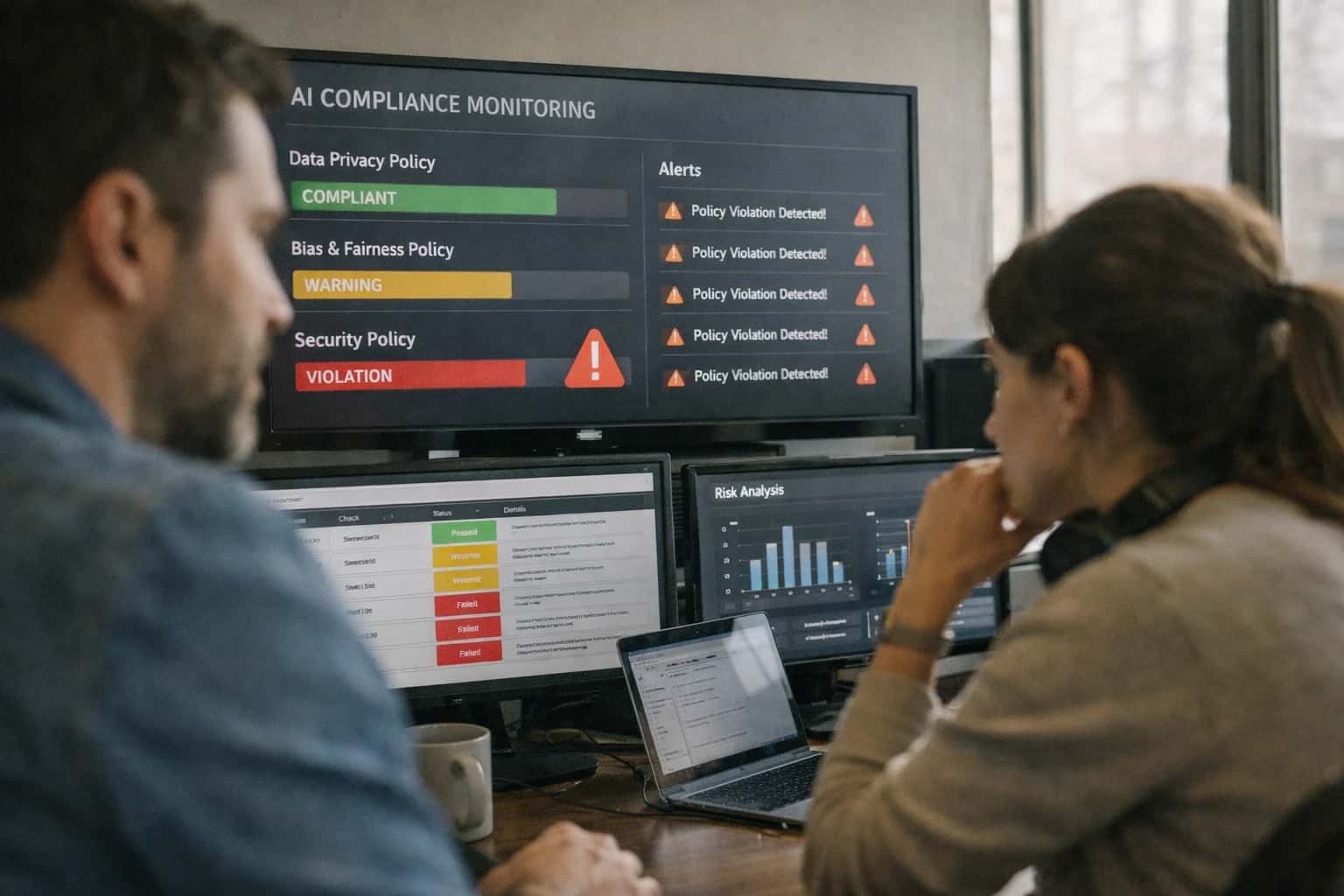
Continuous Deployment Monitoring
What is Post-Market Surveillance?
Post-market surveillance is the systematic, continuous process of monitoring an AI system's real-world performance, safety, and compliance after it has been deployed to users, ensuring ongoing adherence to regulatory standards.
Under frameworks like the EU AI Act, providers of high-risk classification systems must implement a formal PMS plan that feeds into a continuous residual risk scoring loop. This process integrates human-on-the-loop oversight mechanisms and automated decision logging to generate an immutable third-party audit trail, ensuring that any necessary rollback procedure or model deprecation policy can be triggered immediately upon anomaly detection.
POST-MARKET SURVEILLANCE
Key Characteristics of Effective PMS
An effective Post-Market Surveillance (PMS) system is not a passive log; it is an active, automated feedback loop that continuously validates safety, detects performance drift, and triggers corrective actions in deployed AI systems.
01
Continuous Performance Monitoring
Automated telemetry pipelines must track model accuracy, latency, and throughput against established pre-deployment baselines. This involves real-time monitoring of data drift and concept drift to detect when the statistical properties of production data diverge from training data, signaling potential model degradation before it impacts business outcomes.
Sub-second
Drift Detection Latency
02
Automated Feedback Loops
PMS requires a closed-loop system where production data and user corrections are systematically captured and routed back for model improvement. This includes logging explicit user feedback (thumbs up/down) and implicit signals (copying/pasting text) to construct reinforcement learning from human feedback (RLHF) datasets for continuous alignment and accuracy tuning.
03
Incident Detection and Response
The system must automatically trigger alerts based on predefined safety alignment thresholds and dangerous capability benchmarks. An effective PMS integrates a kill switch mechanism and a documented rollback procedure to immediately halt or revert the system during critical failures, safety violations, or containment breaches.
04
Immutable Audit Logging
Every AI-driven decision, input, and output must be recorded in a tamper-proof, chronological third-party audit trail. This ensures non-repudiation and provides the necessary forensic evidence for regulatory compliance, disparate impact ratio analysis, and fulfilling the right to explanation under frameworks like the EU AI Act.
05
Adversarial Robustness Testing
PMS must continuously probe the live system with adversarial robustness benchmarks to test resilience against evasion attacks, prompt injection vulnerabilities, and jailbreak attempts. This proactive red-teaming in the production environment ensures that security postures hold against evolving threats that were not present during pre-deployment certification.
06
Regulatory Compliance Reporting
The system must automate the generation of Post-Market Surveillance Reports required by regulatory bodies. This includes compiling data on hallucination rate benchmarks, safety incidents, and residual risk scoring to demonstrate ongoing conformity with the essential requirements of regulations like the EU AI Act, specifically for high-risk classification systems.
POST-MARKET SURVEILLANCE
Frequently Asked Questions
Essential questions about the continuous monitoring of AI system performance and safety after deployment, a critical requirement under the EU AI Act and other emerging regulatory frameworks.
Post-market surveillance (PMS) is the systematic, continuous process of monitoring an AI system's real-world performance, safety, and compliance after it has been deployed to users. Unlike pre-deployment conformity assessments, PMS captures emergent behaviors, concept drift, and unforeseen failure modes that only manifest in production environments. Under the EU AI Act, providers of high-risk AI systems are legally obligated to establish and document a PMS plan that collects and analyzes operational data, user feedback, and incident reports. This lifecycle phase bridges the gap between laboratory validation and actual human impact, ensuring that algorithmic systems remain safe and effective as real-world conditions evolve.
Enabling Efficiency, Speed & Accuracy
Intelligent Analysis, Decision & Execution
We build AI systems for teams that need search across company data, workflow automation across tools, or AI features inside products and internal software.
Talk to Us
Search across company data
Give teams answers from docs, tickets, runbooks, and product data with sources and permissions.
Useful when people spend too long searching or get different answers from different systems.
Enterprise searchRAGPermissions
Read more
Automate internal workflows
Use AI to route work, draft outputs, trigger actions, and keep approvals and logs in place.
Useful when repetitive work moves across multiple tools and teams.
AI agentsWorkflow automationGovernance
Read more
Add AI to products and internal tools
Build assistants, guided actions, or decision support into the software your team or customers already use.
Useful when AI needs to be part of the product, not a separate tool.
AI integrationDecision supportModel routing
Read more
About the author
Prasad Kumkar
CEO & MD, Inference Systems
Prasad Kumkar is the CEO & MD of Inference Systems and writes about AI systems architecture, LLM infrastructure, model serving, evaluation, and production deployment. Over 5+ years, he has worked across computer vision models, L5 autonomous vehicle systems, and LLM research, with a focus on taking complex AI ideas into real-world engineering systems.
His work and writing cover AI systems, large language models, AI agents, multimodal systems, autonomous systems, inference optimization, RAG, evaluation, and production AI engineering.
LinkedIn
Limited slotsGet a Free AI Consultation
Partnered with leading AI, data, and software stack.





How We Work
Custom AI workflows for your Business
One-fit-all AI don't work for modern businesses. At Inferensys, we aim to understand your business & custom requirements; which we use to define most efficient agentic workflows, the data, and the tools for your business.
01
Review the use case
We understand the task, the users, and where AI can actually help.
Read more02
Pick the right approach
We define what needs search, automation, or product integration.
Read more03
Build the first useful version
We implement the part that proves the value first.
Read more04
Improve from there
We add the checks and visibility needed to keep it useful.
Read moreThe first call is a practical review of your use case and the right next step.
Talk to Us