An Output Moderation API is a programmable interface that acts as a real-time safety gateway between a generative model's raw output and the end user. It programmatically inspects generated text, images, or audio against a configurable set of safety policies—detecting hate speech, violence, self-harm content, or proprietary data leakage—and either blocks, redacts, or flags the violating content before delivery. This mechanism is a critical component of guardrail configuration, ensuring that model outputs remain within defined operational boundaries.

Glossary
Output Moderation API
A programmable interface that filters or blocks toxic, unsafe, or policy-violating content generated by a model in real-time.
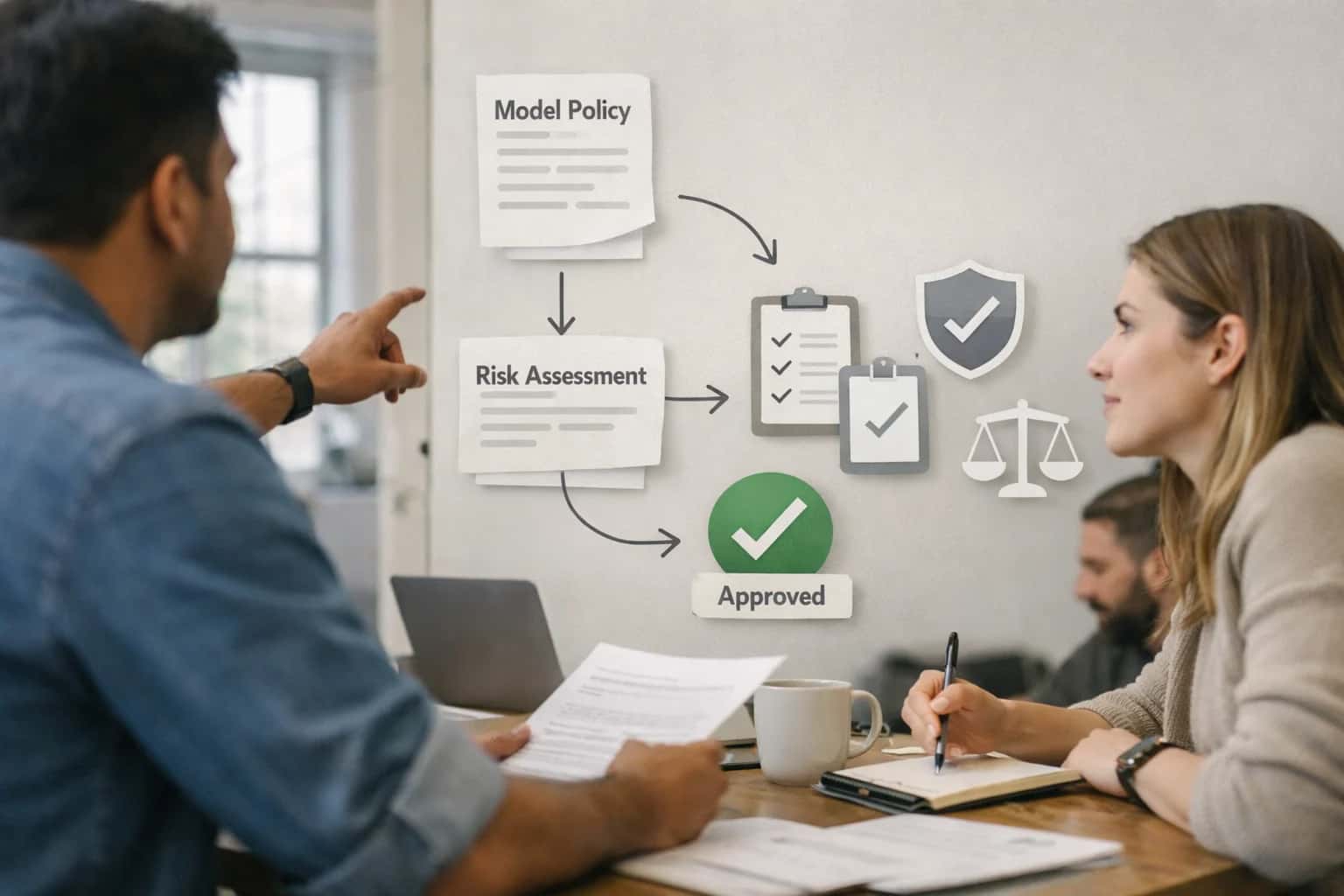
REAL-TIME CONTENT FILTERING
What is Output Moderation API?
A programmable interface that intercepts, evaluates, and filters or blocks toxic, unsafe, or policy-violating content generated by a model in real-time before it reaches the end user.
These APIs typically employ a combination of classification models, pattern matching, and semantic similarity checks to score content against predefined harm categories with configurable thresholds. In enterprise AI governance frameworks, output moderation APIs serve as a technical enforcement layer for human-on-the-loop oversight, providing audit logs of blocked content and enabling compliance with platform safety requirements. They are distinct from input filtering, focusing exclusively on the model's generated response rather than the user's prompt.
Real-Time Safety Enforcement
Core Capabilities of Output Moderation APIs
Output Moderation APIs provide a programmable safety layer that intercepts and evaluates generated text, images, or audio before it reaches the end-user, blocking or flagging policy violations in milliseconds.
01
Toxicity and Harm Classification
The foundational capability to detect and block hate speech, harassment, threats, and obscenity.
- Uses fine-tuned transformer models trained on large-scale toxicity datasets.
- Returns a hierarchical toxicity score (e.g., 0.0 to 1.0) with granular category labels.
- Example: Blocking a model output that contains a death threat while allowing a stern but safe customer service response.
< 50ms
Typical Latency Overhead
02
Prompt Injection and Jailbreak Detection
Identifies when a user or downstream process is attempting to override system instructions or bypass safety guardrails.
- Scans both user inputs and model outputs for adversarial patterns.
- Detects obfuscation techniques like Base64 encoding, token smuggling, and role-playing scenarios.
- Example: Catching a 'DAN' (Do Anything Now) jailbreak attempt hidden in a user's multi-turn conversation.
03
Personally Identifiable Information (PII) Redaction
Scans generated text for PII entities and either blocks the output or replaces them with placeholder tokens.
- Detects 40+ global entity types: SSNs, credit card numbers, email addresses, phone numbers, and medical record numbers.
- Supports context-aware redaction to avoid false positives on non-sensitive number sequences.
- Example: Automatically masking a customer's physical address that a model hallucinated into a product description.
04
Regulated Content Filtering
Enforces compliance with industry-specific regulations by blocking prohibited content categories.
- Configurable taxonomies for finance (e.g., investment advice disclaimers), healthcare (e.g., unverified medical claims), and legal domains.
- Blocks age-restricted content and self-harm or violence glorification.
- Example: Preventing a financial chatbot from providing specific, unqualified trading recommendations to a retail investor.
05
Hallucination and Grounding Verification
Evaluates whether generated statements are factually supported by the provided context or source documents.
- Computes a grounding score by comparing output claims against a verified knowledge base.
- Flags contradictions and unsupported fabrications in real-time.
- Example: Detecting when a RAG-based support bot invents a non-existent 'premium tier' feature not found in the retrieved documentation.
06
Custom Safety Policy Engine
Allows organizations to define and enforce proprietary content rules beyond standard safety taxonomies.
- Uses policy-as-code configurations to block competitor mentions, internal project codenames, or off-brand messaging.
- Supports regex patterns, semantic similarity thresholds, and keyword blocklists.
- Example: A media company blocking any generated text that references a specific unreleased product to prevent leaks.
OUTPUT MODERATION API
Frequently Asked Questions
Essential questions and answers about programmable interfaces that filter or block toxic, unsafe, or policy-violating content generated by language models in real-time.
An Output Moderation API is a programmable interface that intercepts and evaluates text generated by a language model in real-time, blocking or rewriting content that violates predefined safety policies before it reaches the end user. The API operates as a synchronous filter in the inference pipeline: when a model produces a token or sequence, the moderation service classifies it against categories such as hate speech, sexual content, violence, self-harm, or proprietary data leakage. Modern implementations use a combination of fine-tuned classifier models, rule-based pattern matching, and semantic similarity scoring to make sub-100ms decisions. The API typically returns a structured response containing a flagged boolean, the violated category, a confidence score, and optionally a rewritten safe alternative. This architecture decouples safety enforcement from the generative model itself, allowing security teams to update moderation policies without retraining the core model.
Enabling Efficiency, Speed & Accuracy
Intelligent Analysis, Decision & Execution
We build AI systems for teams that need search across company data, workflow automation across tools, or AI features inside products and internal software.
Talk to Us
Search across company data
Give teams answers from docs, tickets, runbooks, and product data with sources and permissions.
Useful when people spend too long searching or get different answers from different systems.
Enterprise searchRAGPermissions
Read more
Automate internal workflows
Use AI to route work, draft outputs, trigger actions, and keep approvals and logs in place.
Useful when repetitive work moves across multiple tools and teams.
AI agentsWorkflow automationGovernance
Read more
Add AI to products and internal tools
Build assistants, guided actions, or decision support into the software your team or customers already use.
Useful when AI needs to be part of the product, not a separate tool.
AI integrationDecision supportModel routing
Read more
About the author
Prasad Kumkar
CEO & MD, Inference Systems
Prasad Kumkar is the CEO & MD of Inference Systems and writes about AI systems architecture, LLM infrastructure, model serving, evaluation, and production deployment. Over 5+ years, he has worked across computer vision models, L5 autonomous vehicle systems, and LLM research, with a focus on taking complex AI ideas into real-world engineering systems.
His work and writing cover AI systems, large language models, AI agents, multimodal systems, autonomous systems, inference optimization, RAG, evaluation, and production AI engineering.
LinkedIn
Limited slotsGet a Free AI Consultation
Partnered with leading AI, data, and software stack.





How We Work
Custom AI workflows for your Business
One-fit-all AI don't work for modern businesses. At Inferensys, we aim to understand your business & custom requirements; which we use to define most efficient agentic workflows, the data, and the tools for your business.
01
Review the use case
We understand the task, the users, and where AI can actually help.
Read more02
Pick the right approach
We define what needs search, automation, or product integration.
Read more03
Build the first useful version
We implement the part that proves the value first.
Read more04
Improve from there
We add the checks and visibility needed to keep it useful.
Read moreThe first call is a practical review of your use case and the right next step.
Talk to Us