Model Risk Tiering is a risk classification framework that assigns third-party AI models to distinct oversight categories—typically low, medium, high, and critical—based on the severity of potential harm from failure, bias, or misuse. The tier dictates the depth of vendor due diligence, the frequency of algorithmic audits, and the stringency of human oversight mechanisms required before and after deployment.

Glossary
Model Risk Tiering
A framework for classifying third-party AI models based on their potential for harm to determine the intensity of required oversight.
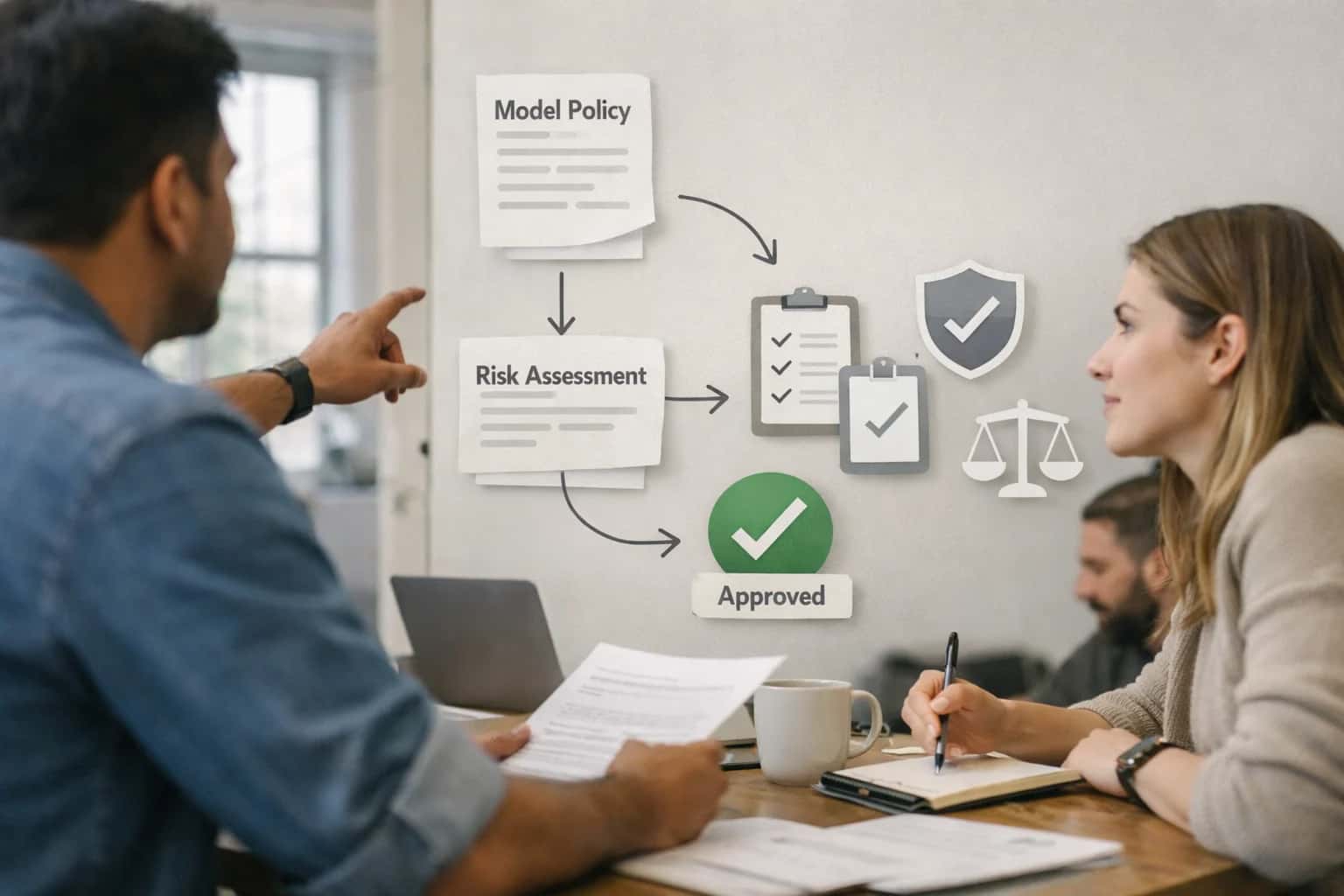
VENDOR RISK CLASSIFICATION
What is Model Risk Tiering?
A structured framework for classifying third-party AI models based on their potential for harm to determine the intensity of required oversight, due diligence, and ongoing monitoring.
Tiering criteria include the model's decision autonomy, the sensitivity of training data, the potential for disparate impact on protected groups, and the reversibility of automated outcomes. A model making consequential decisions in healthcare or lending receives a higher inherent risk rating than a recommendation engine, triggering mandatory conformity assessments and continuous post-market surveillance under frameworks like the EU AI Act.
STRUCTURING OVERSIGHT INTENSITY
Core Components of a Risk Tiering Framework
A robust model risk tiering framework systematically classifies third-party AI systems based on their potential for harm, ensuring that the intensity of due diligence and ongoing monitoring is proportionate to the risk.
01
Inherent Risk Profiling
The initial assessment of a vendor's AI system's raw risk level before any mitigating controls are applied. This evaluation is based on the model's intrinsic characteristics and its intended use case.
- Key Factors: Data sensitivity, decision autonomy, potential for physical or psychological harm, and impact on fundamental rights.
- Example: A model used for autonomous credit denial has a higher inherent risk than one used for product recommendation.
- Output: A preliminary risk score that dictates the depth of the subsequent due diligence process.
02
Residual Risk Scoring
The quantification of risk that remains after internal controls and vendor-provided mitigations are factored in. This score represents the true risk exposure an organization accepts.
- Calculation: Inherent Risk - Mitigating Controls = Residual Risk.
- Controls Evaluated: Human-on-the-loop oversight, guardrail configurations, output moderation APIs, and data encryption.
- Decision Point: If the residual risk exceeds the organization's risk appetite, the vendor engagement must be restructured or rejected.
03
Use Case Impact Analysis
A granular assessment of the specific operational context in which the AI model will be deployed. The same model can have vastly different risk profiles depending on its application.
- Criticality Tiers:
- Low-Impact: Internal productivity tools, non-customer-facing summarization.
- Medium-Impact: Customer service chatbots with human escalation paths.
- High-Impact: Autonomous financial trading, medical diagnosis support, or critical infrastructure control.
- Regulatory Trigger: High-impact use cases often trigger mandatory conformity assessments under frameworks like the EU AI Act.
04
Data Sensitivity Classification
A tiered categorization of the data the model will process, which is a primary driver of privacy and compliance risk. This classification directly informs the required security controls.
- Public Data: No restrictions; marketing copy or public web data.
- Internal Data: Confidential business information; requires access controls.
- Sensitive Data: PII, PHI, or financial records; mandates encryption, anonymization, and strict access logging.
- Prohibited Data: Data types that are contractually or legally barred from third-party processing, triggering an automatic rejection of the vendor.
05
Vendor Maturity Assessment
An evaluation of the third-party provider's organizational capability to manage AI risk, independent of the model's technical specifications. A high-risk model from an immature vendor is an unacceptable combination.
- Assessment Vectors:
- Documentation: Availability of model cards, system cards, and transparency reports.
- Security Posture: Adversarial robustness benchmarks, red-teaming reports, and incident response protocols.
- Operational Maturity: Model deprecation policies, rollback procedures, and API stability commitments.
- Outcome: A vendor maturity score that acts as a multiplier on the technical risk score.
06
Continuous Tier Re-Evaluation
A dynamic process that acknowledges risk is not static. A model's tier assignment must be periodically reviewed and automatically adjusted based on real-world triggers.
- Re-evaluation Triggers:
- Model Update: A new version or significant fine-tuning is released by the vendor.
- Concept Drift: Monitoring detects that the statistical relationship between inputs and outputs has shifted.
- Incident Response: A safety or security failure in production triggers an immediate out-of-cycle review.
- Regulatory Change: A new legal obligation, such as a systemic risk threshold, is introduced.
- Mechanism: Automated data drift detection pipelines feed into a quarterly manual governance review.
RISK CLASSIFICATION FRAMEWORK
How Model Risk Tiering Works in Practice
Model risk tiering is a structured framework for classifying third-party AI models based on their inherent potential for harm, determining the intensity and frequency of required oversight, due diligence, and ongoing monitoring.
Model risk tiering assigns a risk level—typically low, medium, high, or critical—to each vendor AI system by evaluating factors like decision autonomy, data sensitivity, and potential for disparate impact. A chatbot handling public FAQs is low-tier, while an AI screening loan applicants is high-tier, triggering mandatory conformity assessments and human-on-the-loop oversight.
The tier dictates the entire governance lifecycle. High-tier models require exhaustive vendor due diligence questionnaires, red-teaming reports, and continuous data drift detection. This proportional approach ensures that procurement and risk teams allocate scarce auditing resources to the models posing the greatest systemic risk, rather than applying uniform controls across all AI assets.
MODEL RISK TIERING
Frequently Asked Questions
Clear, technical answers to the most common questions about classifying third-party AI models by their potential for harm to determine oversight intensity.
Model risk tiering is a structured governance framework that classifies third-party AI models into distinct categories—typically low, medium, high, and critical—based on their inherent risk rating and potential for harm. The process works by evaluating a model against a standardized set of risk factors, including the sensitivity of data processed, the autonomy of decisions made, the potential for disparate impact, and the severity of consequences if the model fails. Each tier mandates a corresponding intensity of oversight: low-tier models may require only basic documentation, while critical-tier models demand rigorous conformity assessments, continuous post-market surveillance, and mandatory human-on-the-loop oversight. This proportional approach ensures that procurement and risk management resources are allocated efficiently, focusing intensive auditing on the small fraction of models that pose existential or high-severity risks to the organization.
Enabling Efficiency, Speed & Accuracy
Intelligent Analysis, Decision & Execution
We build AI systems for teams that need search across company data, workflow automation across tools, or AI features inside products and internal software.
Talk to Us
Search across company data
Give teams answers from docs, tickets, runbooks, and product data with sources and permissions.
Useful when people spend too long searching or get different answers from different systems.
Enterprise searchRAGPermissions
Read more
Automate internal workflows
Use AI to route work, draft outputs, trigger actions, and keep approvals and logs in place.
Useful when repetitive work moves across multiple tools and teams.
AI agentsWorkflow automationGovernance
Read more
Add AI to products and internal tools
Build assistants, guided actions, or decision support into the software your team or customers already use.
Useful when AI needs to be part of the product, not a separate tool.
AI integrationDecision supportModel routing
Read more
About the author
Prasad Kumkar
CEO & MD, Inference Systems
Prasad Kumkar is the CEO & MD of Inference Systems and writes about AI systems architecture, LLM infrastructure, model serving, evaluation, and production deployment. Over 5+ years, he has worked across computer vision models, L5 autonomous vehicle systems, and LLM research, with a focus on taking complex AI ideas into real-world engineering systems.
His work and writing cover AI systems, large language models, AI agents, multimodal systems, autonomous systems, inference optimization, RAG, evaluation, and production AI engineering.
LinkedIn
Limited slotsGet a Free AI Consultation
Partnered with leading AI, data, and software stack.





How We Work
Custom AI workflows for your Business
One-fit-all AI don't work for modern businesses. At Inferensys, we aim to understand your business & custom requirements; which we use to define most efficient agentic workflows, the data, and the tools for your business.
01
Review the use case
We understand the task, the users, and where AI can actually help.
Read more02
Pick the right approach
We define what needs search, automation, or product integration.
Read more03
Build the first useful version
We implement the part that proves the value first.
Read more04
Improve from there
We add the checks and visibility needed to keep it useful.
Read moreThe first call is a practical review of your use case and the right next step.
Talk to Us