Model distillation is a knowledge transfer process where a compact student model learns to mimic the output distribution of a computationally expensive teacher model. Instead of training solely on ground-truth labels, the student is optimized to match the teacher's softened probability outputs, capturing nuanced inter-class relationships that raw labels miss.

Glossary
Model Distillation
A compression technique where a smaller, efficient 'student' model is trained to replicate the behavior of a larger, computationally expensive 'teacher' model, reducing the carbon footprint of inference.
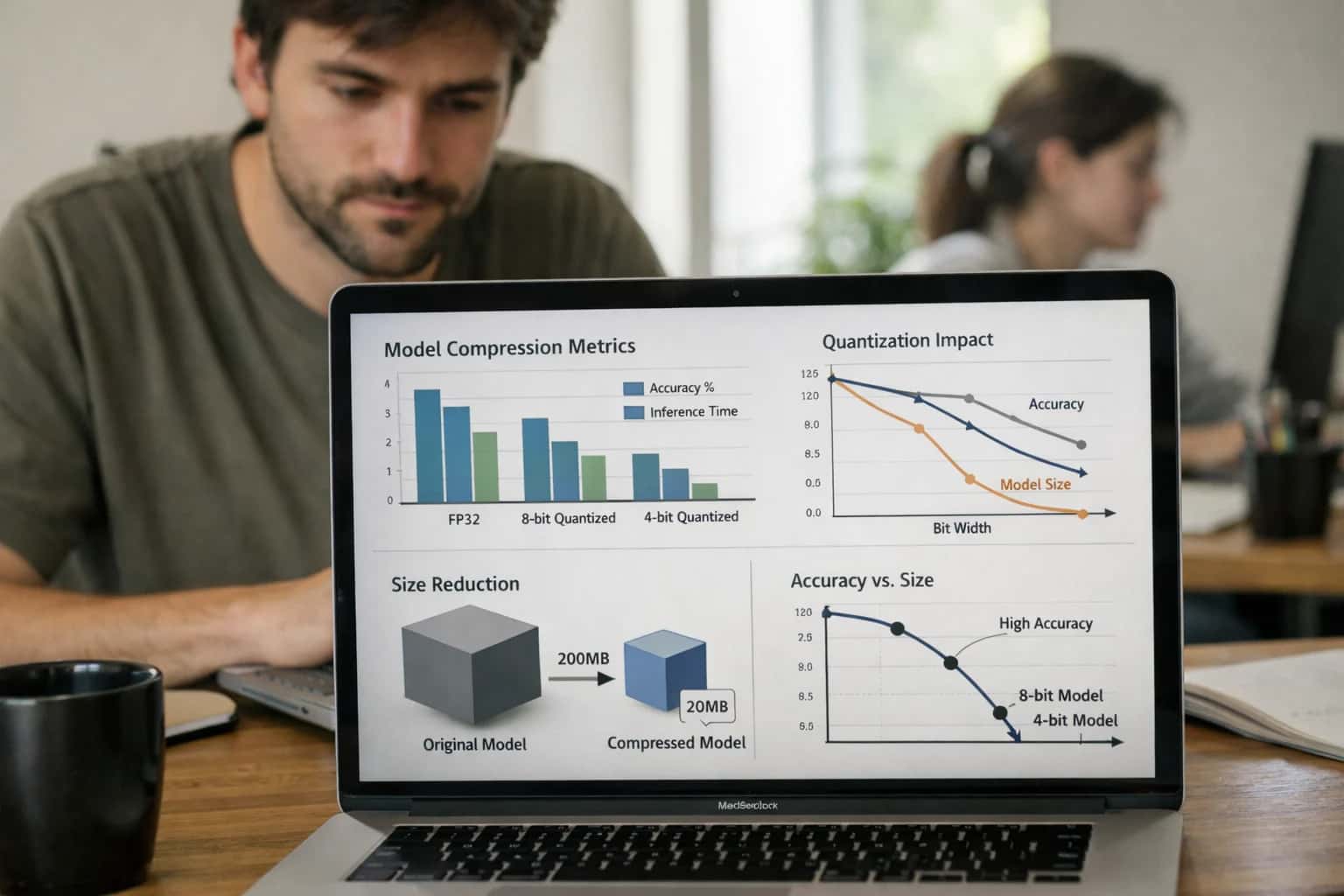
KNOWLEDGE TRANSFER
What is Model Distillation?
Model distillation is a compression technique where a smaller 'student' model is trained to replicate the behavior of a larger 'teacher' model, reducing inference costs and carbon footprint.
This technique significantly reduces the carbon footprint of inference by enabling deployment of smaller models that require fewer FLOPs per inference. The student model preserves much of the teacher's accuracy while dramatically lowering Joules per inference, making it a cornerstone of Green AI and sustainable deployment strategies.
COMPRESSION MECHANICS
Key Characteristics of Model Distillation
Model distillation transfers knowledge from a large, complex teacher model to a compact, efficient student model. This technique preserves predictive performance while dramatically reducing the computational and energy costs of inference.
01
Teacher-Student Architecture
The process involves a two-model setup: a large, pre-trained teacher model with high capacity and a smaller student model with fewer parameters. The student is trained not on the original ground-truth labels alone, but to mimic the teacher's output distribution.
- Soft targets: The teacher produces a probability distribution over classes, revealing inter-class similarities (e.g., a cat image is more similar to a dog than a truck).
- Softmax temperature: A hyperparameter (T) sharpens or smooths the teacher's output probabilities. Higher temperatures reveal more granular knowledge about non-target classes.
- Combined loss: The student optimizes a weighted sum of the distillation loss (matching the teacher) and the standard task loss (matching ground truth).
10-100x
Typical Size Reduction
02
Knowledge Transfer Mechanisms
Distillation transfers three distinct types of knowledge from teacher to student:
- Response-based knowledge: The teacher's final output layer activations (logits). This is the most common form, teaching the student the teacher's predictive confidence.
- Feature-based knowledge: The intermediate representations and activation maps from the teacher's hidden layers. The student learns to replicate internal feature hierarchies.
- Relation-based knowledge: The pairwise relationships between data samples as learned by the teacher, often captured through similarity matrices or Gram matrices.
Each mechanism captures different structural information, and combining them often yields the best student performance.
03
Distillation vs. Standard Training
Unlike standard supervised training, distillation provides richer supervision signals:
- Standard training: The model sees only a hard label (e.g., 'dog'). All incorrect classes receive zero gradient, discarding information about class similarity.
- Distillation: The student sees the teacher's full probability distribution. Even incorrect classes receive gradient signals proportional to their similarity, providing more information per training example.
- Result: Students often generalize better than identically-sized models trained from scratch on the same dataset, achieving higher accuracy with fewer parameters.
04
Online vs. Offline Distillation
Distillation strategies fall into two execution modes:
- Offline distillation: The teacher is pre-trained and frozen. The student trains on the teacher's static outputs. This is the standard approach and requires storing or generating the teacher's predictions in advance.
- Online distillation: Teacher and student train simultaneously, with the teacher updating its knowledge and the student learning from the evolving teacher. This is useful when no suitable pre-trained teacher exists.
- Self-distillation: A special case where the student and teacher share the same architecture. The model distills knowledge from its own earlier training epochs or deeper layers into shallower ones.
05
Environmental Impact Reduction
Distillation directly addresses the carbon footprint of AI inference by enabling smaller models to serve production traffic:
- Inference energy: A distilled student model may require 1/100th the FLOPs per inference compared to its teacher, translating to proportional energy savings.
- Hardware requirements: Students can run on CPUs or edge devices, eliminating the need for power-hungry GPU clusters for deployment.
- Embodied carbon avoidance: Smaller models extend hardware lifespan and reduce the need for new accelerator manufacturing.
- Example: DistilBERT retains 97% of BERT's language understanding while being 40% smaller and 60% faster, significantly lowering the joules-per-inference metric.
60-99%
Inference Energy Reduction
06
Distillation in Large Language Models
For LLMs, distillation takes specialized forms beyond output matching:
- Data distillation: The teacher generates high-quality synthetic training data (instruction-response pairs), and the student trains on this curated dataset. This is the method behind models like Alpaca and Vicuna.
- Chain-of-thought distillation: The teacher generates step-by-step reasoning traces, teaching the student not just what to answer but how to reason through problems.
- Speculative decoding: A small draft model proposes tokens, and a large model verifies them. While not training-based distillation, it achieves similar latency reductions at inference time.
KNOWLEDGE TRANSFER
Frequently Asked Questions About Model Distillation
Clear, technical answers to the most common questions about compressing large AI models into efficient, deployable systems through knowledge distillation.
Model distillation is a model compression technique where a smaller, efficient 'student' model is trained to replicate the behavior of a larger, computationally expensive 'teacher' model. The process works by transferring the teacher's learned representations—specifically its ability to generalize—to the student. Instead of training the student solely on hard labels from a dataset, the student learns from the teacher's output probability distribution, known as soft labels or soft targets. These soft targets contain rich information about inter-class relationships that hard labels lack; for example, a teacher classifying an image of a car might assign a high probability to 'car,' but also a small, non-zero probability to 'truck,' indicating semantic similarity. The student is trained to minimize the divergence between its own softened output distribution and the teacher's, typically using Kullback-Leibler (KL) divergence as the loss function. A temperature parameter T in the softmax function controls the softness of the probability distribution, with higher temperatures revealing more granular knowledge from the teacher. This allows the student to achieve comparable accuracy with a fraction of the parameters, latency, and energy consumption.
Enabling Efficiency, Speed & Accuracy
Intelligent Analysis, Decision & Execution
We build AI systems for teams that need search across company data, workflow automation across tools, or AI features inside products and internal software.
Talk to Us
Search across company data
Give teams answers from docs, tickets, runbooks, and product data with sources and permissions.
Useful when people spend too long searching or get different answers from different systems.
Enterprise searchRAGPermissions
Read more
Automate internal workflows
Use AI to route work, draft outputs, trigger actions, and keep approvals and logs in place.
Useful when repetitive work moves across multiple tools and teams.
AI agentsWorkflow automationGovernance
Read more
Add AI to products and internal tools
Build assistants, guided actions, or decision support into the software your team or customers already use.
Useful when AI needs to be part of the product, not a separate tool.
AI integrationDecision supportModel routing
Read more
About the author
Prasad Kumkar
CEO & MD, Inference Systems
Prasad Kumkar is the CEO & MD of Inference Systems and writes about AI systems architecture, LLM infrastructure, model serving, evaluation, and production deployment. Over 5+ years, he has worked across computer vision models, L5 autonomous vehicle systems, and LLM research, with a focus on taking complex AI ideas into real-world engineering systems.
His work and writing cover AI systems, large language models, AI agents, multimodal systems, autonomous systems, inference optimization, RAG, evaluation, and production AI engineering.
LinkedIn
Limited slotsGet a Free AI Consultation
Partnered with leading AI, data, and software stack.





How We Work
Custom AI workflows for your Business
One-fit-all AI don't work for modern businesses. At Inferensys, we aim to understand your business & custom requirements; which we use to define most efficient agentic workflows, the data, and the tools for your business.
01
Review the use case
We understand the task, the users, and where AI can actually help.
Read more02
Pick the right approach
We define what needs search, automation, or product integration.
Read more03
Build the first useful version
We implement the part that proves the value first.
Read more04
Improve from there
We add the checks and visibility needed to keep it useful.
Read moreThe first call is a practical review of your use case and the right next step.
Talk to Us