Policy-as-Code (PaC) is the practice of writing governance rules in declarative languages like Rego or Sentinel to programmatically enforce purpose limitation controls. Instead of relying on human-readable documents, PaC translates legal requirements into deterministic logic that automatically permits or denies data access based on the specified processing purpose, ensuring that data collected for one objective is not silently repurposed for incompatible AI training.

Glossary
Policy-as-Code (PaC)
Policy-as-Code (PaC) is the practice of writing machine-readable, executable rules using languages like Rego or Sentinel to automate the enforcement, validation, and auditing of governance and purpose limitation policies.
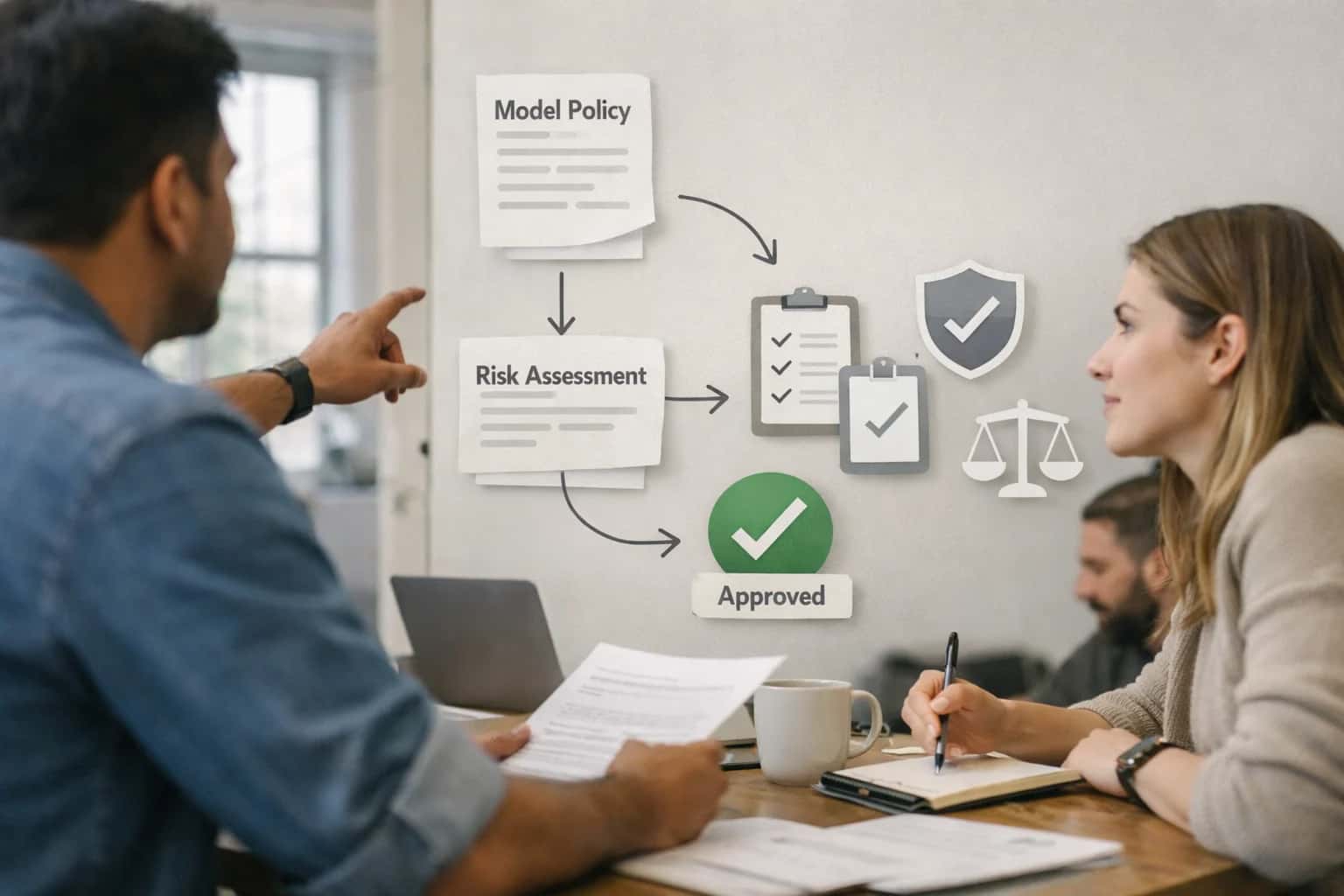
AUTOMATED GOVERNANCE ENFORCEMENT
What is Policy-as-Code (PaC)?
Policy-as-Code is the methodology of defining governance, security, and compliance rules in a machine-readable, executable programming language, enabling the automated validation, enforcement, and auditing of system configurations and data access without manual review.
In an Enterprise AI Governance framework, PaC integrates directly into CI/CD pipelines and Policy Enforcement Points (PEPs) to create an immutable, auditable barrier against function creep. By codifying constraints such as data minimization and use limitation, organizations replace periodic manual audits with continuous, real-time compliance verification, generating a cryptographic data audit trail that proves every data access decision aligns with the original, consented purpose.
AUTOMATED GOVERNANCE ENFORCEMENT
Core Characteristics of Policy-as-Code
Policy-as-Code (PaC) transforms abstract governance requirements into executable, version-controlled artifacts. These characteristics define how machine-readable policies automate enforcement, auditing, and compliance for AI systems.
01
Declarative Logic
Policies are written as declarative statements of desired state, not procedural scripts. Using languages like Rego (Open Policy Agent) or Sentinel, engineers define what is permitted, not how to enforce it. The policy engine evaluates logical rules against input data (e.g., API requests, resource configurations) and returns an allow/deny decision.
- Separates policy logic from application code
- Enables formal verification of policy correctness
- Example:
allow { input.purpose == "model_training" }denies any request where the purpose field deviates
02
Version-Controlled Artifacts
PaC policies are stored in Git repositories alongside application code, treated with the same rigor as software artifacts. This enables:
- Pull request workflows for policy changes with mandatory peer review
- Immutable audit trails showing who changed which policy, when, and why
- Rollback capabilities to instantly revert to a known-good policy state
- Branching strategies for testing policy changes in staging environments before production enforcement
03
Automated Decision Point
The Policy Decision Point (PDP) is a stateless service that evaluates incoming requests against loaded policies in real time. It receives structured input (typically JSON) from a Policy Enforcement Point (PEP) and returns a binary decision with optional context.
- Latency is typically sub-millisecond for pre-compiled Rego policies
- Decisions are deterministic: identical inputs always produce identical outputs
- The PDP can be embedded as a library, deployed as a sidecar, or run as an external service
04
Decoupled Enforcement Architecture
PaC cleanly separates policy decision from policy enforcement. The PEP intercepts requests at the infrastructure layer (API gateway, service mesh, database proxy) and offloads the authorization decision to the PDP. This decoupling means:
- Enforcement points can be added without modifying application code
- A single policy can govern multiple heterogeneous systems (Kubernetes, SQL databases, REST APIs)
- Policy changes propagate instantly across all enforcement points without redeployment
05
Continuous Compliance Validation
PaC enables shift-left compliance by integrating policy evaluation into CI/CD pipelines. Every infrastructure-as-code change, configuration update, or deployment is automatically validated against the current policy set before reaching production.
- Pre-deployment gates block non-compliant changes at the pull request stage
- Drift detection continuously scans running systems and flags deviations from policy-defined state
- Remediation-as-code can automatically correct drift by reapplying the desired state
06
Auditable Decision Logging
Every policy decision generates a structured, immutable log entry containing the full input context, the evaluated policy version, and the resulting decision. This provides:
- Non-repudiation: cryptographic proof that a specific policy version produced a specific outcome
- Forensic replay: auditors can reconstruct historical decisions by replaying logged inputs against historical policy versions
- Purpose limitation evidence: logs prove that data access was gated by explicit purpose checks, satisfying regulatory requirements under the EU AI Act and GDPR
Enabling Efficiency, Speed & Accuracy
Intelligent Analysis, Decision & Execution
We build AI systems for teams that need search across company data, workflow automation across tools, or AI features inside products and internal software.
Talk to Us
Search across company data
Give teams answers from docs, tickets, runbooks, and product data with sources and permissions.
Useful when people spend too long searching or get different answers from different systems.
Enterprise searchRAGPermissions
Read more
Automate internal workflows
Use AI to route work, draft outputs, trigger actions, and keep approvals and logs in place.
Useful when repetitive work moves across multiple tools and teams.
AI agentsWorkflow automationGovernance
Read more
Add AI to products and internal tools
Build assistants, guided actions, or decision support into the software your team or customers already use.
Useful when AI needs to be part of the product, not a separate tool.
AI integrationDecision supportModel routing
Read morePOLICY-AS-CODE
Frequently Asked Questions
Clear, technical answers to the most common questions about automating governance enforcement with machine-readable rules.
Policy-as-Code (PaC) is the practice of writing governance, security, and compliance rules in a machine-readable, executable programming language rather than documenting them in static, human-only prose. It works by integrating a Policy Engine—such as Open Policy Agent (OPA) or HashiCorp Sentinel—into the software development lifecycle or infrastructure middleware. When an application, API call, or infrastructure provisioning request is made, the engine intercepts it, evaluates the request's attributes against the codified logic (e.g., 'data labeled PII cannot leave the EU region'), and returns an allow or deny decision. This decouples the decision logic from the business logic, enabling automated, auditable, and real-time enforcement of purpose limitation controls and other governance mandates without manual review.

About the author
Prasad Kumkar
CEO & MD, Inference Systems
Prasad Kumkar is the CEO & MD of Inference Systems and writes about AI systems architecture, LLM infrastructure, model serving, evaluation, and production deployment. Over 5+ years, he has worked across computer vision models, L5 autonomous vehicle systems, and LLM research, with a focus on taking complex AI ideas into real-world engineering systems.
His work and writing cover AI systems, large language models, AI agents, multimodal systems, autonomous systems, inference optimization, RAG, evaluation, and production AI engineering.
LinkedIn
Limited slotsGet a Free AI Consultation
Partnered with leading AI, data, and software stack.





How We Work
Custom AI workflows for your Business
One-fit-all AI don't work for modern businesses. At Inferensys, we aim to understand your business & custom requirements; which we use to define most efficient agentic workflows, the data, and the tools for your business.
01
Review the use case
We understand the task, the users, and where AI can actually help.
Read more02
Pick the right approach
We define what needs search, automation, or product integration.
Read more03
Build the first useful version
We implement the part that proves the value first.
Read more04
Improve from there
We add the checks and visibility needed to keep it useful.
Read moreThe first call is a practical review of your use case and the right next step.
Talk to Us