Federated learning is a decentralized training technique where a global model is iteratively improved by aggregating local updates computed on distributed client devices. Instead of centralizing sensitive raw data, each client trains the model locally and transmits only model weight updates or gradients to a central coordinating server, which averages them to refine the global model.

Glossary
Federated Learning
A decentralized machine learning technique where a shared global model is trained across multiple edge devices or servers holding local data samples, exchanging only model weight updates rather than raw data.
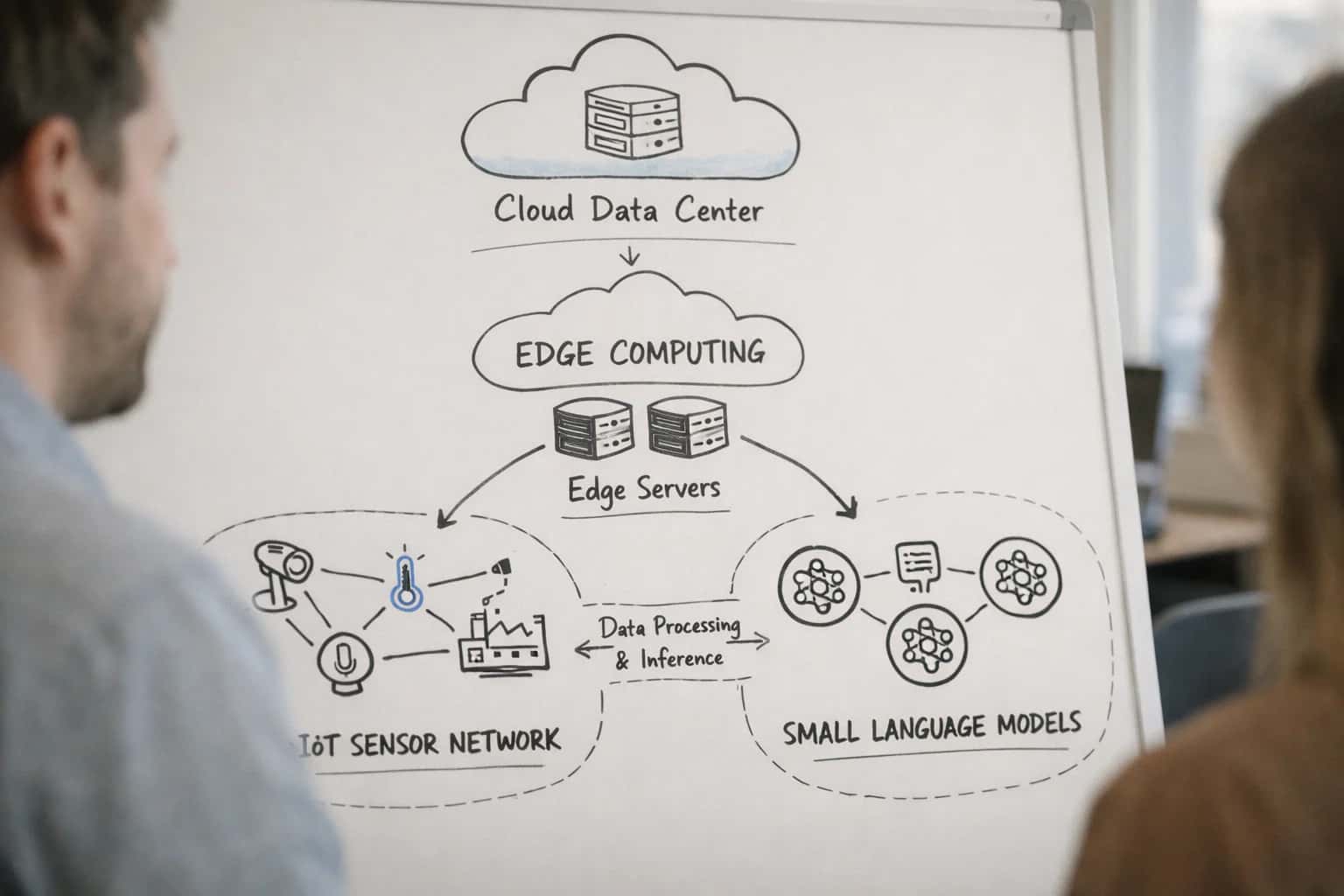
DECENTRALIZED MACHINE LEARNING
What is Federated Learning?
Federated learning is a privacy-preserving machine learning paradigm that trains a shared global model across decentralized edge devices or servers holding local data, exchanging only encrypted model weight updates rather than raw data.
This architecture enforces data minimization and purpose limitation by design, as raw data never leaves its origin device. Variants include horizontal federated learning, where datasets share feature spaces, and vertical federated learning, where they share sample spaces. The approach is often combined with differential privacy and secure multi-party computation to provide formal privacy guarantees against gradient leakage attacks.
DECENTRALIZED INTELLIGENCE
Key Features of Federated Learning
Federated learning fundamentally inverts the traditional machine learning paradigm. Instead of centralizing raw data, the model travels to the data. This architecture is defined by several distinct technical characteristics that enable privacy-preserving, distributed computation.
01
Local Data Silos
The foundational principle: raw training data never leaves the edge device or local server. The global model is dispatched to each client node, where training occurs directly on the local dataset. This enforces data minimization and purpose limitation by design, as the central server never has access to the raw, sensitive information. This is a critical control for compliance with regulations like GDPR and the EU AI Act.
Zero
Raw Data Transmitted
02
Model Weight Aggregation
The core communication protocol. After local training, each client transmits only its model weight updates (gradients or parameters) back to a central coordinating server. The server then applies an aggregation algorithm, most commonly Federated Averaging (FedAvg) , to mathematically fuse these disparate updates into a single, improved global model. This process distills collective intelligence without exposing individual data points.
100-1000x
Data Compression Ratio
03
Non-IID Data Handling
A primary technical challenge. Unlike a curated central database, data distributed across client devices is non-Independent and Identically Distributed (non-IID) . A user's photo library, typing history, or financial transactions are highly personal and do not represent the overall population. Federated learning algorithms must be robust to this statistical heterogeneity to prevent local biases from degrading the global model's performance.
04
Secure Aggregation Protocols
A cryptographic enhancement ensuring the central server can only decrypt the sum of model updates from a group, not any individual client's contribution. Using Secure Multi-Party Computation (SMPC) , clients mask their updates with shared secrets. The masks cancel out upon summation, revealing only the aggregate result. This provides a robust defense against a curious or compromised aggregator attempting to infer private data from individual weight updates.
05
Differential Privacy Integration
A mathematical noise-injection technique applied to model updates before transmission. By clipping and adding calibrated statistical noise to each client's gradient, a privacy budget (epsilon) is enforced. This provides a formal, quantifiable guarantee that the global model's output is indistinguishable from one trained without any single client's data, mitigating membership inference attacks and providing a strong layer of privacy-preserving machine learning.
ε < 1
Strong Privacy Budget
06
Cross-Device vs. Cross-Silo
Two distinct operational topologies. Cross-device FL involves millions of unreliable, low-power edge devices (e.g., smartphones, IoT sensors) with intermittent connectivity. Cross-silo FL involves a small, stable consortium of institutional data silos (e.g., hospitals, banks) with reliable compute resources. The latter is often used for healthcare federated learning to train diagnostic models across multiple hospitals without centralizing patient health information.
FEDERATED LEARNING EXPLAINED
Frequently Asked Questions
Clear, technical answers to the most common questions about decentralized machine learning, data privacy, and how model updates replace raw data sharing.
Federated learning is a decentralized machine learning paradigm where a shared global model is trained collaboratively across multiple edge devices or servers, each holding local data samples, without any raw data ever leaving its origin. The process works by distributing an initial model to all participating nodes, training it locally on each node's private dataset, and then sending only the model weight updates (gradients) back to a central coordinating server. The server aggregates these updates—typically using the Federated Averaging (FedAvg) algorithm—to improve the global model. This cycle repeats for multiple communication rounds until convergence. Crucially, the training data remains on-device, enforcing data minimization and purpose limitation by design, as the central server never sees, stores, or processes the underlying sensitive records.
Enabling Efficiency, Speed & Accuracy
Intelligent Analysis, Decision & Execution
We build AI systems for teams that need search across company data, workflow automation across tools, or AI features inside products and internal software.
Talk to Us
Search across company data
Give teams answers from docs, tickets, runbooks, and product data with sources and permissions.
Useful when people spend too long searching or get different answers from different systems.
Enterprise searchRAGPermissions
Read more
Automate internal workflows
Use AI to route work, draft outputs, trigger actions, and keep approvals and logs in place.
Useful when repetitive work moves across multiple tools and teams.
AI agentsWorkflow automationGovernance
Read more
Add AI to products and internal tools
Build assistants, guided actions, or decision support into the software your team or customers already use.
Useful when AI needs to be part of the product, not a separate tool.
AI integrationDecision supportModel routing
Read more
About the author
Prasad Kumkar
CEO & MD, Inference Systems
Prasad Kumkar is the CEO & MD of Inference Systems and writes about AI systems architecture, LLM infrastructure, model serving, evaluation, and production deployment. Over 5+ years, he has worked across computer vision models, L5 autonomous vehicle systems, and LLM research, with a focus on taking complex AI ideas into real-world engineering systems.
His work and writing cover AI systems, large language models, AI agents, multimodal systems, autonomous systems, inference optimization, RAG, evaluation, and production AI engineering.
LinkedIn
Limited slotsGet a Free AI Consultation
Partnered with leading AI, data, and software stack.





How We Work
Custom AI workflows for your Business
One-fit-all AI don't work for modern businesses. At Inferensys, we aim to understand your business & custom requirements; which we use to define most efficient agentic workflows, the data, and the tools for your business.
01
Review the use case
We understand the task, the users, and where AI can actually help.
Read more02
Pick the right approach
We define what needs search, automation, or product integration.
Read more03
Build the first useful version
We implement the part that proves the value first.
Read more04
Improve from there
We add the checks and visibility needed to keep it useful.
Read moreThe first call is a practical review of your use case and the right next step.
Talk to Us