Policy-as-Code (PaC) is the practice of codifying governance, security, and compliance rules into executable definition files, enabling automated enforcement within CI/CD pipelines and infrastructure provisioning. By treating policies as software artifacts, PaC eliminates manual configuration reviews and ensures that every system change is programmatically validated against a centralized, version-controlled source of truth before deployment.

Glossary
Policy-as-Code (PaC)
Policy-as-Code (PaC) is the practice of defining and managing compliance rules, security policies, and governance standards using machine-readable definition files rather than manual processes, enabling automated enforcement within CI/CD pipelines.
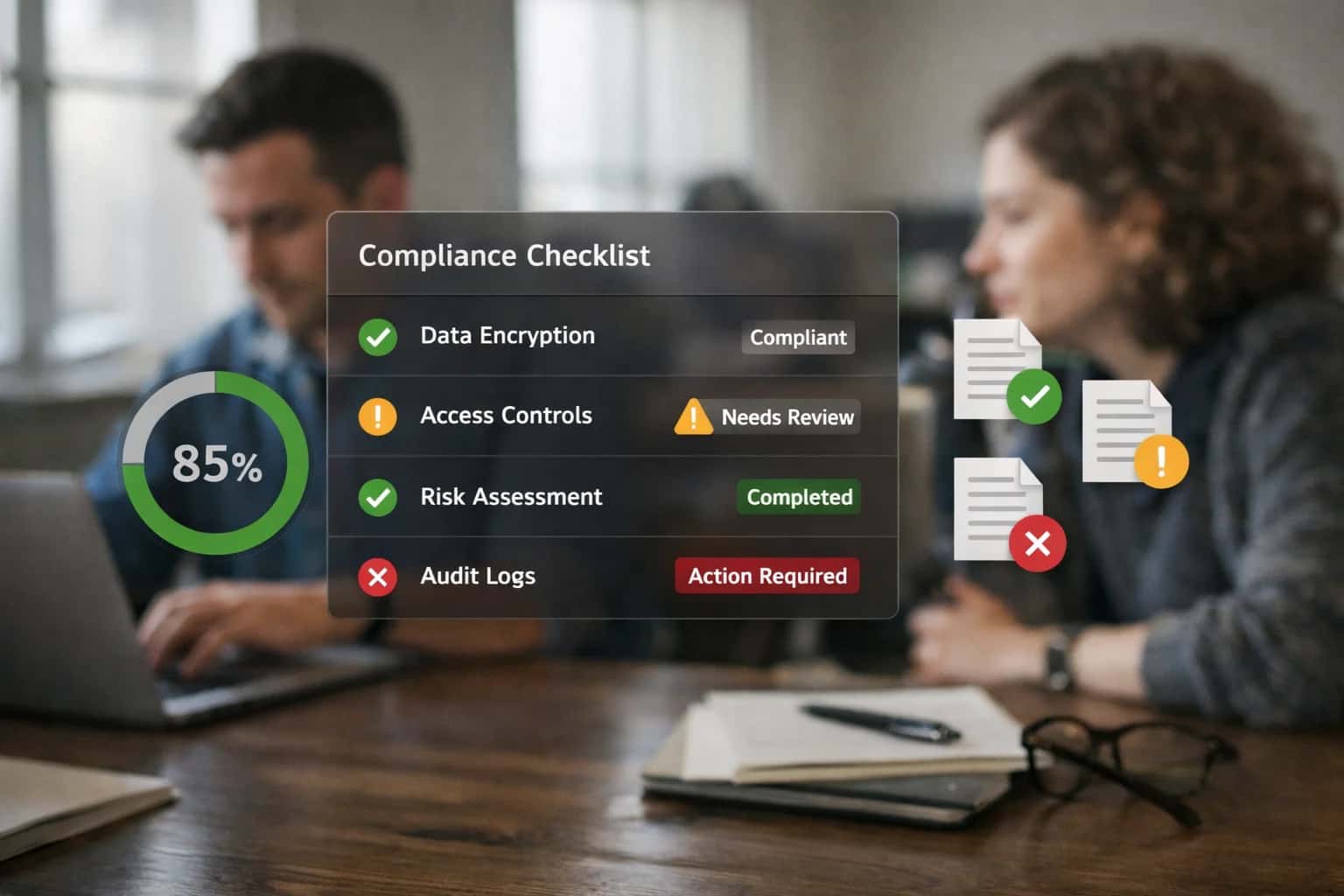
AUTOMATED GOVERNANCE ENFORCEMENT
What is Policy-as-Code (PaC)?
Policy-as-Code (PaC) is the methodology of defining, versioning, and enforcing compliance rules and security standards through machine-readable code rather than manual, document-based processes.
PaC relies on declarative languages like Rego and policy engines such as the Open Policy Agent (OPA) to decouple decision logic from application code. This architecture facilitates Continuous Control Monitoring (CCM) and Automated Remediation, providing an immutable audit trail that proves compliance to frameworks like the NIST AI RMF without slowing down engineering velocity.
AUTOMATED GOVERNANCE
Core Characteristics of Policy-as-Code
Policy-as-Code (PaC) transforms manual compliance checks into automated, verifiable software logic. These core characteristics define how machine-readable policies enforce security and governance standards within CI/CD pipelines.
01
Declarative Language Specification
Policies are written in high-level, declarative languages like Rego (for Open Policy Agent) or Sentinel, specifying the desired state of compliance rather than the step-by-step procedure to achieve it. This separates the logic of a decision from the application's business logic. The policy engine evaluates structured input data (JSON) against these rules to return a simple allow/deny decision.
- Key Benefit: Reduces complexity by abstracting the decision-making process.
- Example: A Rego rule stating
allow { input.user.role == "admin" }is evaluated against an API request's JSON payload.
02
Version-Controlled Artifact
Policy definitions are stored as text files in a Git repository, making them first-class software artifacts. This practice subjects all governance rules to the same rigorous lifecycle as application code: peer review, automated testing, and version history. A change to a compliance rule requires a pull request, creating an immutable audit log of who changed what policy and why.
- Key Benefit: Enables collaboration, rollback, and a complete history of governance changes.
- Tooling: Standard Git workflows (GitHub, GitLab) manage policy evolution.
03
Automated Testing and Validation
PaC enables unit and integration testing for compliance. Teams can write tests that assert specific behaviors—for example, verifying that a policy correctly blocks a non-compliant infrastructure configuration before deployment. This shifts governance left, catching violations in development environments rather than during post-deployment audits.
- Key Benefit: Prevents compliance regressions and provides fast feedback to developers.
- Example: A test fixture provides a mock Terraform plan to a policy, and the test asserts that the policy returns a violation for an unencrypted S3 bucket.
04
Decoupled Decision-Making
The policy decision point (the engine) is architecturally decoupled from the policy enforcement point (the application or infrastructure). A service queries the policy engine via an API at runtime, providing contextual data. The engine evaluates the data against the latest policies and returns a decision. This allows policies to be updated and enforced across a heterogeneous stack without modifying any application code.
- Key Benefit: Centralizes governance logic and ensures consistent enforcement across all systems.
- Protocol: Typically uses a REST API or a sidecar proxy to offload authorization decisions.
05
Real-Time Enforcement and Remediation
PaC is integrated into CI/CD pipelines and admission controllers to enforce rules in real-time. A non-compliant Terraform plan is blocked before apply, and a non-conformant Kubernetes pod is rejected before scheduling. Advanced implementations combine this with automated remediation, where a policy violation triggers a pre-authorized corrective action, such as reverting a configuration change or revoking access.
- Key Benefit: Prevents misconfigurations from ever reaching production, enforcing a continuous compliance posture.
- Mechanism: Kubernetes Admission Webhooks or CI pipeline policy checks.
06
Policy as Data for Auditability
Every decision made by a PaC engine can be logged as a structured, immutable event, including the input data, the policy version evaluated, and the resulting decision. This creates a high-fidelity, machine-readable audit trail that proves exactly which rules were enforced at any given moment. This evidence-as-code approach replaces manual evidence collection with a continuous, verifiable stream of compliance data.
- Key Benefit: Provides real-time, non-repudiable proof of control effectiveness for auditors.
- Output: Structured JSON logs that can be streamed to a SIEM or compliance monitoring platform.
POLICY-AS-CODE CLARIFIED
Frequently Asked Questions
Precise answers to the most common technical and strategic questions surrounding the implementation of Policy-as-Code for AI governance and continuous compliance.
Policy-as-Code (PaC) is the practice of defining, managing, and enforcing compliance rules, security policies, and governance standards using machine-readable definition files rather than manual, document-based processes. It works by codifying a desired state—such as 'encryption must be enabled' or 'a human must approve any transaction over $10,000'—into a declarative language like Rego, which a policy engine like the Open Policy Agent (OPA) evaluates against structured system data (JSON). The engine decouples policy decisions from application logic, providing a yes/no or allow/deny answer that can be programmatically enforced within CI/CD pipelines, Kubernetes admission controllers, and API gateways. This transforms compliance from a periodic audit into an automated, continuous verification loop, ensuring that every infrastructure change or AI model inference is checked against the latest regulatory requirements before execution.
Enabling Efficiency, Speed & Accuracy
Intelligent Analysis, Decision & Execution
We build AI systems for teams that need search across company data, workflow automation across tools, or AI features inside products and internal software.
Talk to Us
Search across company data
Give teams answers from docs, tickets, runbooks, and product data with sources and permissions.
Useful when people spend too long searching or get different answers from different systems.
Enterprise searchRAGPermissions
Read more
Automate internal workflows
Use AI to route work, draft outputs, trigger actions, and keep approvals and logs in place.
Useful when repetitive work moves across multiple tools and teams.
AI agentsWorkflow automationGovernance
Read more
Add AI to products and internal tools
Build assistants, guided actions, or decision support into the software your team or customers already use.
Useful when AI needs to be part of the product, not a separate tool.
AI integrationDecision supportModel routing
Read more
About the author
Prasad Kumkar
CEO & MD, Inference Systems
Prasad Kumkar is the CEO & MD of Inference Systems and writes about AI systems architecture, LLM infrastructure, model serving, evaluation, and production deployment. Over 5+ years, he has worked across computer vision models, L5 autonomous vehicle systems, and LLM research, with a focus on taking complex AI ideas into real-world engineering systems.
His work and writing cover AI systems, large language models, AI agents, multimodal systems, autonomous systems, inference optimization, RAG, evaluation, and production AI engineering.
LinkedIn
Limited slotsGet a Free AI Consultation
Partnered with leading AI, data, and software stack.





How We Work
Custom AI workflows for your Business
One-fit-all AI don't work for modern businesses. At Inferensys, we aim to understand your business & custom requirements; which we use to define most efficient agentic workflows, the data, and the tools for your business.
01
Review the use case
We understand the task, the users, and where AI can actually help.
Read more02
Pick the right approach
We define what needs search, automation, or product integration.
Read more03
Build the first useful version
We implement the part that proves the value first.
Read more04
Improve from there
We add the checks and visibility needed to keep it useful.
Read moreThe first call is a practical review of your use case and the right next step.
Talk to Us