Model Risk Management (MRM) is a structured governance discipline for the end-to-end lifecycle of quantitative models, encompassing the identification, measurement, monitoring, and control of risks arising from flawed assumptions, data errors, or misuse. It mandates independent validation and rigorous review to ensure models perform as intended and do not expose the organization to financial, reputational, or regulatory harm.

Glossary
Model Risk Management (MRM)
A structured governance discipline encompassing the identification, measurement, monitoring, and control of risks arising from the use of machine learning models, including validation and independent review.
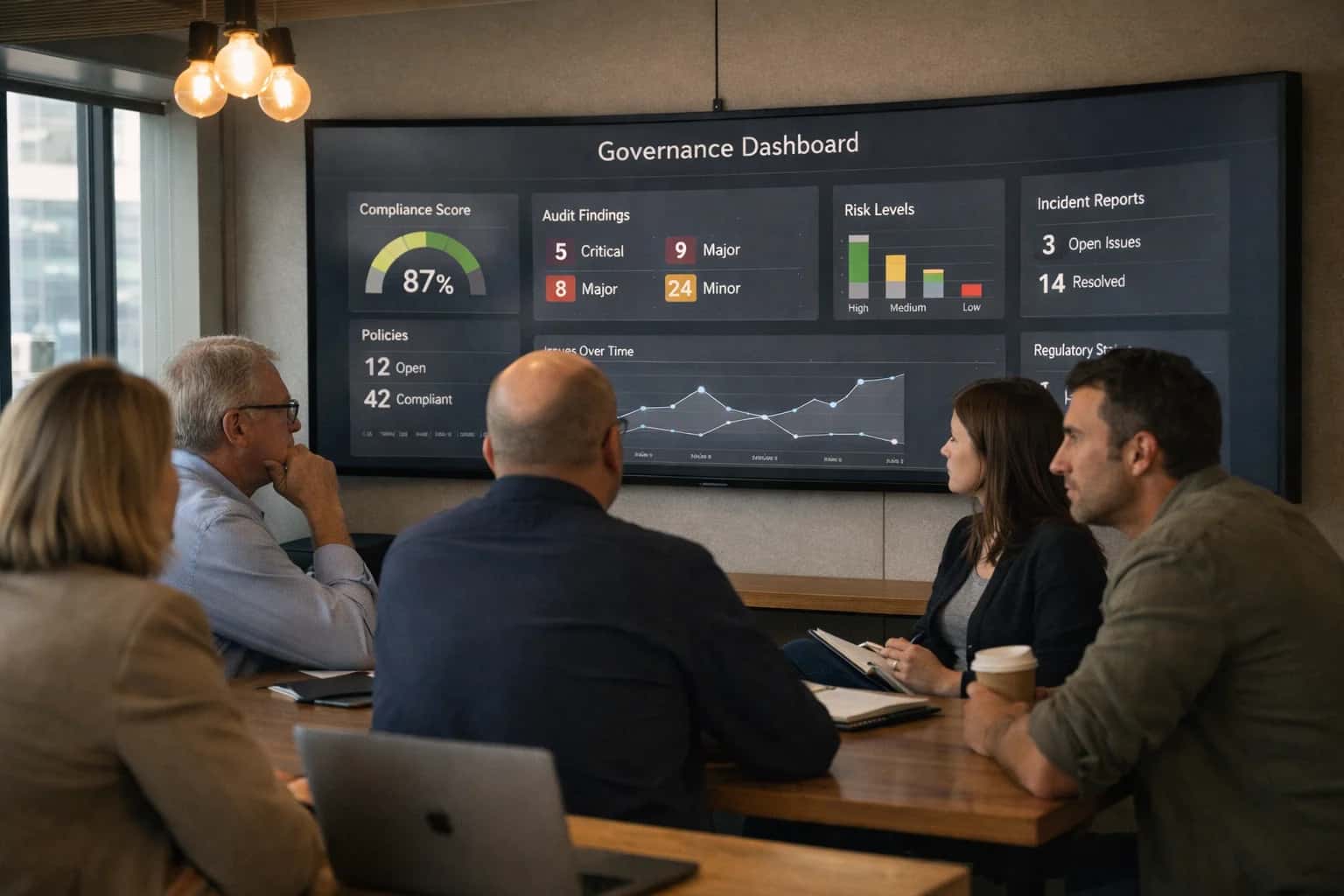
GOVERNANCE DISCIPLINE
What is Model Risk Management (MRM)?
A structured governance discipline encompassing the identification, measurement, monitoring, and control of risks arising from the use of machine learning models, including validation and independent review.
Effective MRM frameworks enforce a three-lines-of-defense model, separating model ownership from independent validation and internal audit. This discipline relies on continuous monitoring for concept drift and data drift, maintaining a central model registry for inventory, and producing structured documentation like model cards to ensure transparency and auditability throughout the model's operational life.
STRUCTURED GOVERNANCE
Core Components of MRM
Model Risk Management (MRM) is a structured governance discipline encompassing the identification, measurement, monitoring, and control of risks arising from the use of machine learning models. It ensures models are sound, stable, and compliant throughout their lifecycle.
01
Model Identification & Risk Tiering
The foundational process of cataloging all models in the enterprise inventory and assigning a risk tier based on materiality and complexity. This determines the rigor of validation required.
- Materiality Assessment: Quantifies the financial, reputational, and regulatory impact of model failure.
- Complexity Scoring: Evaluates model architecture, data inputs, and operational criticality.
- Tier Assignment: Classifies models (e.g., Tier 1 for high-risk, Tier 3 for low-risk) to allocate oversight resources efficiently.
02
Independent Model Validation
A rigorous, objective review conducted by a qualified party independent of model development. It challenges the conceptual soundness, data integrity, and mathematical formulation of a model before and after deployment.
- Conceptual Soundness Review: Evaluates the theoretical framework and modeling choices.
- Outcomes Analysis: Back-testing and benchmarking against challenger models to assess predictive power.
- Limitations Identification: Explicitly documents all known model weaknesses and their potential consequences.
03
Ongoing Monitoring & Thresholds
The continuous, automated process of tracking model performance and operational metrics against pre-defined tolerance thresholds. This acts as an early warning system for model decay.
- Performance Metrics: Tracks statistical measures like PSI, KS, and Gini coefficient in production.
- Operational Metrics: Monitors data quality, input drift, and system latency.
- Breach Protocols: Triggers automated alerts and predefined remediation workflows when a threshold is violated, such as a circuit breaker activation.
04
Comprehensive Documentation & Audit Trail
The creation and maintenance of an immutable, structured record of every decision, change, and validation in a model's lifecycle. This provides the evidence required for regulatory scrutiny and internal audit.
- Model Development Document: A complete technical specification of the model's methodology.
- Validation Reports: Formal records of independent review findings and remediation actions.
- Change Logs: An immutable audit trail capturing all model versioning, retraining events, and approval gating.
05
Governance & Approval Gating
The formal framework of committees, policies, and policy-as-code controls that enforce accountability and prevent unauthorized model changes. It establishes a clear chain of command for model risk decisions.
- Model Risk Committee: A cross-functional body providing executive oversight and approving high-risk models.
- Role-Based Access Control: Technical enforcement of separation of duties between developers, validators, and deployers.
- Approval Workflows: Automated gating in the model registry that prevents promotion to production without required sign-offs.
06
Issue Management & Remediation
A closed-loop process for tracking, prioritizing, and resolving model weaknesses identified during validation or monitoring. It ensures that risks are not just identified but actively mitigated.
- Findings Logging: Captures all model limitations, validation gaps, and threshold breaches as structured issues.
- Remediation Planning: Defines action plans, ownership, and timelines for corrective actions like recalibration or redevelopment.
- Retrospective Verification: Confirms that implemented fixes effectively resolved the identified risk without introducing new issues.
MODEL RISK MANAGEMENT
Frequently Asked Questions
Essential questions and answers about the structured governance discipline of identifying, measuring, monitoring, and controlling risks arising from machine learning model usage.
Model Risk Management (MRM) is a structured governance discipline encompassing the identification, measurement, monitoring, and control of risks arising from the use of machine learning and statistical models in business decision-making. It works by establishing a three-lines-of-defense framework: model owners who develop and maintain models, an independent model validation team that challenges assumptions and verifies performance, and internal audit providing objective assurance. The process spans the full model lifecycle—from development and independent review through deployment, ongoing concept drift monitoring, and eventual decommissioning. MRM frameworks require comprehensive documentation including model cards, rigorous back-testing against out-of-sample data, and stress testing under adverse scenarios. For high-risk AI systems under regulations like the EU AI Act, MRM extends to include bias detection, explainability analysis, and human oversight mechanisms. The discipline ensures that models do not expose organizations to financial loss, regulatory penalties, or reputational damage due to flawed design, implementation, or misuse.
Enabling Efficiency, Speed & Accuracy
Intelligent Analysis, Decision & Execution
We build AI systems for teams that need search across company data, workflow automation across tools, or AI features inside products and internal software.
Talk to Us
Search across company data
Give teams answers from docs, tickets, runbooks, and product data with sources and permissions.
Useful when people spend too long searching or get different answers from different systems.
Enterprise searchRAGPermissions
Read more
Automate internal workflows
Use AI to route work, draft outputs, trigger actions, and keep approvals and logs in place.
Useful when repetitive work moves across multiple tools and teams.
AI agentsWorkflow automationGovernance
Read more
Add AI to products and internal tools
Build assistants, guided actions, or decision support into the software your team or customers already use.
Useful when AI needs to be part of the product, not a separate tool.
AI integrationDecision supportModel routing
Read more
About the author
Prasad Kumkar
CEO & MD, Inference Systems
Prasad Kumkar is the CEO & MD of Inference Systems and writes about AI systems architecture, LLM infrastructure, model serving, evaluation, and production deployment. Over 5+ years, he has worked across computer vision models, L5 autonomous vehicle systems, and LLM research, with a focus on taking complex AI ideas into real-world engineering systems.
His work and writing cover AI systems, large language models, AI agents, multimodal systems, autonomous systems, inference optimization, RAG, evaluation, and production AI engineering.
LinkedIn
Limited slotsGet a Free AI Consultation
Partnered with leading AI, data, and software stack.





How We Work
Custom AI workflows for your Business
One-fit-all AI don't work for modern businesses. At Inferensys, we aim to understand your business & custom requirements; which we use to define most efficient agentic workflows, the data, and the tools for your business.
01
Review the use case
We understand the task, the users, and where AI can actually help.
Read more02
Pick the right approach
We define what needs search, automation, or product integration.
Read more03
Build the first useful version
We implement the part that proves the value first.
Read more04
Improve from there
We add the checks and visibility needed to keep it useful.
Read moreThe first call is a practical review of your use case and the right next step.
Talk to Us