A model registry is a centralized repository that serves as the definitive source of truth for machine learning models in production. It stores versioned model artifacts, including serialized weights, environment dependencies, and evaluation metrics, alongside immutable metadata such as training data lineage and author signatures. This system bridges the gap between experimentation and operations by providing a structured interface for model discovery, staging, and approval workflows.

Glossary
Model Registry
A centralized repository for managing the lifecycle of machine learning models, storing versioned artifacts, metadata, and approval states to facilitate governance, reproducibility, and deployment gating.
MLOps Governance
What is Model Registry?
A centralized repository for managing the lifecycle of machine learning models, storing versioned artifacts, metadata, and approval states to facilitate governance, reproducibility, and deployment gating.
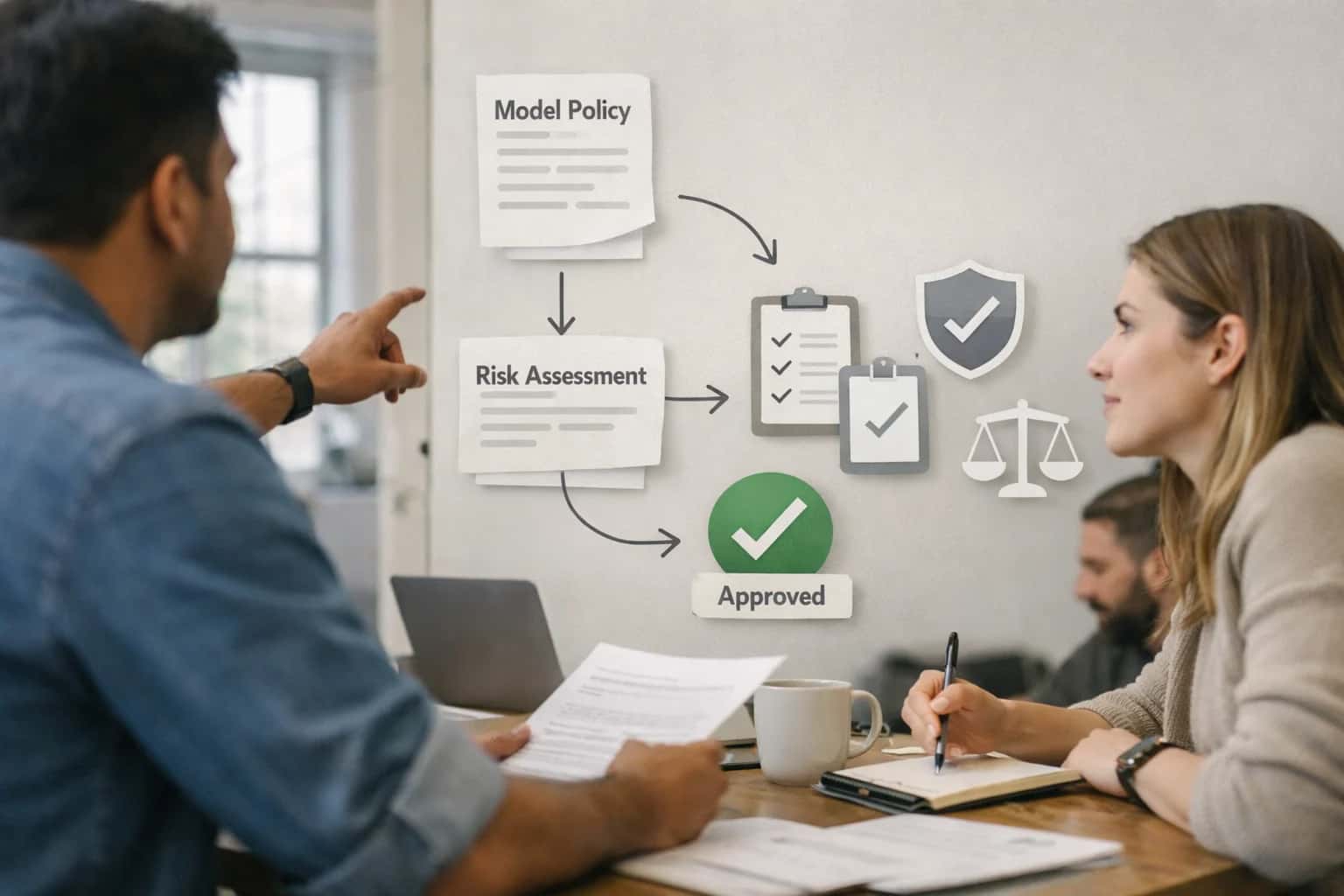
By enforcing strict deployment gating through manual approval states or automated policy checks, the registry prevents unvetted models from reaching production. It integrates directly with CI/CD pipelines to enable reproducible deployments and rapid rollbacks, while maintaining a comprehensive audit trail for regulatory compliance. This makes it an essential component of Model Risk Management (MRM) and enterprise AI governance frameworks.
GOVERNANCE BACKBONE
Core Capabilities of a Model Registry
A model registry serves as the centralized source of truth for the machine learning lifecycle, enforcing governance gates and enabling reproducibility from experimentation to production.
01
Centralized Metadata Store
Acts as the definitive catalog for all model artifacts and their associated metadata. It tracks versioned lineage, including the exact training dataset, hyperparameters, and code commit hash used to produce a model. This eliminates the "black box" problem by ensuring every model in production can be traced back to its raw ingredients, enabling strict audit compliance and reproducibility.
02
Lifecycle Stage Management
Enforces a structured promotion workflow through distinct stages such as Staging, Production, and Archived. Each transition can be gated by automated checks and manual approvals, preventing untested models from reaching deployment. This formalizes the handoff between data science and engineering teams, ensuring only validated artifacts are served to downstream applications.
03
Schema & Signature Enforcement
Validates that the input and output tensor signatures of a new model version match the expected contract of the serving endpoint. By comparing the expected feature names, data types, and shapes against the registered baseline, the registry automatically rejects incompatible artifacts, preventing runtime errors and silent failures in production pipelines.
04
Approval & Governance Gates
Integrates with Policy-as-Code engines to automate compliance checks before deployment. The registry can trigger bias audits, adversarial robustness evaluations, and license scans, holding a model in a "pending" state until all required validators pass. This provides cryptographic proof that a specific artifact was approved for a specific environment.
05
Deployment Aliasing
Abstracts the physical model version from the consuming application using mutable aliases like "champion" or "challenger". This allows for instant rollbacks and shadow deployments without changing application code. Traffic splitting can be managed at the registry level, enabling canary releases and A/B testing by simply reassigning logical pointers.
06
Cross-Environment Synchronization
Facilitates the secure promotion of artifacts across isolated environments (e.g., from a development VPC to a production VPC). The registry manages the cryptographic hash verification of the artifact during transfer, ensuring the binary has not been tampered with. This capability is critical for air-gapped networks and sovereign cloud deployments.
MODEL REGISTRY
Frequently Asked Questions
Clear, technical answers to the most common questions about centralized model lifecycle management, versioning, and governance.
A model registry is a centralized repository that manages the full lifecycle of machine learning models by storing versioned artifacts, metadata, and approval states. It functions as the single source of truth for all models in production, staging, and development environments. The registry tracks model lineage—recording which training dataset, hyperparameters, and code commit produced each version—and enforces deployment gating through approval workflows. When a data scientist registers a model, the system assigns a unique version ID, captures the environment dependencies, and stores the serialized model artifact alongside evaluation metrics. Downstream systems query the registry to retrieve the correct model version for inference, ensuring reproducibility and eliminating the risk of deploying unapproved or stale models into production.
Enabling Efficiency, Speed & Accuracy
Intelligent Analysis, Decision & Execution
We build AI systems for teams that need search across company data, workflow automation across tools, or AI features inside products and internal software.
Talk to Us
Search across company data
Give teams answers from docs, tickets, runbooks, and product data with sources and permissions.
Useful when people spend too long searching or get different answers from different systems.
Enterprise searchRAGPermissions
Read more
Automate internal workflows
Use AI to route work, draft outputs, trigger actions, and keep approvals and logs in place.
Useful when repetitive work moves across multiple tools and teams.
AI agentsWorkflow automationGovernance
Read more
Add AI to products and internal tools
Build assistants, guided actions, or decision support into the software your team or customers already use.
Useful when AI needs to be part of the product, not a separate tool.
AI integrationDecision supportModel routing
Read more
About the author
Prasad Kumkar
CEO & MD, Inference Systems
Prasad Kumkar is the CEO & MD of Inference Systems and writes about AI systems architecture, LLM infrastructure, model serving, evaluation, and production deployment. Over 5+ years, he has worked across computer vision models, L5 autonomous vehicle systems, and LLM research, with a focus on taking complex AI ideas into real-world engineering systems.
His work and writing cover AI systems, large language models, AI agents, multimodal systems, autonomous systems, inference optimization, RAG, evaluation, and production AI engineering.
LinkedIn
Limited slotsGet a Free AI Consultation
Partnered with leading AI, data, and software stack.





How We Work
Custom AI workflows for your Business
One-fit-all AI don't work for modern businesses. At Inferensys, we aim to understand your business & custom requirements; which we use to define most efficient agentic workflows, the data, and the tools for your business.
01
Review the use case
We understand the task, the users, and where AI can actually help.
Read more02
Pick the right approach
We define what needs search, automation, or product integration.
Read more03
Build the first useful version
We implement the part that proves the value first.
Read more04
Improve from there
We add the checks and visibility needed to keep it useful.
Read moreThe first call is a practical review of your use case and the right next step.
Talk to Us