Human-in-the-Loop Override is a governance control that mandates a human operator actively intervene to approve, reject, or escalate a specific algorithmic decision before it results in an irreversible action. It serves as a critical circuit breaker in high-stakes pipelines, ensuring that meaningful human oversight is not merely advisory but constitutes a gating function that halts execution until a conscious validation is received.

Glossary
Human-in-the-Loop Override
A governance control requiring a human operator to actively intervene and approve or reject a high-stakes algorithmic decision before it is executed, ensuring meaningful human oversight.
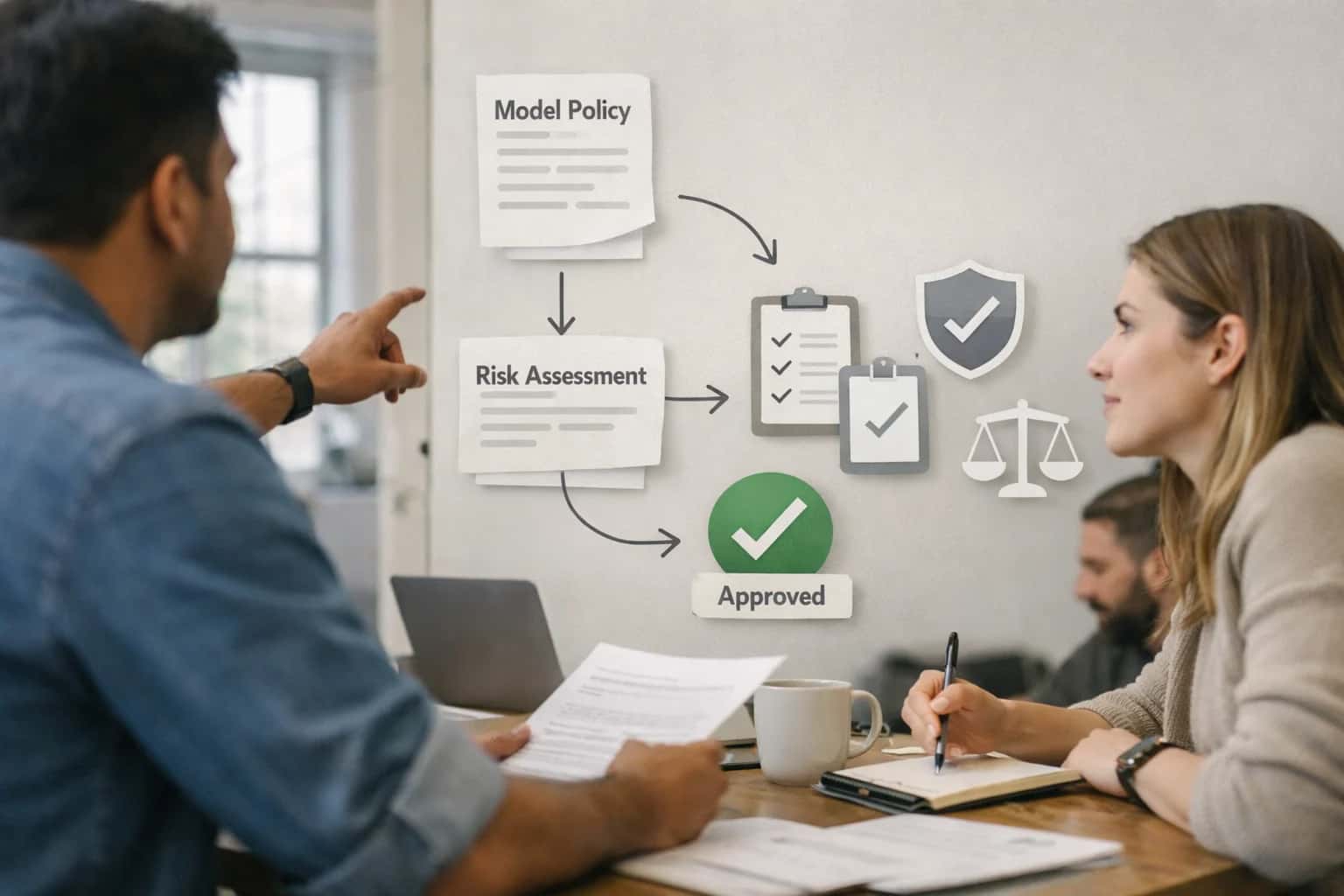
GOVERNANCE CONTROL
What is Human-in-the-Loop Override?
A mandatory intervention point in an automated workflow requiring explicit human approval before a high-stakes algorithmic decision is executed.
This mechanism is distinct from passive monitoring or post-hoc review; the override is a synchronous, blocking step in the inference flow. It is a core requirement of the EU AI Act for high-risk systems, ensuring that automated decisions affecting legal status or safety retain a direct, verifiable human point of accountability to prevent unchecked autonomous harm.
DESIGN PRINCIPLES
Key Characteristics of an Effective Override
A robust Human-in-the-Loop (HITL) override is not merely a stop button; it is a carefully architected governance control. The following characteristics ensure the override mechanism is meaningful, timely, and resistant to automation bias.
01
Meaningful Human Agency
The operator must possess the contextual understanding and sufficient time to analyze the algorithmic recommendation. Overrides fail when humans become mere 'rubber stamps' due to information overload or time pressure.
- Cognitive Load Management: Present only the top-k relevant features influencing the decision.
- Skepticism by Default: The interface should encourage critical evaluation, not passive acceptance.
- Contrastive Explanations: Show why the AI chose Option A over Option B to facilitate a genuine review.
02
Deterministic Intervention Thresholds
The system must have pre-defined, non-negotiable confidence thresholds that automatically trigger a hard stop and queue the decision for human review. This prevents high-risk decisions from slipping through on low confidence.
- Confidence Score Floor: If the model's prediction probability falls below 95%, flag for override.
- Out-of-Distribution (OOD) Detection: Automatically route inputs that differ statistically from the training data to a human.
- High-Stakes Classification: Specific decision classes (e.g., loan rejection, medical alert) always require a human signature.
03
Tamper-Proof Audit Logging
Every override action must generate an immutable audit trail that captures the state before and after the intervention. This is critical for regulatory scrutiny under frameworks like the EU AI Act.
- Dual-Record Capture: Log both the machine's rejected output and the human's final input.
- Non-Repudiation: Use cryptographic signing to prove the specific operator authorized the change.
- Time-Stamped Decision Latency: Record how long the operator took to decide, proving 'meaningful' review occurred.
04
Override Decay and Reversion
A manual override should not be a permanent patch that silently degrades system integrity. Implement temporal decay where the override expires, forcing a review of the underlying model or rule.
- Time-Bound Validity: The human decision is authoritative for a specific window (e.g., 24 hours) before the model re-evaluates.
- Feedback Loop Integration: The override event is automatically logged as a labeling task to retrain or fine-tune the model, correcting the root cause.
- Break-Glass vs. Standard Override: Distinguish between emergency 'stop' actions and standard operational corrections.
05
Bias-Resistant Interface Design
The user interface must actively combat automation bias (over-reliance on the machine) and selective adherence (accepting only agreeable outputs).
- Blind Review Mode: Optionally hide the AI's recommendation until the human has submitted their initial assessment.
- Devil's Advocate Prompting: The UI can surface counter-evidence to the AI's top prediction to stimulate critical thinking.
- Consequence Visualization: Display the projected downstream impact of accepting vs. overriding the decision.
06
Graceful Degradation Architecture
The override mechanism must function even when the primary AI service is degraded. A circuit breaker pattern ensures that if the human review queue is full or the model is timing out, the system fails safely to a human-driven state.
- Asynchronous Queuing: Decouple the AI inference from the human review step to prevent system blocking.
- Fallback Defaults: If no human is available within the SLA, execute a pre-authorized, conservative safe action.
- Load Shedding: Prioritize the highest-risk items for the limited human review capacity.
HUMAN-IN-THE-LOOP OVERRIDE
Frequently Asked Questions
Explore the critical governance mechanisms that ensure meaningful human oversight over high-stakes algorithmic decisions, a cornerstone of the EU AI Act's mandate for human intervention.
A Human-in-the-Loop (HITL) Override is a governance control that mandates a qualified human operator must actively review, approve, or reject a specific algorithmic decision before it is executed in the real world. This mechanism interrupts the automated inference pipeline at a critical decision point, presenting the model's output, confidence score, and contextual data to a human via a decision-support interface. The operator then validates the logic or exercises an override, ensuring that the final action reflects meaningful human oversight rather than passive rubber-stamping. This is distinct from human-on-the-loop, where a human merely monitors a system and can intervene post-hoc. The override is a synchronous, blocking step in the transaction flow, preventing high-risk actions—such as denying a loan, flagging a patient for a specific treatment, or arresting a suspect—from occurring without a human's explicit authorization.
OVERSIGHT CONTROL COMPARISON
Override vs. Other Human Oversight Mechanisms
A comparative analysis of human-in-the-loop override against other governance mechanisms for high-stakes algorithmic decision-making.
| Feature | Human-in-the-Loop Override | Human-on-the-Loop | Human-out-of-the-Loop |
|---|---|---|---|
Human intervention timing | Pre-execution (before action) | During execution (monitoring) | Post-execution (audit only) |
Decision authority | Human has veto/approval power | Human can abort or redirect | None during operation |
Latency introduced | 500ms - 30s | 1s - 60s | 0ms |
Suitable for high-risk systems | |||
Regulatory compliance (EU AI Act) | Required for high-risk Article 6(2) | Acceptable for limited-risk | Prohibited for high-risk |
Automation rate | 0.3% - 5% of decisions | 95% - 99% of decisions | 100% of decisions |
Operator cognitive load | High (active decision-making) | Medium (vigilance task) | None |
Audit trail granularity | Per-decision with rationale | Per-session with alerts | Aggregate metrics only |
Enabling Efficiency, Speed & Accuracy
Intelligent Analysis, Decision & Execution
We build AI systems for teams that need search across company data, workflow automation across tools, or AI features inside products and internal software.
Talk to Us
Search across company data
Give teams answers from docs, tickets, runbooks, and product data with sources and permissions.
Useful when people spend too long searching or get different answers from different systems.
Enterprise searchRAGPermissions
Read more
Automate internal workflows
Use AI to route work, draft outputs, trigger actions, and keep approvals and logs in place.
Useful when repetitive work moves across multiple tools and teams.
AI agentsWorkflow automationGovernance
Read more
Add AI to products and internal tools
Build assistants, guided actions, or decision support into the software your team or customers already use.
Useful when AI needs to be part of the product, not a separate tool.
AI integrationDecision supportModel routing
Read more
About the author
Prasad Kumkar
CEO & MD, Inference Systems
Prasad Kumkar is the CEO & MD of Inference Systems and writes about AI systems architecture, LLM infrastructure, model serving, evaluation, and production deployment. Over 5+ years, he has worked across computer vision models, L5 autonomous vehicle systems, and LLM research, with a focus on taking complex AI ideas into real-world engineering systems.
His work and writing cover AI systems, large language models, AI agents, multimodal systems, autonomous systems, inference optimization, RAG, evaluation, and production AI engineering.
LinkedIn
Limited slotsGet a Free AI Consultation
Partnered with leading AI, data, and software stack.





How We Work
Custom AI workflows for your Business
One-fit-all AI don't work for modern businesses. At Inferensys, we aim to understand your business & custom requirements; which we use to define most efficient agentic workflows, the data, and the tools for your business.
01
Review the use case
We understand the task, the users, and where AI can actually help.
Read more02
Pick the right approach
We define what needs search, automation, or product integration.
Read more03
Build the first useful version
We implement the part that proves the value first.
Read more04
Improve from there
We add the checks and visibility needed to keep it useful.
Read moreThe first call is a practical review of your use case and the right next step.
Talk to Us