Control Mapping is the process of identifying equivalent or duplicate security and privacy requirements across disparate regulatory frameworks—such as SOC 2, GDPR, ISO 27001, and NIST SP 800-53—and consolidating them into a single Common Control Framework. By establishing a one-to-many relationship between a unified control and its underlying mandates, organizations eliminate redundant audit evidence collection and streamline compliance assessments.

Glossary
Control Mapping
The process of harmonizing overlapping security and privacy requirements from multiple regulatory frameworks (e.g., SOC 2, GDPR, NIST) into a single Common Control Framework to streamline compliance assessments.
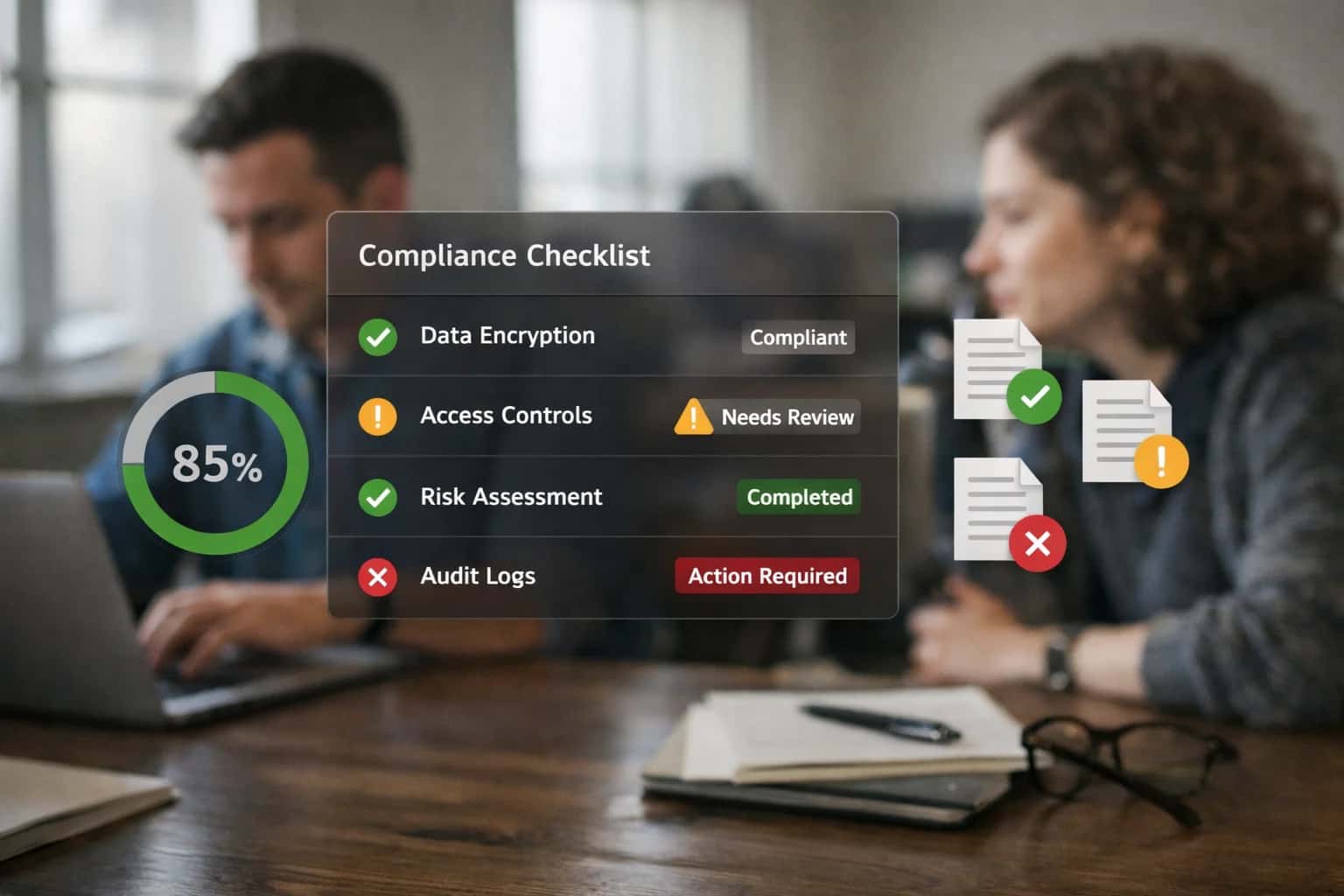
COMPLIANCE HARMONIZATION
What is Control Mapping?
The systematic process of harmonizing overlapping security, privacy, and operational requirements from multiple regulatory frameworks into a single, unified Common Control Framework.
This methodology relies on a structured obligation register to track the specific statutory or contractual text that maps to each technical or administrative control. When a regulation is amended, regulatory drift detection mechanisms identify the specific control mappings affected, enabling targeted updates rather than a full-scale audit. Effective control mapping transforms compliance from a siloed, checklist-driven activity into a continuous, automated governance function.
UNIFIED COMPLIANCE
Key Features of Effective Control Mapping
Effective control mapping transforms fragmented compliance efforts into a streamlined, strategic asset. These core features define a mature, automated approach to harmonizing overlapping regulatory requirements.
01
Common Control Framework (CCF)
A Common Control Framework is the single, rationalized set of controls derived from harmonizing multiple regulatory standards. Instead of managing separate controls for SOC 2, GDPR, and ISO 27001, an organization manages one control that satisfies all three. This eliminates redundant testing and documentation.
- Core Principle: Write once, comply many times.
- Example: A single 'Access Revocation' control maps to SOC 2 CC6.1, GDPR Art. 17, and ISO 27001 A.9.2.6.
02
Granular Requirement Decomposition
This process involves parsing high-level regulatory articles into discrete, testable requirement statements. A single GDPR paragraph might decompose into five distinct technical requirements. This atomic breakdown is essential for precise mapping and automated validation.
- Technique: Natural Language Processing (NLP) is increasingly used to identify imperative verbs ('shall', 'must') in legal text.
- Output: A structured obligation register with unique identifiers for every requirement.
03
Bidirectional Traceability
A robust mapping provides a navigable link from a specific regulatory requirement down to the technical control that implements it, and back up. An auditor can select a control and instantly see every regulation it satisfies. Conversely, a compliance officer can select a regulation and see every control that contributes to its compliance.
- Downward Trace: Regulation → Requirement → Control → Asset.
- Upward Trace: Control → Requirement → Regulation.
04
Automated Gap Analysis
Once a framework is mapped, the system can automatically identify compliance gaps. When a new regulation like the EU AI Act is introduced, its decomposed requirements are compared against the existing control set. The output is a prioritized list of new controls to implement or existing controls to modify, drastically reducing manual scoping effort.
- Metric: Gap remediation time is reduced from months to weeks.
- Trigger: New regulatory version release initiates an automated differential analysis.
05
Policy-as-Code Integration
Modern control mapping extends beyond static spreadsheets by linking controls directly to Policy-as-Code (PaC) implementations. A mapped 'Encryption at Rest' control isn't just a document; it's linked to an Open Policy Agent (OPA) rule that continuously enforces and validates the encryption state of cloud storage buckets in real-time.
- Static: Control description and test procedure.
- Dynamic: Executable code providing continuous compliance telemetry.
06
Unified Evidence Collection
A mapped control framework consolidates evidence collection. Instead of gathering screenshots for each audit, a single piece of immutable evidence—like a cryptographically signed log—is collected once and automatically reused to satisfy the evidence requirements for all mapped regulations. This creates a single source of truth for auditors.
- Efficiency: Reduces audit evidence collection effort by up to 70%.
- Technology: Leverages Evidence-as-Code to generate artifacts automatically.
CONTROL MAPPING
Frequently Asked Questions
Clear answers to the most common questions about harmonizing regulatory requirements into a unified compliance framework.
Control mapping is the systematic process of harmonizing overlapping security, privacy, and operational requirements from multiple regulatory frameworks into a single Common Control Framework. It works by identifying semantically equivalent or functionally similar controls across standards like SOC 2, GDPR, ISO 27001, and NIST SP 800-53, then creating a unified control that satisfies all source requirements simultaneously.
- De-duplication: A single technical control, such as multi-factor authentication, can satisfy requirements from five different frameworks.
- Gap Analysis: The mapping process immediately reveals where an organization lacks coverage for a specific regulatory obligation.
- Inheritance: Common controls mapped at an organizational level can be inherited by multiple systems, drastically reducing assessment scope.
This transforms compliance from a siloed, checklist-driven exercise into a scalable, evidence-based engineering function.
Enabling Efficiency, Speed & Accuracy
Intelligent Analysis, Decision & Execution
We build AI systems for teams that need search across company data, workflow automation across tools, or AI features inside products and internal software.
Talk to Us
Search across company data
Give teams answers from docs, tickets, runbooks, and product data with sources and permissions.
Useful when people spend too long searching or get different answers from different systems.
Enterprise searchRAGPermissions
Read more
Automate internal workflows
Use AI to route work, draft outputs, trigger actions, and keep approvals and logs in place.
Useful when repetitive work moves across multiple tools and teams.
AI agentsWorkflow automationGovernance
Read more
Add AI to products and internal tools
Build assistants, guided actions, or decision support into the software your team or customers already use.
Useful when AI needs to be part of the product, not a separate tool.
AI integrationDecision supportModel routing
Read more
About the author
Prasad Kumkar
CEO & MD, Inference Systems
Prasad Kumkar is the CEO & MD of Inference Systems and writes about AI systems architecture, LLM infrastructure, model serving, evaluation, and production deployment. Over 5+ years, he has worked across computer vision models, L5 autonomous vehicle systems, and LLM research, with a focus on taking complex AI ideas into real-world engineering systems.
His work and writing cover AI systems, large language models, AI agents, multimodal systems, autonomous systems, inference optimization, RAG, evaluation, and production AI engineering.
LinkedIn
Limited slotsGet a Free AI Consultation
Partnered with leading AI, data, and software stack.





How We Work
Custom AI workflows for your Business
One-fit-all AI don't work for modern businesses. At Inferensys, we aim to understand your business & custom requirements; which we use to define most efficient agentic workflows, the data, and the tools for your business.
01
Review the use case
We understand the task, the users, and where AI can actually help.
Read more02
Pick the right approach
We define what needs search, automation, or product integration.
Read more03
Build the first useful version
We implement the part that proves the value first.
Read more04
Improve from there
We add the checks and visibility needed to keep it useful.
Read moreThe first call is a practical review of your use case and the right next step.
Talk to Us