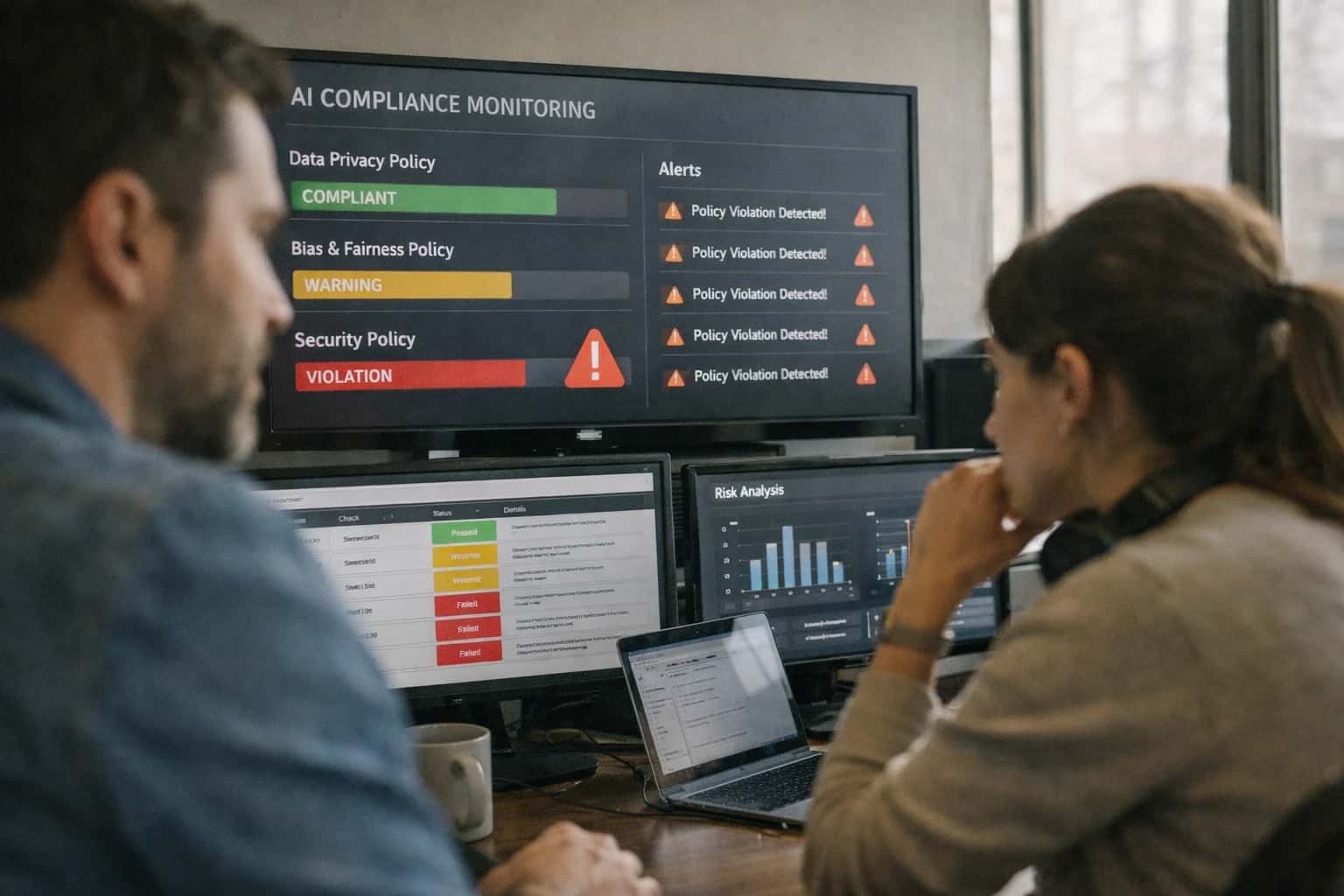
Continuous Control Monitoring (CCM) replaces periodic, point-in-time audits with an automated engine that continuously ingests telemetry from security tools, cloud APIs, and identity providers. By applying policy-as-code logic against this data stream, CCM detects configuration drift, unauthorized access, and control failures the moment they occur, enabling immediate automated remediation rather than waiting for a quarterly review.

Glossary
Continuous Control Monitoring (CCM)
An automated, high-frequency process that validates the operating effectiveness of technical and administrative controls to provide real-time assurance of a system's security and compliance posture.
REAL-TIME ASSURANCE
What is Continuous Control Monitoring (CCM)?
Continuous Control Monitoring (CCM) is an automated, high-frequency process that validates the operating effectiveness of technical and administrative controls to provide real-time assurance of a system's security and compliance posture.
The architecture relies on a feedback loop between the monitoring engine and a compliance posture management dashboard, providing auditors with a real-time, immutable view of control health. This shift from manual evidence collection to evidence-as-code generation is foundational for achieving a Continuous Authorization to Operate (cATO) in highly regulated DevSecOps environments.
REAL-TIME ASSURANCE
Key Characteristics of CCM
Continuous Control Monitoring (CCM) is defined by a set of core architectural and operational characteristics that distinguish it from periodic, manual audit processes. These principles enable automated, high-frequency validation of security and compliance postures.
01
High-Frequency Automation
CCM replaces point-in-time manual sampling with automated, high-frequency queries against live systems. Instead of quarterly access reviews, CCM engines poll APIs and log streams continuously—often every few minutes—to validate control effectiveness. This eliminates the 'audit gap' between scheduled assessments and provides a near-real-time view of the compliance posture. The automation relies on Policy-as-Code (PaC) to define rules programmatically, ensuring tests are repeatable and immune to human error.
02
Direct Source Validation
Unlike traditional audits that rely on screenshots or managerial attestations, CCM validates controls by querying the source systems directly via APIs. For example, a CCM tool verifies encryption at rest not by reading a policy document, but by calling the cloud provider's API to check the bucket's configuration flag. This provides immutable, machine-generated evidence that the control is operating as designed, removing subjectivity and the risk of falsified artifacts.
03
Control Drift Detection
A core function of CCM is identifying configuration drift—the silent divergence of a system's state from its secure baseline. CCM tools continuously compare the current state against a desired state defined in code. If a production firewall rule is modified outside of the change management process, CCM detects the variance instantly. This is often paired with Automated Remediation to self-heal the drift, restoring the compliant state without opening a manual ticket.
04
Evidence-as-Code Integration
CCM systems generate cryptographically signed, timestamped audit artifacts automatically. Every control validation produces a log entry that serves as a piece of evidence, stored in an Immutable Audit Trail. This 'Evidence-as-Code' approach eliminates the manual labor of collecting screenshots for auditors. The evidence is linked directly to specific regulatory controls through Control Mapping, creating a live, auditable compliance narrative that satisfies frameworks like SOC 2 and NIST AI RMF.
05
Comprehensive Coverage Scope
CCM provides visibility across the entire technology stack, from cloud infrastructure to the application layer. It monitors:
- Infrastructure: Encryption, network ACLs, IAM roles
- Platform: Kubernetes pod security policies, database configurations
- Application: Code dependencies via SBOM analysis, library vulnerabilities This unified view breaks down silos between security, operations, and compliance teams, providing a single source of truth for the organization's risk posture.
06
Real-Time Risk Quantification
CCM aggregates control failures into a dynamic Compliance Posture Management dashboard, often scoring the environment against frameworks like the NIST AI RMF. Instead of a static report, stakeholders see a live 'compliance score' that drops immediately upon a violation. This enables Continuous Authorization to Operate (cATO), where a system's authority to run is contingent on real-time control health, not a paper-based ATO from six months prior.
Enabling Efficiency, Speed & Accuracy
Intelligent Analysis, Decision & Execution
We build AI systems for teams that need search across company data, workflow automation across tools, or AI features inside products and internal software.
Talk to Us
Search across company data
Give teams answers from docs, tickets, runbooks, and product data with sources and permissions.
Useful when people spend too long searching or get different answers from different systems.
Enterprise searchRAGPermissions
Read more
Automate internal workflows
Use AI to route work, draft outputs, trigger actions, and keep approvals and logs in place.
Useful when repetitive work moves across multiple tools and teams.
AI agentsWorkflow automationGovernance
Read more
Add AI to products and internal tools
Build assistants, guided actions, or decision support into the software your team or customers already use.
Useful when AI needs to be part of the product, not a separate tool.
AI integrationDecision supportModel routing
Read moreCONTINUOUS CONTROL MONITORING
Frequently Asked Questions
Clear, technical answers to the most common questions about automating control validation and achieving real-time assurance.
Continuous Control Monitoring (CCM) is an automated, high-frequency process that validates the operating effectiveness of technical and administrative controls to provide real-time assurance of a system's security and compliance posture. Unlike periodic, point-in-time audits, CCM operates on a near real-time basis, ingesting telemetry from cloud APIs, configuration management databases, and identity providers. The engine continuously evaluates this data against a defined set of rules, often written as Policy-as-Code (PaC) in languages like Rego. When a control deviates from its expected state—such as an S3 bucket becoming publicly accessible or a multi-factor authentication (MFA) policy being disabled—the system instantly flags the violation, updates a Compliance Posture Management dashboard, and can trigger an Automated Remediation workflow to restore the compliant state without human intervention.

About the author
Prasad Kumkar
CEO & MD, Inference Systems
Prasad Kumkar is the CEO & MD of Inference Systems and writes about AI systems architecture, LLM infrastructure, model serving, evaluation, and production deployment. Over 5+ years, he has worked across computer vision models, L5 autonomous vehicle systems, and LLM research, with a focus on taking complex AI ideas into real-world engineering systems.
His work and writing cover AI systems, large language models, AI agents, multimodal systems, autonomous systems, inference optimization, RAG, evaluation, and production AI engineering.
LinkedIn
Limited slotsGet a Free AI Consultation
Partnered with leading AI, data, and software stack.





How We Work
Custom AI workflows for your Business
One-fit-all AI don't work for modern businesses. At Inferensys, we aim to understand your business & custom requirements; which we use to define most efficient agentic workflows, the data, and the tools for your business.
01
Review the use case
We understand the task, the users, and where AI can actually help.
Read more02
Pick the right approach
We define what needs search, automation, or product integration.
Read more03
Build the first useful version
We implement the part that proves the value first.
Read more04
Improve from there
We add the checks and visibility needed to keep it useful.
Read moreThe first call is a practical review of your use case and the right next step.
Talk to Us