A bias audit is a structured, independent examination of an algorithmic system designed to identify, measure, and document discriminatory outcomes against legally or ethically defined protected groups. The process applies quantitative fairness metrics—such as demographic parity, equalized odds, or the four-fifths rule—to model predictions, comparing error rates and selection rates across subgroups defined by attributes like race, gender, or age. Unlike general model evaluation, a bias audit specifically interrogates the societal impact of automated decisions, providing an evidentiary basis for disparate impact claims and regulatory compliance under frameworks like the EU AI Act.

Glossary
Bias Audit
A systematic, independent evaluation of an algorithmic system to detect and measure discriminatory outcomes against protected groups using quantitative fairness metrics.
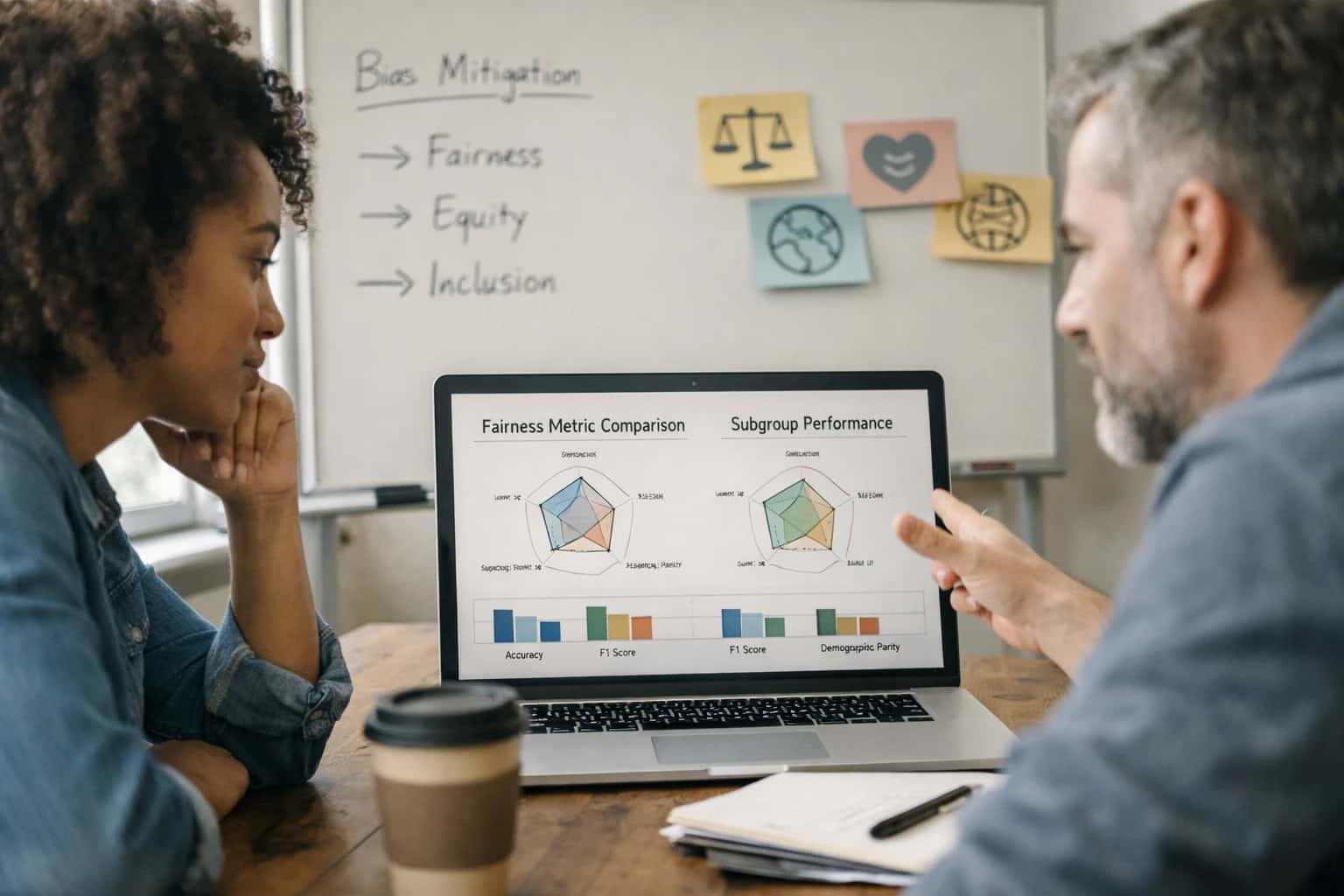
ALGORITHMIC EVALUATION
What is a Bias Audit?
A bias audit is a systematic, independent evaluation of an algorithmic system to detect and measure discriminatory outcomes against protected groups using quantitative fairness metrics.
A comprehensive bias audit extends beyond output testing to examine the entire machine learning pipeline, including representation bias in training data, historical bias in labels, and proxy variables that encode protected attributes. Auditors produce structured documentation—often a model card or transparency report—disaggregating performance metrics and detailing any accuracy-fairness trade-offs discovered. The process is distinct from bias mitigation; an audit is a diagnostic assessment, not a corrective intervention. For high-risk AI systems, independent third-party bias audits are increasingly mandated as part of conformity assessments, ensuring that algorithmic fairness claims are verifiable and that affected individuals have a basis for algorithmic recourse.
SYSTEMATIC EVALUATION
Core Characteristics of a Bias Audit
A bias audit is a structured, independent investigation that quantifies discriminatory risk in algorithmic systems. It moves beyond theoretical fairness to provide empirical evidence of disparate outcomes against protected groups.
01
Independent Third-Party Review
A valid audit requires an independent evaluator with no stake in the model's development or deployment. This separation ensures objectivity and prevents conflicts of interest. Auditors must have unrestricted access to the model's training data, source code, and inference logs. The independence principle mirrors financial auditing standards, where the auditor's credibility depends entirely on their organizational and financial separation from the system under review.
02
Quantitative Fairness Metric Analysis
The audit applies a battery of fairness metrics to disaggregated prediction data. Key measurements include:
- Demographic Parity Difference: The gap in positive prediction rates between groups
- Equalized Odds Difference: The disparity in true positive and false positive rates
- Disparate Impact Ratio: The ratio of favorable outcomes for a protected group versus the most advantaged group
Each metric reveals a different facet of potential discrimination, and no single metric is sufficient alone.
03
Protected Attribute Stratification
The audit must evaluate outcomes across all legally and ethically protected attributes relevant to the deployment context. This includes race, gender, age, disability status, and religion. Advanced audits also examine intersectional subgroups—combinations like Black women or elderly disabled individuals—where compounded discrimination often hides within aggregated statistics. The EU AI Act specifically mandates this disaggregated analysis for high-risk systems.
04
Root Cause Identification
Beyond measuring bias, the audit traces discriminatory outcomes to their origin in the ML pipeline:
- Representation Bias: Under-sampling of protected groups in training data
- Historical Bias: Societal prejudices encoded in labels or historical decisions
- Measurement Bias: Proxy features that inadvertently encode protected attributes (e.g., zip code as a proxy for race)
- Aggregation Bias: One-size-fits-all models that fail on minority subgroups
This diagnostic step distinguishes an audit from a simple fairness report.
05
Remediation Recommendations
A complete audit concludes with actionable mitigation strategies mapped to the identified root causes. Recommendations may include:
- Pre-processing: Reweighting or resampling training data to balance representation
- In-processing: Applying adversarial debiasing or constrained optimization during training
- Post-processing: Adjusting decision thresholds per group to equalize outcomes
The auditor must specify the expected fairness-accuracy trade-off for each intervention, enabling informed governance decisions.
06
Documentation and Transparency Artifacts
The audit produces structured transparency documentation aligned with regulatory standards. This includes a completed Model Card or System Card reporting evaluation results across all demographic subgroups, the specific fairness metrics used, and any identified limitations. For high-risk systems under the EU AI Act, this documentation feeds directly into the conformity assessment and technical documentation required for market access. The artifact serves as the permanent, auditable record of due diligence.
BIAS AUDIT ESSENTIALS
Frequently Asked Questions
A bias audit is a systematic, independent evaluation of an algorithmic system to detect and measure discriminatory outcomes. Below are the most common questions asked by compliance officers, data scientists, and CTOs navigating the technical and regulatory landscape of algorithmic fairness.
A bias audit is a structured, independent evaluation that quantitatively measures whether an algorithmic system produces discriminatory outcomes against protected groups. The process works by first defining the scope of the audit, including the model's intended use case and the protected attributes under review. Auditors then collect or generate a representative evaluation dataset, often stratified by demographic subgroups. Using a suite of fairness metrics—such as demographic parity difference, equalized odds, and disparate impact ratio—the auditor calculates statistical disparities in the model's predictions. The final phase involves interpreting these metrics against established legal thresholds, such as the Four-Fifths Rule, and producing a detailed report that documents any identified harms, their potential root causes in the training data or objective function, and recommended bias mitigation strategies. Unlike a one-time check, a mature bias audit is integrated into the continuous compliance monitoring lifecycle, ensuring that fairness is maintained as data distributions shift over time.
BIAS AUDIT IN PRACTICE
Real-World Bias Audit Applications
Bias audits are not purely academic exercises; they are operational requirements deployed across high-stakes sectors to ensure algorithmic integrity and regulatory compliance.
01
Pre-Deployment Compliance Gate
Before a model enters production, a bias audit acts as a mandatory conformity assessment under the EU AI Act. The audit quantifies disparate impact across protected attributes like race and gender.
- Validates equalized odds and statistical parity thresholds
- Generates immutable audit trail evidence for regulatory submission
- Blocks deployment if the Four-Fifths Rule is violated
High-Risk
EU AI Act Classification
02
Recidivism Risk Assessment
The COMPAS algorithm audit serves as a canonical case study. A third-party bias audit revealed that the tool falsely flagged Black defendants as high-risk at nearly twice the rate of white defendants.
- Applied causal fairness analysis to isolate discriminatory paths
- Demonstrated failure of equalized odds in criminal justice
- Led to mandatory human-in-the-loop oversight protocols
03
Facial Recognition Intersectional Testing
The Gender Shades audit evaluated commercial classifiers from Microsoft, IBM, and Face++. It exposed that darker-skinned females had error rates up to 34.7% higher than lighter-skinned males.
- Utilized intersectional fairness methodology
- Tested representation bias in training data
- Triggered immediate model retraining and transparency disclosures
04
Automated Hiring & Adverse Impact
Bias audits in HR tech scan resume screening models for disparate impact against protected classes. An audit might reveal that a model systematically downgrades candidates from specific zip codes.
- Measures compliance with the Four-Fifths Rule
- Analyzes counterfactual fairness by swapping demographic indicators
- Provides algorithmic recourse instructions for rejected candidates
05
Credit Underwriting Fairness
Financial regulators require bias audits to ensure credit scoring models do not engage in redlining by proxy. Audits test if statistical parity holds between majority and minority applicants with identical financial profiles.
- Detects historical bias embedded in repayment data
- Applies adversarial debiasing to blind the model to protected attributes
- Ensures compliance with Equal Credit Opportunity Act
06
Continuous Post-Market Monitoring
A bias audit is not a one-time event. Continuous compliance monitoring pipelines run fairness metrics on live prediction logs to detect model drift that introduces new biases.
- Tracks accuracy-fairness trade-off fluctuations over time
- Triggers automated model rollback if fairness thresholds breach
- Logs decisions for data subject rights automation requests
Enabling Efficiency, Speed & Accuracy
Intelligent Analysis, Decision & Execution
We build AI systems for teams that need search across company data, workflow automation across tools, or AI features inside products and internal software.
Talk to Us
Search across company data
Give teams answers from docs, tickets, runbooks, and product data with sources and permissions.
Useful when people spend too long searching or get different answers from different systems.
Enterprise searchRAGPermissions
Read more
Automate internal workflows
Use AI to route work, draft outputs, trigger actions, and keep approvals and logs in place.
Useful when repetitive work moves across multiple tools and teams.
AI agentsWorkflow automationGovernance
Read more
Add AI to products and internal tools
Build assistants, guided actions, or decision support into the software your team or customers already use.
Useful when AI needs to be part of the product, not a separate tool.
AI integrationDecision supportModel routing
Read moreDISTINGUISHING SYSTEMATIC AUDITS FROM ADJACENT ASSESSMENTS
Bias Audit vs. Related Evaluations
A comparison of the scope, methodology, and regulatory standing of a formal bias audit against other common algorithmic evaluation activities.
| Feature | Bias Audit | Fairness Assessment | Model Validation |
|---|---|---|---|
Primary Objective | Independent, quantitative detection of discriminatory outcomes against protected groups | Internal measurement of model performance across demographic segments | Verification that model meets specified business and performance requirements |
Evaluator Independence | |||
Regulatory Mandate | Required by NYC Local Law 144 and proposed EU AI Act for high-risk systems | Best practice, not legally mandated | Required by SR 11-7 for financial models |
Protected Attribute Analysis | |||
Uses Formal Fairness Metrics | |||
Public Disclosure of Results | |||
Scope of Evaluation | Disparate impact, equalized odds, and intersectional outcomes | Model accuracy, precision, and recall by subgroup | Stability, robustness, and conceptual soundness |
Typical Frequency | Annual or upon material model change | Continuous during development | Pre-deployment and periodic review |

About the author
Prasad Kumkar
CEO & MD, Inference Systems
Prasad Kumkar is the CEO & MD of Inference Systems and writes about AI systems architecture, LLM infrastructure, model serving, evaluation, and production deployment. Over 5+ years, he has worked across computer vision models, L5 autonomous vehicle systems, and LLM research, with a focus on taking complex AI ideas into real-world engineering systems.
His work and writing cover AI systems, large language models, AI agents, multimodal systems, autonomous systems, inference optimization, RAG, evaluation, and production AI engineering.
LinkedIn
Limited slotsGet a Free AI Consultation
Partnered with leading AI, data, and software stack.





How We Work
Custom AI workflows for your Business
One-fit-all AI don't work for modern businesses. At Inferensys, we aim to understand your business & custom requirements; which we use to define most efficient agentic workflows, the data, and the tools for your business.
01
Review the use case
We understand the task, the users, and where AI can actually help.
Read more02
Pick the right approach
We define what needs search, automation, or product integration.
Read more03
Build the first useful version
We implement the part that proves the value first.
Read more04
Improve from there
We add the checks and visibility needed to keep it useful.
Read moreThe first call is a practical review of your use case and the right next step.
Talk to Us