Data lineage is the systematic tracking of data's complete lifecycle, documenting its origin, all intermediate transformations, and final destinations. It creates a visual or metadata-driven map that shows how data flows through an organization's pipelines, enabling teams to trace any analytical result back to its source and assess the impact of upstream changes.

Glossary
Data Lineage
The complete lifecycle tracking of data from its origin through all transformations and movements, providing a clear audit trail for governance and debugging.
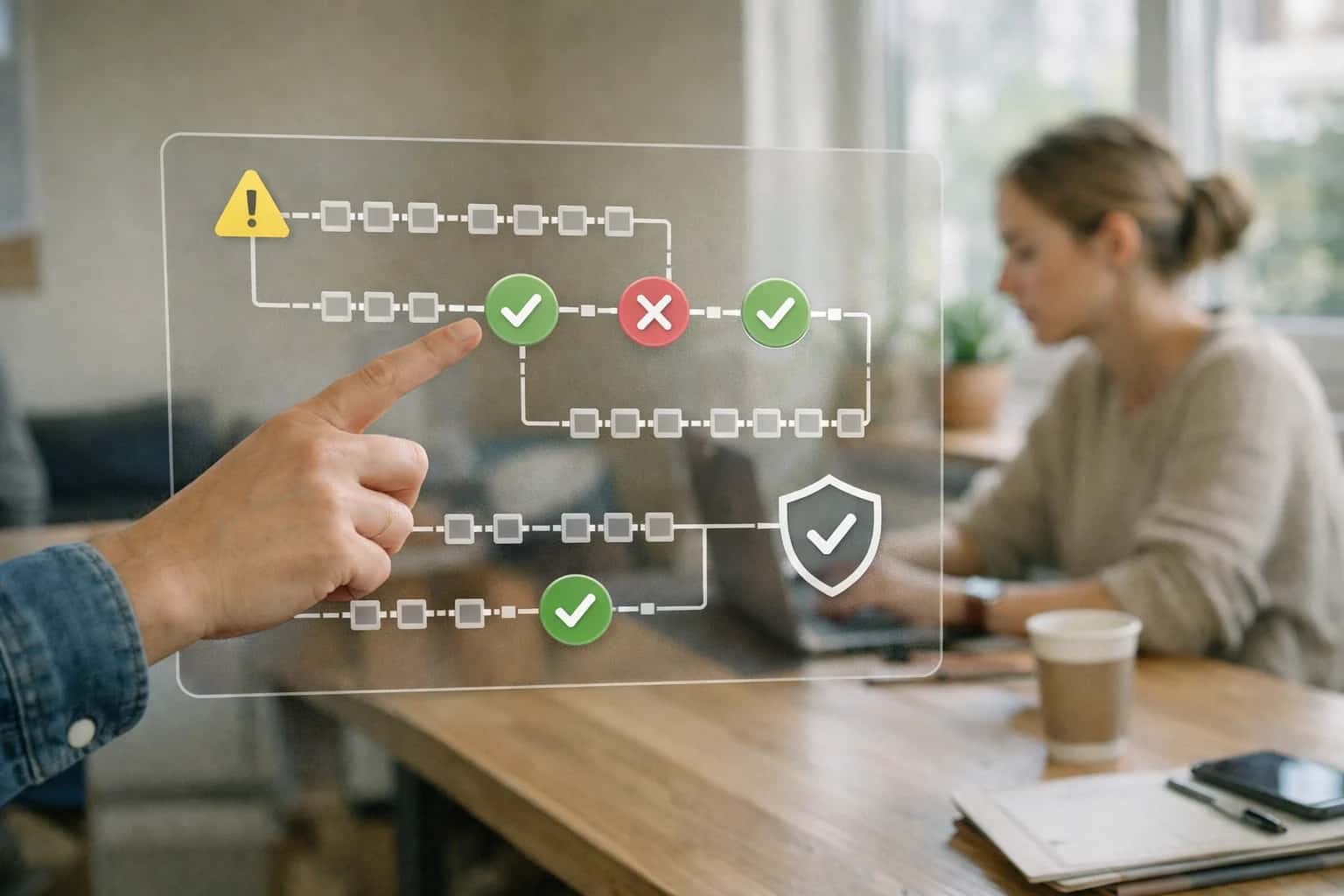
DATA GOVERNANCE
What is Data Lineage?
Data lineage provides a complete, end-to-end map of data's journey from its origin through every transformation and movement, creating an essential audit trail for governance, debugging, and regulatory compliance.
Effective lineage systems capture both technical lineage—the actual code-level transformations and schema changes—and business lineage—the conceptual meaning and ownership of data assets. This dual visibility is critical for root cause analysis, regulatory compliance under frameworks like GDPR and the EU AI Act, and maintaining trust in the datasets that feed machine learning models.
TRACEABILITY
Core Characteristics of Data Lineage
Data lineage provides the foundational audit trail for AI governance, mapping the complete journey of data from origin to consumption. This visibility is critical for debugging model drift, proving regulatory compliance, and managing data quality.
01
Backward vs. Forward Lineage
Lineage is a bidirectional graph. Backward lineage traces data to its source to answer 'Where did this come from?' for audit and debugging. Forward lineage tracks data propagation to answer 'What downstream models and reports will this change impact?' for impact analysis before a schema migration or pipeline update.
02
Granularity: Table vs. Column vs. Row
Effective governance requires varying levels of detail:
- Table-level: Tracks movement between systems (e.g., CRM to Data Lake).
- Column-level: Maps how a specific field like
customer_risk_scoreis calculated across joins and aggregations. - Row-level: Tags individual records with a source timestamp and batch ID for point-in-time debugging of a specific prediction error.
03
Technical vs. Business Lineage
A dual representation bridges the gap between engineers and stakeholders. Technical lineage visualizes the physical execution plan: ETL jobs, query logic, and schema mappings. Business lineage abstracts this into a simplified glossary view, showing how a business term like 'Monthly Active Users' is derived, hiding the underlying SQL complexity for compliance auditors.
04
Automated Extraction via Parsing
Manual lineage mapping is fragile. Modern systems automate extraction by parsing:
- SQL query logs to infer column-level dependencies.
- Spark/ETL execution plans to capture transformation logic.
- OpenLineage events emitted directly from job schedulers. This ensures the lineage graph updates dynamically as code changes, preventing stale documentation.
05
Impact Analysis & Root Cause
Lineage enables two critical operational workflows:
- Impact Analysis: Before deprecating a source table, forward lineage instantly identifies all affected dashboards, models, and downstream consumers.
- Root Cause Analysis: When a financial report breaks, backward lineage allows engineers to trace the error back to the exact failed transformation step or corrupted source partition in seconds rather than days.
06
Immutable Audit Trails
For regulatory compliance under frameworks like the EU AI Act, lineage must be immutable. This requires capturing a point-in-time snapshot of the transformation logic and data inputs that produced a specific model weight or business decision. If a model is later found to be biased, auditors can replay the exact lineage to identify the contaminated training dataset.
Enabling Efficiency, Speed & Accuracy
Intelligent Analysis, Decision & Execution
We build AI systems for teams that need search across company data, workflow automation across tools, or AI features inside products and internal software.
Talk to Us
Search across company data
Give teams answers from docs, tickets, runbooks, and product data with sources and permissions.
Useful when people spend too long searching or get different answers from different systems.
Enterprise searchRAGPermissions
Read more
Automate internal workflows
Use AI to route work, draft outputs, trigger actions, and keep approvals and logs in place.
Useful when repetitive work moves across multiple tools and teams.
AI agentsWorkflow automationGovernance
Read more
Add AI to products and internal tools
Build assistants, guided actions, or decision support into the software your team or customers already use.
Useful when AI needs to be part of the product, not a separate tool.
AI integrationDecision supportModel routing
Read moreDATA LINEAGE
Frequently Asked Questions
Clear answers to the most common questions about tracking data provenance, transformations, and lifecycle for AI governance and auditability.
Data lineage is the complete lifecycle tracking of data from its origin through all transformations and movements, providing a clear audit trail for governance and debugging. It works by capturing metadata at each stage of a data pipeline—ingestion, cleansing, normalization, feature engineering, and model training—and linking these stages together in a directed acyclic graph (DAG). This graph maps the flow of data across systems, recording every operation, join, filter, and aggregation. Modern lineage tools use automated parsing of SQL queries, ETL job logs, and API calls to construct this map dynamically, rather than relying on manual documentation. The result is an end-to-end visual and queryable representation of how a specific dataset, feature, or model input came to be, enabling root cause analysis, impact assessment, and regulatory compliance.

About the author
Prasad Kumkar
CEO & MD, Inference Systems
Prasad Kumkar is the CEO & MD of Inference Systems and writes about AI systems architecture, LLM infrastructure, model serving, evaluation, and production deployment. Over 5+ years, he has worked across computer vision models, L5 autonomous vehicle systems, and LLM research, with a focus on taking complex AI ideas into real-world engineering systems.
His work and writing cover AI systems, large language models, AI agents, multimodal systems, autonomous systems, inference optimization, RAG, evaluation, and production AI engineering.
LinkedIn
Limited slotsGet a Free AI Consultation
Partnered with leading AI, data, and software stack.





How We Work
Custom AI workflows for your Business
One-fit-all AI don't work for modern businesses. At Inferensys, we aim to understand your business & custom requirements; which we use to define most efficient agentic workflows, the data, and the tools for your business.
01
Review the use case
We understand the task, the users, and where AI can actually help.
Read more02
Pick the right approach
We define what needs search, automation, or product integration.
Read more03
Build the first useful version
We implement the part that proves the value first.
Read more04
Improve from there
We add the checks and visibility needed to keep it useful.
Read moreThe first call is a practical review of your use case and the right next step.
Talk to Us