Post-Market Monitoring (PMM) is a legally mandated, continuous process requiring providers to systematically collect, document, and analyze data on the real-world performance of a high-risk AI system throughout its operational lifetime. Unlike pre-market conformity assessments, PMM is a dynamic feedback loop designed to detect emergent risks, unintended biases, or performance degradation that were not apparent during initial testing. This process is a cornerstone of the EU AI Act, transforming regulatory compliance from a one-time gate into a perpetual obligation, ensuring that the system remains aligned with its intended purpose declaration and safety requirements long after the CE marking is affixed.

Glossary
Post-Market Monitoring
The continuous, systematic process by which providers collect and analyze data on the real-world performance of an AI system to ensure ongoing compliance after registration.
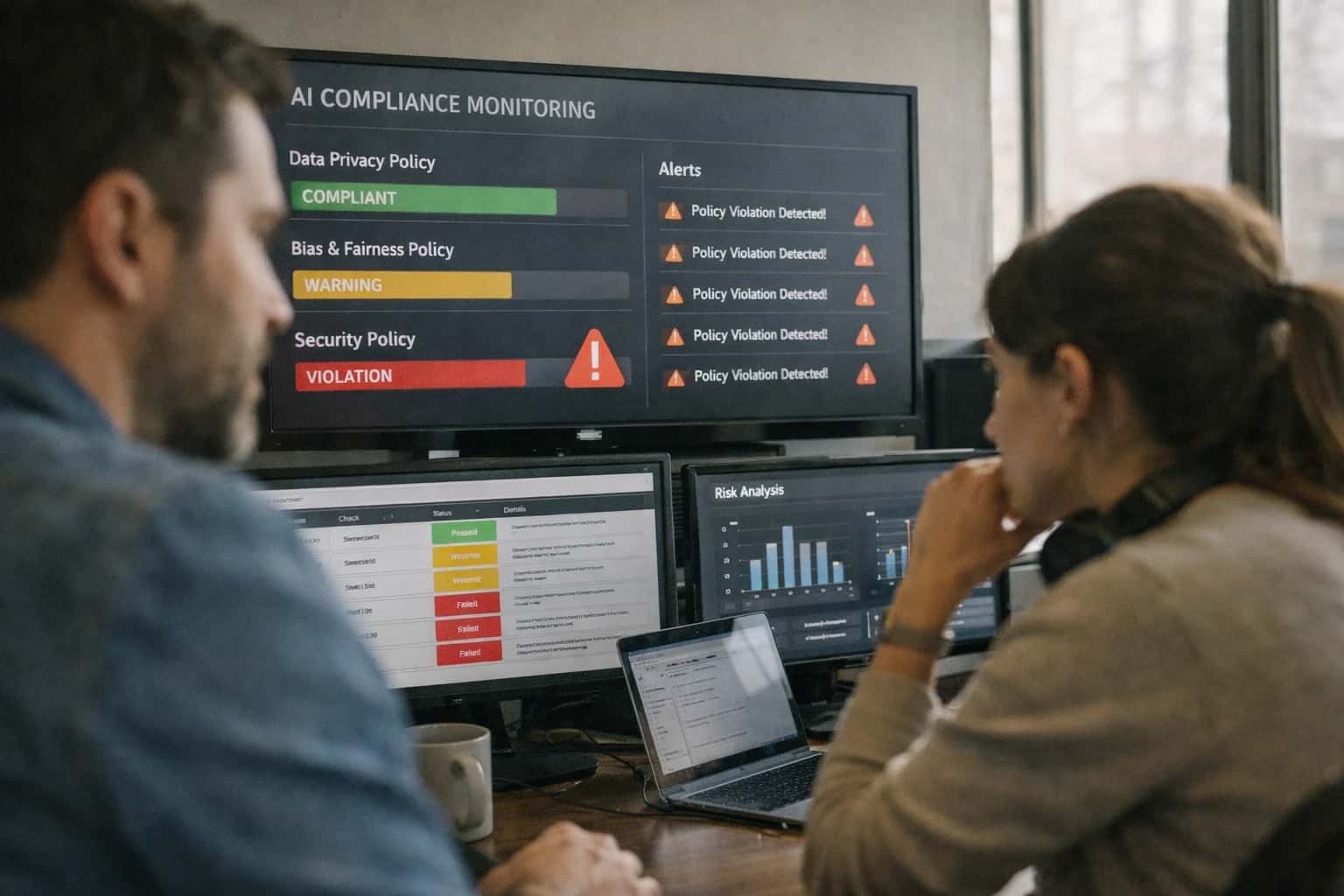
CONTINUOUS COMPLIANCE SURVEILLANCE
What is Post-Market Monitoring?
Post-market monitoring is the systematic, continuous lifecycle process by which AI providers proactively collect and analyze real-world performance data to ensure ongoing regulatory compliance and safety after deployment.
The technical execution of PMM involves aggregating operational logs, user feedback, and incident reports to compare against the baseline metrics established in the technical documentation file. Providers must establish a formal PMM plan that defines the indicators for data collection, the frequency of analysis, and the thresholds that trigger a mandatory incident reporting linkage to the National Competent Authority. If a substantial modification is identified or a critical safety gap emerges, the provider must initiate a new conformity assessment and update the EU AI Act Database registration, potentially leading to corrective action or a market withdrawal notification.
POST-MARKET MONITORING
Core Characteristics of PMM
The continuous, systematic process by which providers collect and analyze data on the real-world performance of an AI system to ensure ongoing compliance after registration.
01
Continuous Data Collection
The foundational mechanism of PMM involves the automated ingestion of operational logs directly from the deployed AI system. This is not a periodic audit; it is a persistent data pipeline.
- Telemetry Streams: Captures input data distributions, model inference outputs, and confidence scores.
- Drift Detection: Compares live production data against the baseline training data provenance record to identify data drift.
- User Feedback Loops: Systematically logs reported errors or overrides from the human-in-the-loop interface to flag potential safety issues.
Real-time
Data Latency
02
Proactive Risk Reassessment
PMM mandates that the initial residual risk disclosure is a living document. Providers must actively search for unknown failure modes that were not apparent during the pre-market conformity assessment.
- Safety Signal Detection: Uses statistical anomaly detection to identify clusters of unexpected outputs that may constitute a new hazard.
- Substantial Modification Trigger: If the system's real-world performance deviates significantly from the intended purpose declaration, it legally triggers a re-registration requirement.
- Incident Reporting Linkage: Automatically correlates system behavior with the mandatory reporting portal to ensure a serious incident is filed within the regulatory deadline.
72 Hours
Max Incident Report Window
03
Quality Management System Integration
PMM is not an isolated activity; it is a mandatory component of the provider's audited Quality Management System. The QMS must define explicit procedures for feedback loops.
- Corrective Action Protocols: Documented steps for how the organization reacts to PMM findings, including model rollback or emergency patching.
- Audit Trail Immutability: All monitoring data and subsequent human decisions must be logged immutably to satisfy AI audit trail requirements.
- Notified Body Access: The data collected during PMM must be structured and preserved for inspection by the Notified Body during periodic QMS audits.
04
Dynamic Accuracy & Fairness Monitoring
PMM extends beyond safety to ensure the model maintains its ethical and performance standards over time. A model that was fair at launch can become biased due to environmental shifts.
- Fairness Metric Decay: Continuously calculates disparate impact ratios and other fairness metrics against live data to detect emergent bias.
- Model Drift Evaluation: Compares the current model accuracy against the baseline established in the model card submission to detect performance degradation.
- Segmented Analysis: Breaks down performance by demographic or operational segments to ensure no specific user group is suffering from silent model failure.
POST-MARKET MONITORING
Frequently Asked Questions
Clarifying the continuous obligations for AI providers after system registration, including data collection, reporting, and incident response.
Post-market monitoring is the continuous, systematic process by which a provider collects and analyzes data on the real-world performance of an AI system to ensure ongoing compliance after registration. Unlike pre-market conformity assessments, this is a proactive lifecycle obligation mandated by regulations such as the EU AI Act. It requires the provider to establish a documented plan that actively and systematically gathers user feedback and operational telemetry. The goal is to detect emergent risks, performance drift, and unintended use cases that were not apparent during the initial testing phase, ensuring the system remains safe throughout its operational lifetime.
Enabling Efficiency, Speed & Accuracy
Intelligent Analysis, Decision & Execution
We build AI systems for teams that need search across company data, workflow automation across tools, or AI features inside products and internal software.
Talk to Us
Search across company data
Give teams answers from docs, tickets, runbooks, and product data with sources and permissions.
Useful when people spend too long searching or get different answers from different systems.
Enterprise searchRAGPermissions
Read more
Automate internal workflows
Use AI to route work, draft outputs, trigger actions, and keep approvals and logs in place.
Useful when repetitive work moves across multiple tools and teams.
AI agentsWorkflow automationGovernance
Read more
Add AI to products and internal tools
Build assistants, guided actions, or decision support into the software your team or customers already use.
Useful when AI needs to be part of the product, not a separate tool.
AI integrationDecision supportModel routing
Read more
About the author
Prasad Kumkar
CEO & MD, Inference Systems
Prasad Kumkar is the CEO & MD of Inference Systems and writes about AI systems architecture, LLM infrastructure, model serving, evaluation, and production deployment. Over 5+ years, he has worked across computer vision models, L5 autonomous vehicle systems, and LLM research, with a focus on taking complex AI ideas into real-world engineering systems.
His work and writing cover AI systems, large language models, AI agents, multimodal systems, autonomous systems, inference optimization, RAG, evaluation, and production AI engineering.
LinkedIn
Limited slotsGet a Free AI Consultation
Partnered with leading AI, data, and software stack.





How We Work
Custom AI workflows for your Business
One-fit-all AI don't work for modern businesses. At Inferensys, we aim to understand your business & custom requirements; which we use to define most efficient agentic workflows, the data, and the tools for your business.
01
Review the use case
We understand the task, the users, and where AI can actually help.
Read more02
Pick the right approach
We define what needs search, automation, or product integration.
Read more03
Build the first useful version
We implement the part that proves the value first.
Read more04
Improve from there
We add the checks and visibility needed to keep it useful.
Read moreThe first call is a practical review of your use case and the right next step.
Talk to Us