Meaningful human intervention is a legal standard mandating that a human operator has the genuine ability, requisite training, and organizational authority to understand, contest, and override an AI system's automated decision. It explicitly prohibits a perfunctory review where the human merely rubber-stamps the algorithmic output without critical evaluation.

Glossary
Meaningful Human Intervention
The legal standard requiring that a human reviewer possesses the competence, authority, and actual capacity to override an AI system's automated decision, going beyond a mere tokenistic rubber-stamping of the output.
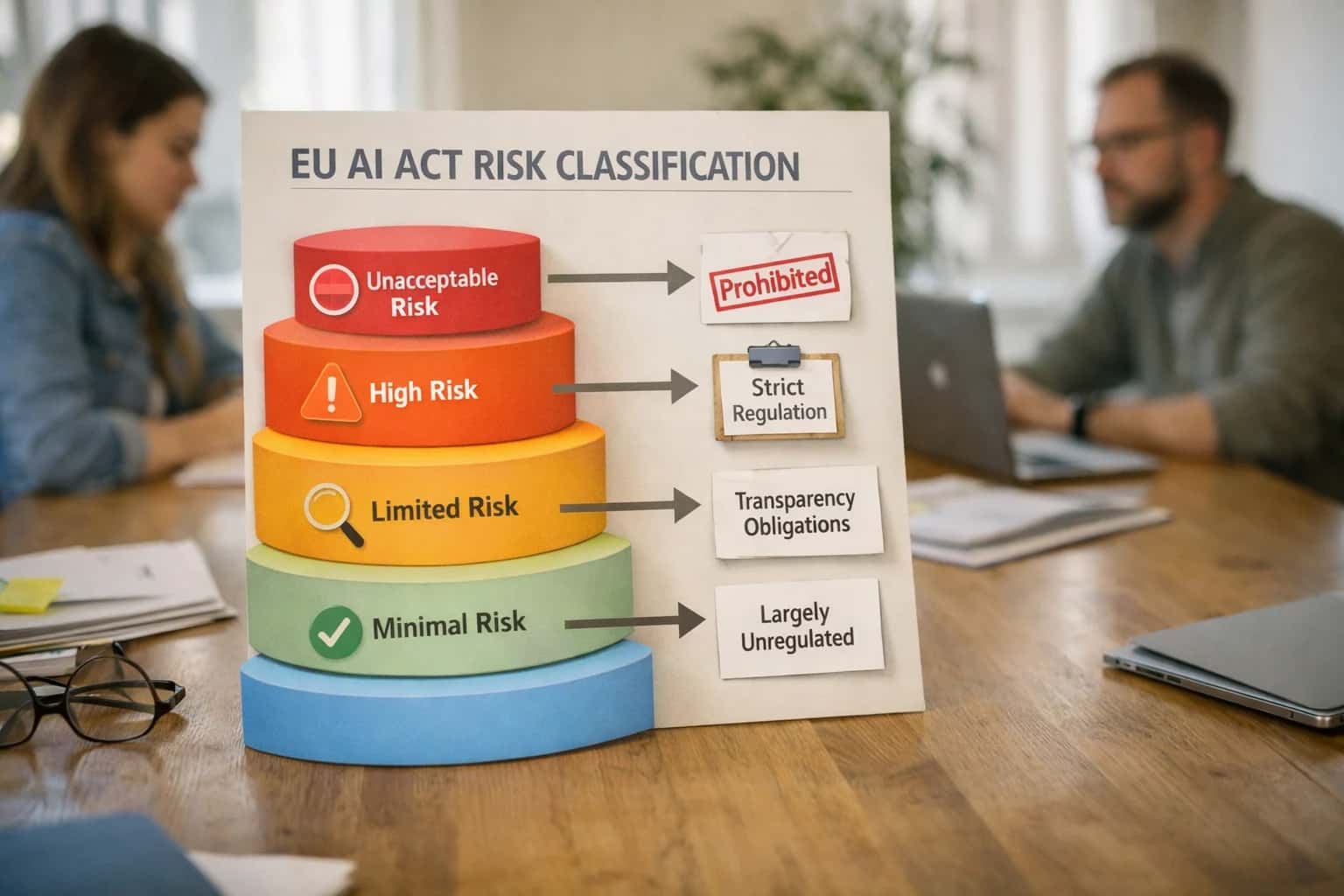
HUMAN OVERSIGHT MECHANISM
What is Meaningful Human Intervention?
The legal and operational standard requiring that a human reviewer possesses the competence, authority, and actual capacity to override an AI system's automated output, going beyond a tokenistic rubber-stamp.
Under the EU AI Act, this principle is a cornerstone of human oversight for high-risk systems. The operator must be able to interpret the system's logic, correct errors, and disregard outputs that could lead to a consequential decision with legal or significant impact, ensuring accountability remains with a natural person.
Meaningful Human Intervention
Core Characteristics
The legal and operational standard that distinguishes genuine human oversight from a mere procedural formality in automated decision-making.
01
Competence and Authority
The human reviewer must possess the necessary domain expertise and organizational authority to understand the AI's output and veto it. This is not a passive monitoring role; the operator must be qualified to diagnose errors. Without subject-matter competence, the intervention is legally meaningless.
- Requires documented training and certification
- Authority must be codified in standard operating procedures
- Distinct from a 'human-on-the-loop' who merely observes
02
Actual Capacity to Override
The system's user interface and workflow must provide a realistic opportunity to intervene. If the AI's decision is executed automatically in milliseconds or the override process is buried in inaccessible menus, the capacity is considered nullified.
- Intervention must be possible before a legal or similarly significant effect occurs
- The 'stop' button cannot be a placebo
- Relevant to high-risk AI systems under the EU AI Act
03
Informed Decision-Making
The operator must have access to sufficiently transparent information about the AI's reasoning to make an independent assessment. This includes explainability features like feature attribution scores or counterfactual explanations. A reviewer cannot meaningfully override a decision they do not understand.
- Requires access to model confidence scores
- Contextual data that influenced the output must be visible
- Links directly to Algorithmic Explainability requirements
04
Auditability of the Intervention
Every override, confirmation, or modification must be immutably logged to prove that the intervention was not a rubber stamp. The Human Oversight Log must capture the operator's identity, the timestamp, the specific action taken, and the justification.
- Creates legal evidence for Conformity Assessments
- Enables post-market monitoring and Serious Incident Reporting
- Prevents automation bias by holding operators accountable
05
Absence of Automation Bias
The system must be designed to prevent the human operator from becoming a rubber-stamping automaton. Interface design, cognitive load, and alert fatigue can erode vigilance. Meaningful intervention requires active skepticism, not passive acceptance.
- Mitigation strategies include mandatory 'cool-down' periods
- Randomly inserted control questions to verify attention
- Avoiding 'agreeable' anthropomorphic design patterns
06
Timing and Latency Constraints
The intervention point must be situated at the correct stage of the decision pipeline. If the human is placed after a critical physical actuation or an irreversible transaction, the oversight is performative. The system architecture must enforce a synchronous 'human-gate' for consequential decisions.
- Critical for Embodied Intelligence Systems and physical safety
- Requires deterministic latency budgets for the review process
- Prevents 'fait accompli' scenarios where reversal is impossible
Enabling Efficiency, Speed & Accuracy
Intelligent Analysis, Decision & Execution
We build AI systems for teams that need search across company data, workflow automation across tools, or AI features inside products and internal software.
Talk to Us
Search across company data
Give teams answers from docs, tickets, runbooks, and product data with sources and permissions.
Useful when people spend too long searching or get different answers from different systems.
Enterprise searchRAGPermissions
Read more
Automate internal workflows
Use AI to route work, draft outputs, trigger actions, and keep approvals and logs in place.
Useful when repetitive work moves across multiple tools and teams.
AI agentsWorkflow automationGovernance
Read more
Add AI to products and internal tools
Build assistants, guided actions, or decision support into the software your team or customers already use.
Useful when AI needs to be part of the product, not a separate tool.
AI integrationDecision supportModel routing
Read moreMEANINGFUL HUMAN INTERVENTION
Frequently Asked Questions
Clarifying the legal and operational standard that distinguishes genuine human oversight from tokenistic rubber-stamping in automated decision-making systems.
Meaningful human intervention is the legal and operational standard requiring that a human reviewer possesses the competence, authority, and actual capacity to override an AI system's automated output, going beyond a mere tokenistic rubber-stamping of the decision. Under frameworks like the EU AI Act, this standard mandates that the human-in-the-loop is not merely a procedural formality but an active, informed participant capable of independently evaluating the system's recommendation. The reviewer must have access to sufficient information about the AI's logic, confidence levels, and input data to make an autonomous determination. Without these elements, the human role is considered a compliance fig leaf rather than a genuine safeguard against algorithmic harm.

About the author
Prasad Kumkar
CEO & MD, Inference Systems
Prasad Kumkar is the CEO & MD of Inference Systems and writes about AI systems architecture, LLM infrastructure, model serving, evaluation, and production deployment. Over 5+ years, he has worked across computer vision models, L5 autonomous vehicle systems, and LLM research, with a focus on taking complex AI ideas into real-world engineering systems.
His work and writing cover AI systems, large language models, AI agents, multimodal systems, autonomous systems, inference optimization, RAG, evaluation, and production AI engineering.
LinkedIn
Limited slotsGet a Free AI Consultation
Partnered with leading AI, data, and software stack.





How We Work
Custom AI workflows for your Business
One-fit-all AI don't work for modern businesses. At Inferensys, we aim to understand your business & custom requirements; which we use to define most efficient agentic workflows, the data, and the tools for your business.
01
Review the use case
We understand the task, the users, and where AI can actually help.
Read more02
Pick the right approach
We define what needs search, automation, or product integration.
Read more03
Build the first useful version
We implement the part that proves the value first.
Read more04
Improve from there
We add the checks and visibility needed to keep it useful.
Read moreThe first call is a practical review of your use case and the right next step.
Talk to Us